Gaming is built for entertainment. At its best, it is fast, exciting, and genuinely fun. But like any activity that involves money and emotional stakes, it works best when you approach it with a clear head and a defined plan. What is responsible gambling? It is the practice of treating gaming as a controlled form of entertainment rather than a financial solution, keeping play within limits that protect your time, budget, and wellbeing.
This guide breaks down what responsible gambling actually means in practice, how to set limits that hold up under pressure, and what tools exist to help you stay in control without taking the enjoyment out of the experience.
Responsible Gambling: Key Things to Know
|
What Is Responsible Gambling, Really?
Responsible gambling is a framework of habits, decisions, and tools that keeps gaming in its rightful place as a leisure activity. It is not a rulebook imposed from outside. It is a personal approach that starts with understanding what gaming actually is: a chance-based activity with a built-in house edge, designed primarily for entertainment. Understanding how online casinos actually work is one of the most useful foundations for responsible gambling, because it removes the illusion that systems, timing, or emotional persistence change the underlying mathematics.
What is responsible gambling in practical terms? It means deciding how much money you are comfortable spending on entertainment before you open a game, treating that amount the same way you would treat a cinema ticket or a dinner out, and stopping when that limit is reached. It means playing because the experience is enjoyable, not because you are chasing a previous loss or trying to solve a financial problem with a gaming session.
Why Players Struggle With Limits?
Setting limits sounds straightforward, but the reality is that gaming environments are designed to keep players engaged. Fast rounds, near-miss mechanics, visual feedback, and the variable reward structure of modern games all create conditions where time passes quickly and spending escalates without conscious awareness. This is not accidental. It is the same psychological architecture behind social media feeds and subscription services, applied to gaming. Why players lose money at online casinos is partly explained by this dynamic: spending decisions get made in a heightened emotional state, and boundaries set before play often dissolve under pressure.
Recognising this is the starting point for responsible gambling. The solution is not willpower at the moment. It is a structure set in advance, before any session begins, when judgment is clear and unaffected by recent wins or losses.
How to Set Limits That Actually Hold?
The most effective responsible gambling limits share one characteristic: they are decided before the session, not during it. Here are the core limit types every player should have in place.
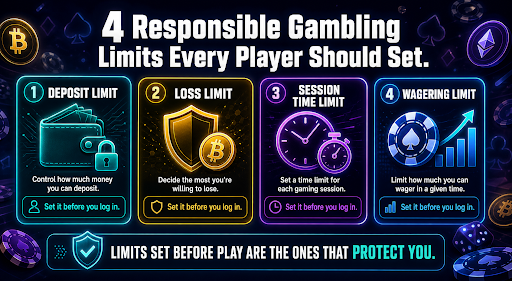
- Deposit limits. A deposit limit caps how much you can add to your casino balance within a defined period, daily, weekly, or monthly. This is the single most protective limit available because it works upstream of every other decision. Once the deposit cap is reached, no amount of in-session enthusiasm can override it.
- Loss limits. A loss limit defines the maximum you are willing to lose in a session or over a set period. When that threshold is reached, the session ends. Setting this in advance and sticking to it removes the most common trigger for problem escalation: chasing losses to recover what was spent.
- Session time limits. Time limits prevent the common experience of looking up from a gaming session to discover hours have passed. A time limit creates a natural stopping point that is not tied to whether you are winning or losing.
- Wagering limits. Some platforms allow players to cap how much they stake per bet or per round. This is particularly relevant for high-volatility games and bonus buy features where single bets can represent a large portion of a session budget.
| Player Reminder: The limits that work are the ones set before you start. Adjusting a limit mid-session, especially downward to let yourself play more, defeats the purpose entirely. |
For players looking to manage their budget more effectively, our minimum deposit casino guide explains how you can use lower deposits to maintain control from the beginning.
Warning Signs Worth Knowing
Responsible gambling also means knowing when play is crossing from entertainment into something more concerning. These signs do not appear all at once. They build gradually, which is why early awareness matters.
| Warning Sign | What It Looks Like in Practice |
| Chasing losses | Continuing to play specifically to recover money already lost |
| Budget creep | Regularly spending more than originally planned per session |
| Time distortion | Losing track of how long sessions are running |
| Emotional dependency | Feeling anxious, irritable, or low when not gaming |
| Concealment | Hiding gaming activity or spending from people close to you |
| Financial stress | Using funds set aside for bills or essentials to fund play |
None of these signs means a player is beyond help or that gaming needs to stop permanently. They are signals that the current approach needs to change, whether through stricter limits, a short break, or speaking with a support organisation. Choosing a platform that is transparent about its protections also matters at this stage, and knowing what makes an online casino safe helps players identify environments that genuinely support responsible play rather than just paying lip service to it.
What Tools Are Available and When to Use?
Most reputable online casino platforms offer a suite of responsible gambling tools built directly into the account settings. Knowing what exists makes it much easier to use them proactively rather than reactively.
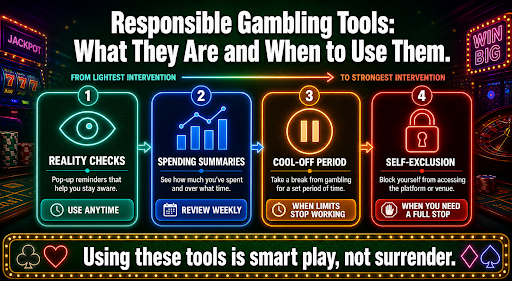
- Reality checks are timed notifications that appear during a session to remind players how long they have been playing and how much they have spent. They are easy to dismiss, but their presence creates a moment of deliberate awareness that interrupts automatic play behavior.
- Account history and spending summaries allow players to review their actual behavior over time, which is often quite different from what they believe their habits to be. Seeing real numbers in a clear format is one of the most grounding tools available.
- Cool-off periods sit between active play and full self-exclusion. A cool-off typically locks an account for 24 hours to 6 weeks, giving players a structured pause without permanent closure.
- Self-exclusion allows players to block access to their account for a defined period, ranging from days to years, or permanently. This is the strongest available tool and the right choice when self-imposed limits are no longer effective.
When evaluating any casino platform, responsible gambling tool availability should be a non-negotiable feature.
Play on Twinqo, Play With a Plan!
What is responsible gambling if not the foundation of a genuinely enjoyable gaming experience? At Twinqo, responsible gaming is built into the platform because players who feel in control have better sessions. Whether you are on Aviator, Plinko XY, Minesweeper XY, or spinning through slots like Skull Carnival, Egypt’s Moon, or Lucky Streak 1000, the experience is at its best when you arrive with a clear deposit limit, a session time in mind, and no financial pressure riding on the outcome.
Set your limits before you start, use the tools available, and treat every session as entertainment with a defined budget. That is what responsible gambling looks like in practice, and it is the only foundation that makes long-term gaming genuinely sustainable and fun.
Get started on Twinqo today with instant crypto transactions and a better start to every session, while keeping responsible play in mind.