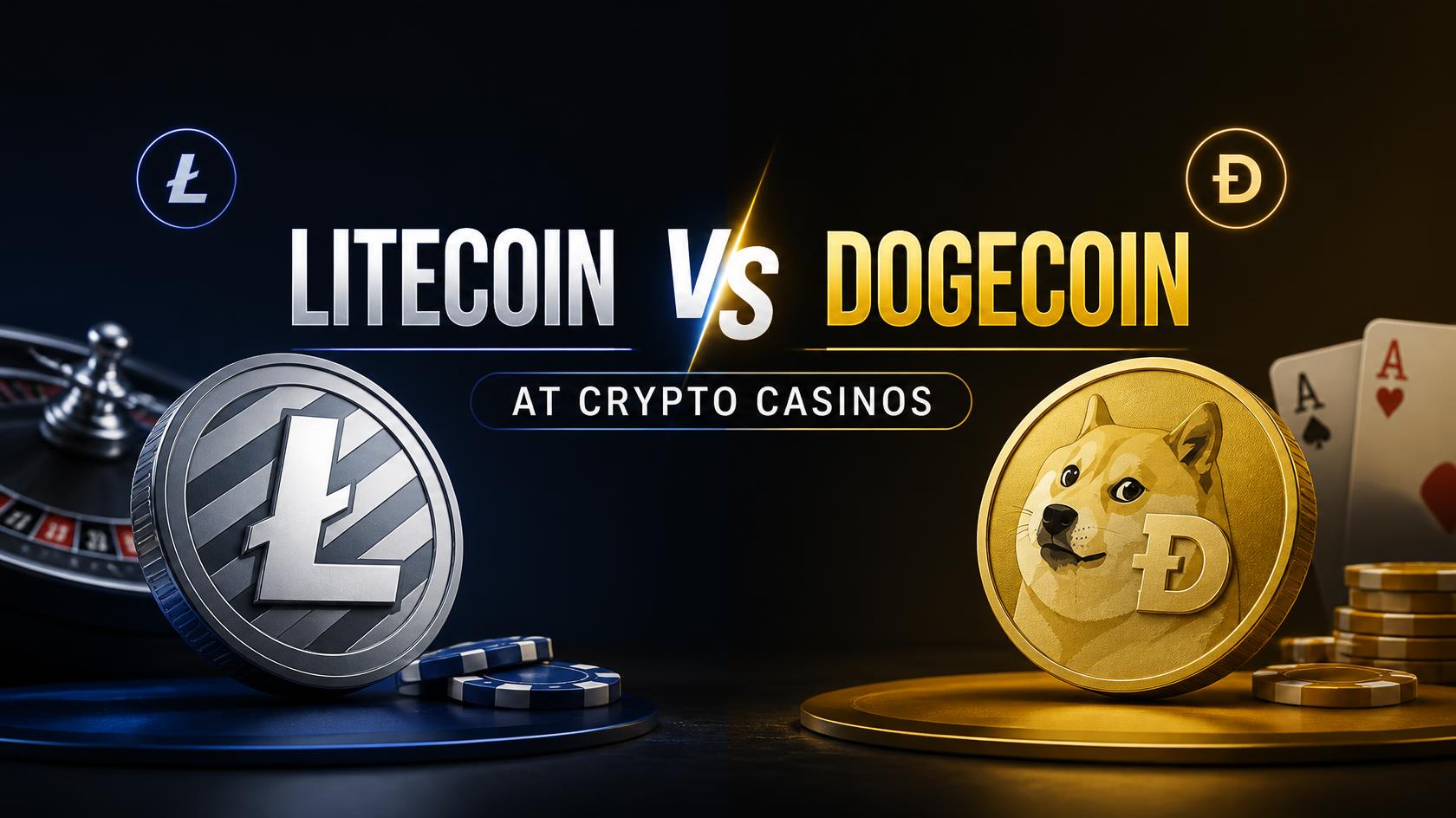
In a Litecoin vs Dogecoin casino comparison, both coins run the same Scrypt algorithm and are merged and mined together. Around 90% of Dogecoin’s hashrate comes from Litecoin mining pools. For a deposit, the real differences are block time, supply, and upgrade path. Litecoin has SegWit, Lightning and MWEB. Dogecoin has none of them.
Litecoin vs Dogecoin Casino Deposits: What Actually Separates Them?
Less than the branding suggests, and more than the price charts show.
Both are scrypt coins. Casino cashiers list them side by side for a reason. They settle faster than Bitcoin, and both cost fractions of a cent to send. On the surface, a deposit in either behaves the same way.
Where they split is what happened after launch. Litecoin kept shipping protocol upgrades. Dogecoin kept its base layer close to how it started. That one difference explains most of what follows.
If you want the wider picture on funding a session with Litecoin, our guide to LTC casino platforms covers the deposit and withdrawal flow.
Dogecoin Was Built From Litecoin’s Code
Not directly, but the lineage is short.
Litecoin launched in October 2011, created by Charlie Lee. Dogecoin followed in December 2013, built by Billy Markus and Jackson Palmer.
The code path ran through Luckycoin, which was itself a Litecoin fork. So Dogecoin picked up Litecoin’s Scrypt foundation second-hand rather than straight from source.
That shared foundation turned out to be useful. Scrypt’s structure meant both chains could later be merge-mined together, even though that wasn’t the original reason Litecoin picked it.
Which is what happened in 2014. Dogecoin’s own hashrate was thin. Miners hopped between the two chains chasing short-term profit. That left Dogecoin open to a 51% attack.
Charlie Lee proposed merged mining in April 2014. The Dogecoin community argued about it, then accepted. Merged mining went live on August 28, 2014, at block 371,337.
Within a month, Dogecoin’s hashrate and mining difficulty rose by more than 1,500%.
Where Dogecoin’s Security Actually Comes From
This is the part that makes any scrypt coins casino comparison different from a normal one. Merged mining lets one Scrypt machine work on both chains at once. A miner runs a single round of hashing. If the result meets Dogecoin’s difficulty target as well as Litecoin’s, it counts on both networks. One electricity bill, two block rewards.
The formal name is Auxiliary Proof of Work. Litecoin is the parent chain. Dogecoin is the auxiliary chain.
The practical result is that a majority of Dogecoin’s total hashrate, historically estimated between 70% and over 90% depending on market conditions, comes from large Litecoin mining pools.
So when you deposit Dogecoin at a casino, Litecoin miners are securing that payment. Choosing DOGE over LTC does not move you to a different security model. It moves you to a different chain running on the same hashpower.
That is not a criticism. Borrowed security is still security, and the setup has held for over a decade. It just means any LTC vs DOGE gambling choice is narrower than it looks.
Which Confirms Faster, Litecoin or Dogecoin?
Dogecoin produces a block roughly every minute. Litecoin takes about 2.5 minutes. On block time alone, Dogecoin looks two and a half times quicker.
In practice the gap narrows, because block time is only half the equation.
Casinos wait for a set number of confirmations before crediting a deposit. That number is set per coin.
Faster blocks usually need more confirmations to reach the same security. Each block carries less work. So a casino asking for six Dogecoin confirmations and three Litecoin ones ends up in a similar place.
Check the cashier for the confirmation count. The number that matters is blocks times confirmations, not block time alone.
Why Litecoin Kept Upgrading and Dogecoin Did Not
Here is the difference that matters most for a casino deposit, and no coin comparison seems to cover it.
Litecoin has shipped three major protocol upgrades:
| Upgrade | Litecoin | Dogecoin |
| SegWit | Activated 2017 | Not implemented |
| Lightning Network | Supported | Not implemented |
| MWEB privacy layer | Activated May 2022 | Not implemented |
Dogecoin’s base protocol has stayed close to how it launched. Partly design philosophy, partly a smaller development effort. It is not automatically a flaw. A simple chain has fewer moving parts.
But it means Dogecoin has no privacy option and no layer-2 route. It also misses the fungibility gains that SegWit and MWEB brought to Litecoin. Litecoin was the first chain to run a live Lightning Network payment, months before Bitcoin.
For a casino player the read is narrow. Neither coin gives you on-chain privacy at most operators, because casinos do not accept MWEB addresses. What Litecoin gives you is optionality outside the cashier.
Does the Supply Cap Matter for a Casino Balance?
Only if the balance sits.
Litecoin is capped at 84 million coins. More than 92% of that circulating supply is already out. The block reward halves roughly every four years, so new issuance keeps shrinking.
Dogecoin has no cap. Each block pays a fixed 10,000 DOGE and that figure never halves. New coins arrive every minute, permanently.
For a deposit you play through in an hour, this changes nothing. For a balance that sits across weeks, the two coins pull in opposite directions. One issues less over time. The other issues the same amount forever.
The market has not priced them the way those structures suggest. Dogecoin’s market cap is larger than Litecoin’s despite the unlimited supply. Trading volume and public attention drive that, not issuance.
Litecoin vs Dogecoin Casino Comparison: Side by Side
| Factor | Litecoin | Dogecoin |
| Launched | October 2011 | December 2013 |
| Created by | Charlie Lee | Billy Markus and Jackson Palmer |
| Algorithm | Scrypt | Scrypt |
| Chain role | Parent chain | Auxiliary chain |
| Block time | Around 2.5 minutes | Around 1 minute |
| Block reward | 6.25 LTC, halving | 10,000 DOGE, fixed |
| Supply cap | 84 million | None |
| SegWit | Yes | No |
| Lightning | Yes | No |
| Privacy layer | MWEB | None |
| Network fee | Fractions of a cent | Fractions of a cent |
Pros and Cons for Casino Deposits
Where Litecoin wins
Upgrade path. SegWit, Lightning and MWEB all exist as options, even if a casino cashier uses none of them.
Capped supply. Issuance shrinks over time rather than continuing at a fixed rate.
Parent chain status. Litecoin’s security is its own rather than shared from elsewhere.
Fungibility work. MWEB gives Litecoin a privacy tool Dogecoin has no equivalent of.
Where Dogecoin wins
Faster blocks. One minute against two and a half, though confirmation counts narrow the real gap.
Wider liquidity. A larger market cap and higher trading volume make DOGE easy to buy and sell almost anywhere.
Simplicity. Fewer protocol features means fewer things to understand before sending a deposit.
Where neither has an edge
Fees. Both cost a fraction of a cent per transaction under normal conditions.
Mining security. In a scrypt coins casino lineup, both are secured by the same miners, since they are merged and mined together.
Operator approval. Whichever you pick, the casino’s approval queue runs first. Nothing settled on the chain before that.
House edge. Neither coin changes the maths of any game you play with it.
Should You Deposit With Litecoin or Dogecoin?
For a straightforward deposit and withdrawal, the Litecoin vs Dogecoin casino choice is close enough that either works.
Dogecoin suits you if you already hold it, or you want the fastest raw block time. It is widely available and simple to move. For most LTC vs DOGE gambling sessions, that is enough.
Litecoin suits you if you want Lightning or MWEB available outside the casino. It also suits anyone who prefers holding a coin with a fixed supply ceiling between sessions.
Neither choice is a security decision. The same miners secure both chains. Picking one over the other on security grounds misreads how they work.
If Dogecoin’s role interests you separately, our look at why Dogecoin remains a trusted casino coin covers that side of it.
One Chain Secures the Other
The usual framing sets these up as rivals. In a Litecoin vs Dogecoin casino context, the mining data says otherwise.
Dogecoin came out of Litecoin’s code. It adopted Scrypt so the two could share work. Litecoin miners have secured it since 2014. Litecoin gets a steady hashrate. Dogecoin gets protection it could not hold alone.
So a Litecoin vs Dogecoin casino decision comes down to narrower ground than most comparisons suggest. Block time and confirmation policy. Capped supply against permanent issuance. An upgrade path on one side, a deliberately simple protocol on the other.
Both move money into a cashier in a couple of minutes for about a cent. The rest is preference.
Responsible Gambling Notice: For players 18+ (or 21+ where required). The coin you deposit with does not change the house edge, the RTP, or your odds on any game. It changes how money moves in and out, nothing more.