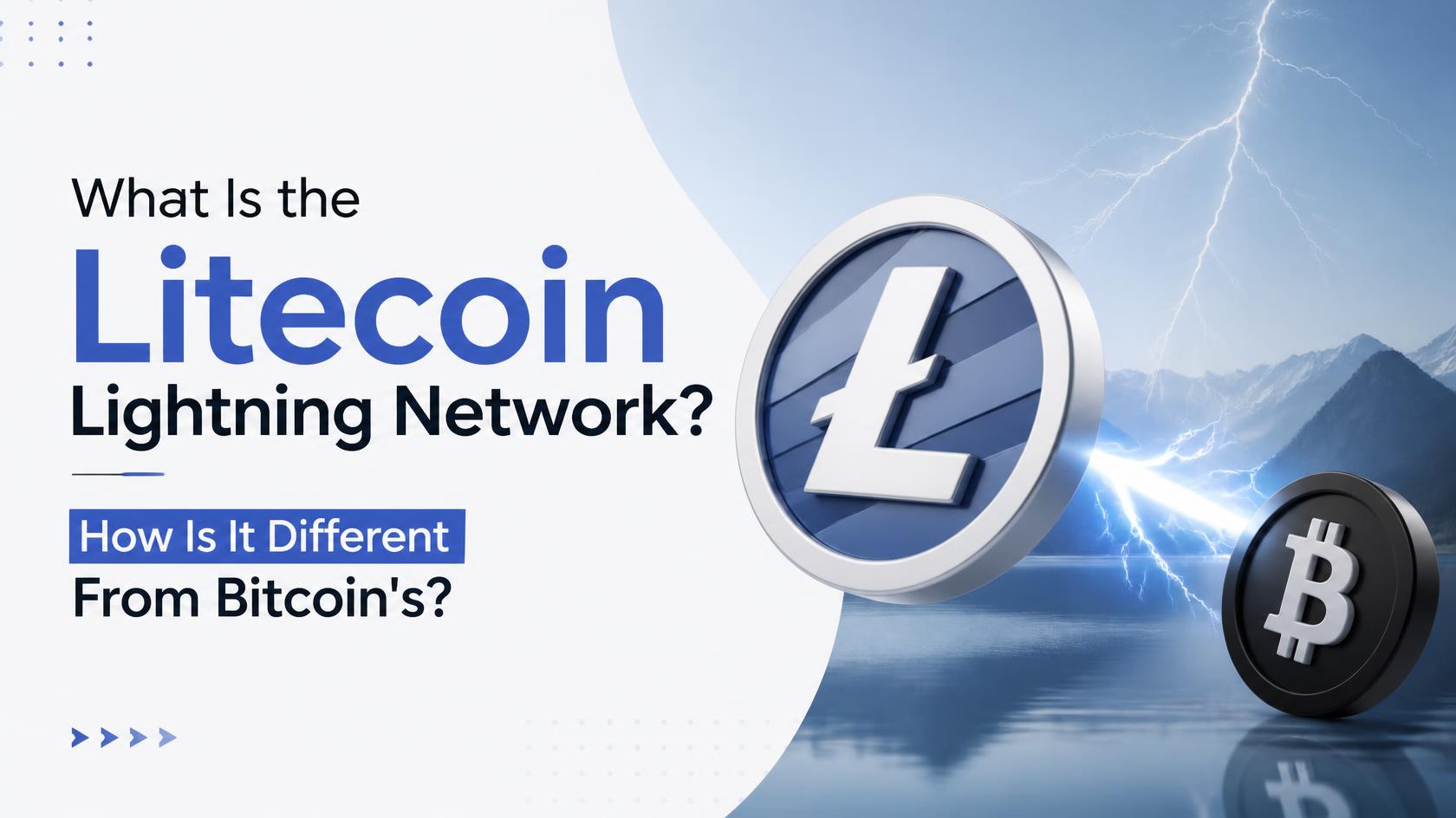
The first secure Lightning payment on Litecoin’s mainnet took place in May 2017, before Bitcoin’s. It still runs, but it stays small. Litecoin’s Lightning Network has about 95 nodes and 170 public channels, with roughly 35.27 LTC of reported channel capacity. Bitcoin’s Lightning is far larger. That is why any lightning network casino you find will be offering the Bitcoin version. Litecoin’s on-chain payments were already fast enough that it never needed Lightning.
What Is the Lightning Network?
A second layer that sits on top of a blockchain and moves payments off it.
Two people open a payment channel by locking funds on the main chain. After that they can send money back and forth as often as they like. Instantly. Without touching the blockchain again. When they close the channel, only the final balance settles on-chain.
The point is speed and cost. A blockchain records every transaction. That takes time and costs a fee. The blockchain does not need to record every payment inside the channel. Instead, the channel’s funding and eventual settlement are handled on-chain.Payments inside the channel can settle in seconds or less, usually at a very low cost, without requiring a new blockchain transaction for every payment.
That works well for frequent small payments. It works badly for one-off transfers. Opening a channel to send one payment defeats the whole point.
Why Did the Litecoin Lightning Network Come First?
Most comparisons skip this part. It explains why the two networks turned out so differently.
Lightning needed one thing before it could work. Lightning depended on SegWit because it addressed transaction malleability, which could otherwise interfere with the transaction references used by payment-channel contracts. Without that fix, payment channels were not safe to build.
The fix was called SegWit. Litecoin switched it on first, and the Litecoin Lightning Network followed within hours.
| Date | Event |
| 10 May 2017 | Litecoin activates SegWit, the first major network to do so |
| 10 May 2017 | First Lightning payment on the Litecoin main network, hours later |
| August 2017 | Bitcoin activates SegWit |
| 1 September 2017 | First sustained Lightning payment channel opens on Litecoin |
| 16 November 2017 | First cross-chain atomic swap between Litecoin and Bitcoin |
Litecoin was not just early. It was the testing ground.
Developers used Litecoin’s mainnet to demonstrate that Lightning could work on a live, SegWit-enabled network. Litecoin’s code was close enough to Bitcoin’s to make the test fair. The network was small enough that a mistake would not be a disaster. They even kept a separate build of their software just for Litecoin.
The November 2017 experiment deserves its own mention. Lightning Labs demonstrated a Bitcoin–Litecoin cross-chain atomic swap on testnets, showing that two assets on different blockchains could be exchanged through Lightning without a centralized exchange. The atomic design meant the swap either completed as intended or the participants could recover their original funds.
Does the Litecoin Lightning Network Still Exist?
Yes. And this is the part nobody writes about honestly.
The Litecoin Lightning Network is still live. It is also small, 95 active nodes across about 170 channels. Bitcoin’s Lightning is bigger by orders of magnitude. The public Bitcoin Lightning Network has approximately 17,438 nodes and 41,080 active payment channels
Two things explain the gap.
Litecoin did not need it
Lightning solved a Bitcoin problem. Ten-minute blocks, and fees that spike when the network is busy, make small on-chain payments painful. A layer on top was the answer.
Litecoin already had 2.5-minute blocks and fees of a fraction of a cent. On-chain payments were fast and cheap enough. The extra layer solved a problem most Litecoin users did not have.
Liquidity follows usage
A payment network only works if enough money sits locked in channels to route payments through. Bitcoin’s Lightning drew that money in. Litecoin’s did not.
With limited liquidity and fewer interconnected channels, successful routing becomes harder, particularly for payments that require multiple hops. Failed payments put people off. Fewer users means less money in channels. That loop is hard to break once it runs the wrong way.
Why Casinos Offer Lightning Bitcoin, Not Lightning Litecoin
The choice comes down to routing, not preference.
For a Lightning casino, the important issue is usable routing liquidity and channel connectivity. Bitcoin’s Lightning Network has a much larger ecosystem of nodes, channels and liquidity than Litecoin’s, making Bitcoin the more practical option for broad Lightning payments. That takes channels with enough room along the route between the casino’s node and your wallet. Bitcoin’s Lightning has that depth. Litecoin’s does not, at 170 channels.
Wallet support points the same way. Most Lightning wallets are built for Bitcoin. Far fewer support Litecoin’s version. A casino offering it would be serving a small slice of an already small group.
So the setup at most crypto casinos is Lightning for Bitcoin, on-chain for Litecoin. That is not Litecoin being treated as second class. It is Litecoin not needing a workaround.
Twinqo follows the same pattern. Lightning runs on Bitcoin, Litecoin runs on-chain. That comes down to where the routing capacity sits, not a preference for one coin over the other.
Our guide to Litecoin casino sites covers how the on-chain flow works in practice.
The irony is hard to miss. Litecoin proved the technology worked, then Bitcoin took it and scaled it into the version everyone uses.
Is Lightning Actually Faster Than Litecoin On-Chain?
For a single casino deposit, the Litecoin vs Lightning Bitcoin gap is smaller than you would expect.
A Lightning payment is instant once a channel exists. But the channel has to be opened first. Opening one is an on-chain transaction with an on-chain wait. Open a channel to make one deposit and you have paid the full on-chain cost anyway.
A Litecoin on-chain deposit confirms in a couple of minutes and costs about a cent. No channel. No setup. No capacity to manage. Our breakdown of instant withdrawals without KYC covers what happens on the way out.
| Factor | Bitcoin Lightning | Litecoin on-chain |
| Payment speed | Usually near-instant once a route is available | Block inclusion averages about 2.5 minutes |
| Setup | Lightning wallet/channel or supported service | Litecoin wallet |
| Payment fee | Usually very low; routing fees may apply | Typically less than a cent, but varies |
| Network requirement | Sufficient channel liquidity and routing | On-chain network confirmation |
| Best suited to | Frequent small payments | Simple direct transfers |
For a Litecoin deposit at Twinqo, you will be using the on-chain route. The figures above are what that looks like in practice.
Lightning wins on repeated small payments through a channel that is already open. On-chain Litecoin wins on everything else. Casino deposits usually fall into everything else.
What Can the Lightning Network Not Do?
Every Lightning guide lists the benefits. The limits get less attention. They are the reason it has not replaced on-chain payments.
Channel size caps your payment. You cannot send more than the channel holds. Large payments fail, or have to be split up.
Routing can fail. Your payment travels through other people’s channels. If none of them has enough room, it does not go through.
You need a Lightning wallet. A standard Bitcoin wallet will not work. This is the single biggest friction point for new users.
Receiving offline is limited. Some setups need you online to accept a payment. Fine for a person. Awkward for a service.
None of this makes Lightning bad. It makes Lightning a tool for one job, not a fix for everything.
Built the Road, Handed Over the Keys
The story of the Litecoin Lightning Network is one of the odder ones in crypto. Litecoin cleared the technical blocker. It ran the first payment. It hosted the testing. It made the first cross-chain swap possible. Then the network grew somewhere else.
For anyone moving actual money, the answer is simple enough. Use Lightning if you are on Bitcoin and making frequent small payments. Use Litecoin on-chain if you want one transfer to land in a couple of minutes for about a cent.
Both work. They were built for different problems, and Litecoin solved its own problems before Lightning existed.
Responsible Gambling Notice: For players 18+ (or 21+ where required). Faster payments do not change the house edge or your odds on any game.