NBA Cup betting means placing wagers on games and outcomes tied to the league’s in-season tournament. It’s a competition layered on top of the regular schedule, with its own bracket, prize pool, and pricing quirks separate from a standard NBA game. Group-stage games double as regular-season contests, so a single bet slip can touch both structures at once.
The NBA Cup has grown from a one-off experiment into a permanent part of the league calendar in just a few seasons. Its pricing behaves differently from an ordinary Tuesday-night game, because the bracket, prize money, and tiebreak math all interact with each other. Below is a breakdown of the format, odds, markets, and research habits worth building before Group Play tips off.
NBA Cup Championship Betting Breakdown
|
What Is NBA Cup Betting?
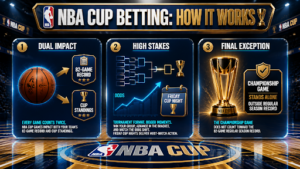
NBA Cup betting covers any wager placed on a game, team, or player tied to the league’s in-season tournament, rather than the standalone 82-game season. The competition threads through the middle of the schedule instead of running as a separate event. Sportsbooks still price it as its own market category with its own futures board, even though the games themselves often look identical to a normal League Pass night. The underlying mechanics won’t feel unfamiliar to anyone who already knows how to bet on football cup competitions, since both formats layer a bracket on top of a normal fixture list.
How an NBA Cup Wager Differs From a Regular-Season NBA Bet
A regular-season NBA bet settles once. It’s tied to one result and nothing beyond that night.
An NBA Cup wager placed during Group Play carries a second layer. The same final score also shifts a team’s tournament standing, which can move futures prices on group winners and knockout qualification. A blowout loss in December might barely dent playoff positioning months later, but it can eliminate that same team from Cup contention within days, since the group phase is short and unforgiving. Anyone who has learned how to bet on football knockout stages will recognize this same win-or-go-home pressure, just compressed into a basketball calendar instead of a football one.
Why Group Games Count Twice
Every Group Play game counts toward a team’s regular-season win-loss record. At the same time, it feeds a separate tournament table used to determine who advances. The championship game is different: it determines the NBA Cup champion but does not count toward the regular-season standings.
This double-counting is unusual among major pro sports leagues, and it changes how bettors should read motivation. A team resting a star for load management still has incentive to win the group game in front of it, since a group loss can cost both a season win and a shot at the bracket. Sharper bettors watch this overlap around the Friday “Cup Night” slate, when the schedule bunches several group-deciding games into one evening.
When Does the 2026 NBA Cup Run, and How Does the Format Work?
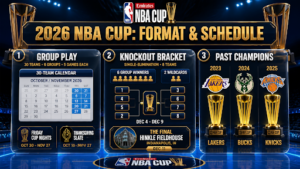
The fourth edition runs from late October through mid-December 2026, compressed into roughly six weeks that overlap the opening stretch of the regular season. Knowing which calendar dates belong to Group Play versus the knockout bracket matters. Betting markets and settlement rules shift the moment a team crosses from one stage to the other.
Group Play Schedule and Cup Nights
Group Play for the 2026 Cup runs on Fridays from October 30 through November 27, with an added wave of games during Thanksgiving week on November 24 and 25. Each of the 30 teams plays four group games total, split evenly between two home dates and two road dates against the other four clubs in its group.
These Friday “Cup Nights” are when the tournament table moves the most. They’re worth circling for anyone watching a group race unfold.
From Six Groups to an Eight-Team Knockout Bracket
Once Group Play wraps, the six group winners plus two wildcard qualifiers form an eight-team bracket. The wildcard spots go to the best non-winning record in each conference, settled by point differential and other tiebreakers.
For 2026, quarterfinals run December 4 and 5, semifinals run December 8 and 9, and the championship is set for December 11. Every round from the quarterfinals onward is win-or-go-home, which flattens the pricing logic of a playoff series into one single game with no margin for a bad quarter.
Where the 2026 Championship Is Played
The 2026 championship is set for Hinkle Fieldhouse on the campus of Butler University in Indianapolis. That ends a three-year run of finals hosted at T-Mobile Arena in Las Vegas.
Hinkle Fieldhouse seats far fewer fans than a typical NBA arena, and neither finalist will have played a home game there before tip-off. That levels a variable that Vegas hosting had made routine for three straight years.
From In-Season Tournament to the Emirates NBA Cup
The league announced the competition in July 2023 under the working name “NBA In-Season Tournament.” The inaugural run played out from November 3 to December 9, 2023.
Starting in its second year, the event took on a title sponsor and became the Emirates NBA Cup, the branding still used today. That naming shift didn’t change any on-court mechanics, but it signaled the league’s intent to treat the competition as a lasting annual event rather than a trial balloon.
Champions So Far and What Their Runs Revealed
Three champions have been crowned before the 2026 edition, and each run offers a different lesson.
The Lakers won the first tournament in 2023 over the Pacers, 123-109 at T-Mobile Arena, with LeBron James named MVP. The Bucks took the 2024 title over the Thunder, 97-81, with Giannis Antetokounmpo earning MVP in a defense-heavy final. In 2025, the Knicks beat the Spurs 124-113, with Jalen Brunson named MVP after New York rallied from an 11-point deficit. OG Anunoby scored 28 points in that game, and the win gave the Knicks their first trophy of any kind since the 1973 NBA championship.
| Edition | Champion | Runner-Up | Score | MVP |
| 2023 | Los Angeles Lakers | Indiana Pacers | 123-109 | LeBron James |
| 2024 | Milwaukee Bucks | Oklahoma City Thunder | 97-81 | Giannis Antetokounmpo |
| 2025 | New York Knicks | San Antonio Spurs | 124-113 | Jalen Brunson |
How the Format Has Changed Since 2023
The core group-then-bracket skeleton has held steady since the first edition, but the seeding around it has been refined each year.
The draw now sorts all 30 teams into five seeding pots per conference, based on the prior season’s final standings. Pot 1 holds the top three records in each conference, down through Pot 5, which holds the bottom three. That pot system, revealed for 2026 on June 30, is designed to spread quality more evenly than a fully random draw. It’s worth knowing before assuming any group is automatically weaker or stronger than another.
Reading NBA Cup Odds in Three Formats
NBA Cup odds can show up in decimal, American, or fractional form depending on the sportsbook. Each format describes the same basketball outcome in a different notation. None of them tells you who will win. They only tell you how the market is priced right now, and how much a winning bet actually returns. These same three formats show up across other sports too, so anyone comfortable reading football betting odds will find the notation immediately familiar.
The following fictional matchup is used only to demonstrate how NBA Cup odds work. Here is how one sportsbook might price that game across all three formats, plus the implied probability behind each price.
| Outcome | Decimal Odds | American Odds | Fractional Odds | Implied Probability |
| Cascade Timberhawks win | 1.63 | -160 | 8/13 | 61.3% |
| Redwood Comets win | 2.40 | +140 | 7/5 | 41.7% |
This is a straightforward moneyline market. Basketball has no draw, so only two outcomes exist: the Timberhawks win, or the Comets win. The Timberhawks are priced as the favorite across all three formats, while the Comets carry the underdog price. Read on for exactly how each column in that table gets built, and what each number means for an actual bet.
Decimal Odds
Decimal odds are the most direct of the three formats, since the number shown is the total payout multiplier on a winning bet, including the original amount placed back.
Take the Timberhawks at 1.63. A 10-unit bet on the Timberhawks multiplies out as:
10 units × 1.63 = 16.3 units total return.
That total includes the original 10 units, so the actual profit is:
16.3 units − 10 units = 6.3 units profit.
Now compare that to the Comets at 2.40. The same 10-unit bet works out differently:
10 units × 2.40 = 24 units total return.
24 units − 10 units = 14 units profit.
The gap between 6.3 units and 14 units of profit on the same 10-unit bet is what decimal odds communicate at a glance. Any decimal number above 2.00 pays more in profit than the amount risked, which is why the Comets, at 2.40, qualify as the underdog here. Any decimal number below 2.00, like the Timberhawks’ 1.63, pays less in profit than the amount risked, marking them as the favorite. This multiplier logic is identical to how football betting odds are displayed in decimal form, since the stake is always included in the total payout regardless of sport.
American Odds
American odds use a plus or minus sign anchored to a 100-unit baseline, and the sign itself tells you instantly which side is favored.
The Comets carry a plus sign at +140. That number means a successful 100-unit bet on the Comets returns 140 units of profit. Scaled down to a 10-unit bet, the math becomes:
(10 ÷ 100) × 140 = 14 units profit, for a 24-unit total return.
That matches the profit figure calculated above from the Comets’ decimal odds of 2.40, since both numbers describe the exact same price in different notation.
The Timberhawks carry a minus sign at -160, which works in reverse. That number means 160 units must be risked to profit 100 units. Scaled to a 16-unit bet:
(16 ÷ 160) × 100 = 10 units profit, for a 26-unit total return.
The minus sign always marks the favorite, and the size of the number shows how heavily favored that side is. A bigger minus number, like -200 or -300, means a shorter payout for backing that side.
Fractional Odds
Fractional odds express potential profit as a ratio against the amount placed, written as profit divided by stake.
The Timberhawks sit at 8/13. Read literally, that fraction means a bettor profits 8 units for every 13 units placed. Betting the full 13 units produces:
13 × (8 ÷ 13) = 8 units profit.
Total return = 13 units placed + 8 units profit = 21 units.
The Comets sit at 7/5, which flips the ratio in the underdog’s favor. A 5-unit bet on the Comets produces:
5 × (7 ÷ 5) = 7 units profit.
Total return = 5 units placed + 7 units profit = 12 units.
Fractional odds are common on UK-facing sportsbooks, and the same underlying price as the Timberhawks’ -160 or 1.63 is just written as a ratio instead of a multiplier or a baseline number.
Implied Probability
Implied probability converts any of these three price formats into a percentage, which is the sportsbook’s own estimate of how likely each outcome is.
Using decimal odds, the formula is:
Implied probability = 1 ÷ decimal odds × 100.
For the Timberhawks at 1.63:
1 ÷ 1.63 × 100 = 61.3%.
For the Comets at 2.40:
1 ÷ 2.40 × 100 = 41.7%.
Add those two numbers together and the total lands at 103%, not an even 100%. That extra few points is the sportsbook’s built-in margin, often called the vig or the juice, and it’s how the book earns money regardless of which side wins. That same built-in margin appears in football betting odds, since bookmakers apply a comparable overround no matter which sport is on the board. The percentage explains the price sitting on the screen right now. It does not predict who actually scores more points, and a tight fourth quarter can flip the final result regardless of what the number implied before tip-off.
Betting Markets Across Group Play and the Knockout Bracket in NBA
NBA Cup markets can focus on a single group game, a knockout matchup, or the tournament as a whole. Availability depends on which stage a game sits in, and some bet types only make sense once a team has actually qualified for the bracket.
To keep every market grounded in one example, the table below uses the same fictional matchup: Cascade Timberhawks versus Redwood Comets, treated as a Group Play game.
| Betting Market | Example Selection | What Must Happen |
| Moneyline | Timberhawks to win | Timberhawks must win the game outright |
| Point Spread | Timberhawks -5.5 | Timberhawks must win by six points or more |
| Team Total | Comets Over 108.5 points | Comets must score 109 points or more |
| Game Total | Over 219.5 combined points | Both teams combined must score 220 points or more |
| Player Prop | Timberhawks guard Over 24.5 points | That named player must score 25 points or more |
| Group Winner Futures | Timberhawks to win their group | Timberhawks must finish first in their five-team group |
| Championship Futures | Timberhawks to win the NBA Cup | Timberhawks must win every knockout game through the final |
| Tournament MVP | Timberhawks guard to win MVP | That player must be named the tournament’s most outstanding performer |
The sections below walk through what changes about each of these markets once a game moves from Group Play into the knockout bracket.
Moneyline
A moneyline bet on the Timberhawks wins if they finish with more points than the Comets, full stop. Margin never factors into settlement, so a one-point win and a blowout pay the exact same way. Because NBA Cup group games count toward both the regular season and the tournament table, a moneyline result also shifts that team’s group standing, even though the bet itself only cares about who wins on the scoreboard that night.
Point Spread
The spread hands the favored Timberhawks a built-in scoring deficit before tip-off. At -5.5, they need to win by six points or more to cover, since the half-point avoids a tie at exactly five. A five-point win, a loss, or any closer finish fails the bet. Spreads react to Group Play urgency too, since a team fighting for a wildcard spot may play with different intensity than one already locked into a group win with nothing left to gain.
Team Total
This isolates the Comets’ own scoring, separate from who wins the game. Over 108.5 needs Redwood to reach 109 points regardless of the final score or which team comes out ahead. Rotation decisions matter heavily here during Group Play, since a team resting players to manage its broader schedule can post a lower team total than its season average would otherwise suggest, independent of matchup quality.
Game Total
Game totals combine both teams’ scoring into one number. Over 219.5 needs 220 combined points across the full contest, whether that comes from one team dominating or an even shootout. Pace and rotation depth both move this number, and Group Play totals can run lower than a typical regular-season total if either side treats the tournament game as a lower scheduling priority and shortens its bench rotation accordingly.
Player Prop
Props narrow the bet to one player’s individual output. A Timberhawks guard Over 24.5 points settles strictly on his own scoring line, regardless of the final result or teammates’ performance. During Group Play, prop bets carry extra risk since coaches sometimes shift a player’s minutes late if a game is treated as a lower priority, making usual per-game averages a less reliable guide than during the regular season.
Group Winner Futures
This future locks in before Group Play concludes, paying out only if the Timberhawks finish first among the five teams in their group. A strong record elsewhere in the conference has no bearing on this specific bet. Because ties get settled by point differential, a team that wins convincingly across its four group games holds a stronger position for this future than one that wins narrowly by the same overall record.
Championship Futures
The broadest bet available, requiring the Timberhawks to win every remaining knockout game, from quarterfinal through the championship, without a single loss anywhere in that stretch. One elimination at any round voids the bet completely. Because the knockout bracket is entirely single-elimination with a short turnaround between rounds, this future carries more variance than a best-of-series future would in a longer tournament format.
Tournament MVP
This prop rewards individual recognition rather than a team outcome. It pays out only if the Timberhawks guard is named the tournament’s top performer, an honor traditionally awarded after the championship game. Team success still matters indirectly, since MVP voting has historically favored standout performances during a deep, successful knockout run rather than strong individual stats on a team eliminated early in Group Play.
How the Wildcard Rule Changes What You’re Pricing
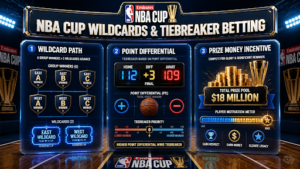
The wildcard mechanism trips up bettors who assume only group winners advance. Understanding it changes how a futures price should be read weeks before the bracket is even set.
Why a Group Runner-Up Can Still Reach the Knockout Stage
Six group winners fill six of the eight knockout spots. The remaining two go to the single best non-winning record in each conference, regardless of which group that team finished in.
A team can finish second in its group and still qualify if it has the best non-winning record in its conference. If records are tied, the NBA’s published tiebreaker rules determine which team gets the wild-card spot. This is why futures markets on individual teams don’t collapse to zero the moment a group is decided. A strong second-place finish still carries real value.
Point Differential and Tiebreak Math That Moves a Futures Price
When teams finish Group Play with matching records, the NBA first uses head-to-head record, followed by point differential, total points scored, regular-season record, and then a random drawing if necessary. That detail rewards teams that win convincingly rather than just winning.
A team that wins three close games by a combined six points can be passed over for a wildcard spot by a team that wins two games by a wider margin. Bettors tracking a wildcard future should watch scoring margins as closely as win-loss records.
The Prize Money Angle Bettors Often Miss
Most bettors research matchups, injuries, and recent form. The financial incentive built into the NBA Cup gets skipped surprisingly often, even though the prize pool pays real money directly to players, and that money is large enough to change effort levels on the floor.
How NBA Cup Prize Money Adds Incentive
Each player on the winning 2025 roster earned $530,933, up from $500,000 in 2023 and $514,971 in 2024. Two-way contract players receive half the full share, roughly $265,467 in 2025.
Runner-up players still collected a meaningful payday near $212,373 per player, or roughly 40% of the champion share. Semifinal losers earned $100,000 per player, and quarterfinal losers earned $50,000.
These bonuses are paid on top of regular salaries and provide an additional financial incentive for players as teams advance through the tournament.
What Shapes NBA Cup Lines That Regular-Season Bets Don’t Face
Setting a line for an NBA Cup game involves extra variables a standard regular-season contest doesn’t carry. Recognizing them explains why a Cup price sometimes looks out of step with a team’s usual form.
Cup Night Motivation and Prize Incentive Effects
Because the prize pool scales with how far a team advances, group games late in the schedule often carry more urgency than their calendar date suggests. A team clinging to a wildcard spot plays differently than one already locked into a group win with nothing left to gain, and sportsbooks adjust lines once that urgency becomes clear.
Rotation Risk When Records Split Priorities
Some teams sit in an awkward spot where a strong regular-season record doesn’t line up with tournament positioning, or the reverse.
A club fighting for playoff seeding might rest a star over a group game it’s already locked out of advancing from, even though the game still counts toward the standings. This split-priority scenario makes late injury reports worth checking against both tables.
What to Research Before Betting on the 2026 NBA Cup
With Group Play still weeks away, the smartest use of time is research rather than prediction. Nothing below is a forecast of who will win. It’s a map of what’s worth checking once games start.
What Last Season’s Knockout Run Signals for This Year
The Knicks’ 2025 run, capped by a comeback from an 11-point deficit against the Spurs, showed that a team doesn’t need to dominate a group to win the bracket. It needs to survive the single-elimination rounds when it matters most.
Group seeding matters less once the knockout stage begins. A hot week can outweigh a mediocre group stage.
Group Assignments Worth Researching Before Group Play Opens
The 2026 seeding pots, revealed June 30, sorted teams by 2025-26 final standings into groups of five.
In the West, Group A pairs the Nuggets with the Rockets, Suns, Mavericks, and Jazz, while Group B places the Thunder alongside the Timberwolves, Clippers, Pelicans, and Grizzlies. In the East, Group A groups the Pistons with the Raptors, Magic, Bucks, and Nets, while Group C puts the Celtics alongside the Hawks, Hornets, Bulls, and Wizards.
Reviewing each group’s full slate, not just the top seed, matters here. Wildcard math depends on how the whole conference performs, not just one group in isolation.
Squads to Track Early in the Group Stage
Teams that finished as Pot 1 seeds carry the most tournament pedigree on paper, but a strong Pot 2 or Pot 3 club in a stacked group is also worth watching.
Squads to track early include any club returning a core from a prior deep Cup run, since continuity in rotation and late-game execution has shown up across past champions from the Lakers to the Bucks to the Knicks. Group frontrunners can shift fast in a five-game round robin, so checking standings weekly beats locking in a futures bet before a single game tips off.
A Step-by-Step Walkthrough of Placing an NBA Cup Bet
The process below follows the same basic sequence used across most sports betting, so it will look familiar to anyone who already knows how to bet on football matches or tournaments.
- Confirm which stage a game belongs to. Check whether the matchup is a Group Play game (counts toward both the season and the tournament table) or a knockout game
- Check the standings and wildcard picture. Look at both teams’ group position and whether either is fighting for a wildcard spot.
- Pick the market. Choose between moneyline, point spread, a total, a player prop, or a futures bet on a group winner, the championship, or tournament MVP.
- Note the odds format your book displays. Confirm whether the line is American, decimal, or fractional, and convert if comparing against another source.
- Review the injury report for that date. Cup Night rotations can differ from a team’s usual pattern, especially late in Group Play.
- Calculate implied probability before deciding whether the price offers value. Convert the posted odds into an implied probability and compare it with your own assessment.
- Enter the amount and confirm the details on the bet slip. Double-check the team, market, and number before submitting.
- Save the confirmation. Note the reference details in case you need to check settlement later, particularly for futures that won’t settle for weeks.
Smarter Habits for Betting a Short Tournament Window
- Track the Friday Cup Night schedule, since that’s when group standings shift most in a single evening.
- Recheck group tables after every round rather than assuming Week 1 positioning holds, given how few games (four) decide each group.
- Weigh a team’s regular-season motivation against its tournament motivation separately, since the two don’t always align late in Group Play.
- Treat knockout-round totals and props with extra caution given the short turnaround and possible travel fatigue.
- Avoid locking in outright futures too early, since one group’s early results don’t reflect wildcard math conference-wide.
- Separate research on rotation players from research on stars, since prize-money incentives can affect bench minutes differently than star workload.
Playing the NBA Cup Smart From Tip-Off to the Final Buzzer
The compressed nature of this tournament rewards patience over impulse. A five-week group stage followed by a single-elimination bracket leaves little room to correct a rushed bet. Treating every decision with the same care as a season-long wager matters more here, not less.
Set a budget for the tournament window, separate from ongoing regular-season betting, and stick to it regardless of how a group race is trending. If betting starts to feel less like entertainment and more like a compulsion, or if amounts placed climb beyond what was planned, that’s a signal to step back.
Responsible Gambling Notice
Sports betting should be treated as entertainment, not as a way to make money or recover losses. Set a budget before betting, keep track of how much you spend, and consider using deposit limits or self-exclusion tools if gambling stops feeling manageable.
If you are concerned about your gambling or someone else’s, free and confidential support is available. Gambling Therapy provides online support to people affected by gambling problems worldwide, with live assistance available in multiple languages.
For additional support, you can also contact:
- Gambling Therapy: Free online advice and emotional support for people affected by gambling worldwide.
- GamCare: 0808 8020 133, with free 24/7 support by phone and online.