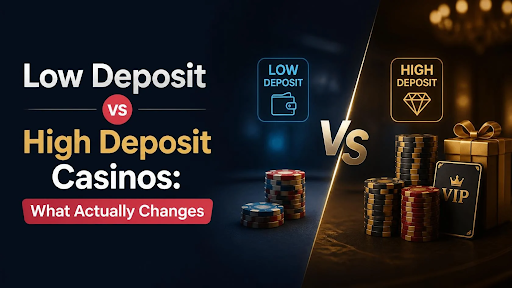
In a low deposit vs high deposit casino comparison, bigger deposits bring better bonus terms, higher bet ceilings, access to high-limit tables, and faster loyalty progression. They also bring more verification, not less. Withdrawal limits often do not move at all, despite what most guides claim. The headline bonus percentage is usually larger at the low end and worth less.
What Separates a Low Deposit Casino From a High Deposit Casino?
There is no official line in a low deposit vs high deposit casino comparison. In practice, three bands exist.
Low deposit play starts at $5 to $20 and covers most casual players. The deposit is small enough that it functions as a test of the platform rather than a bankroll. A 20 minimum deposit online casino sits at the upper end of this band, which is enough balance to reach most bonus thresholds while still keeping the amount at risk small.
Standard play sits between $50 and a few hundred. Most regular players never leave this band, and most casino promotions are built around it.
High deposit play begins where loyalty tiers start recognising you. Industry definitions put a high roller at roughly $100 or more per round, sustained over time rather than in one session. At Twinqo, the second loyalty tier begins at a $550 cumulative deposit, and the tier actually named High Roller starts at $26,300.
That last figure is worth sitting with. What the industry calls a high roller and what a casino’s own top tier requires are very different numbers.
Bonus Percentages Go Up, But the Terms Get Worse
This is the inversion nobody flags clearly, and it is the single most useful thing to understand in a low deposit vs high deposit casino comparison.
Low deposit offers advertise the biggest headline numbers. Match percentages well above 100% are common at the low end, sitting alongside more modest percentages on offers aimed at larger balances. The percentage is the part casinos put in the banner.
The wagering requirement is the part they do not. Reported ranges put bonuses aimed at low deposit players around 35x to 45x playthrough, against roughly 10x to 25x on offers structured for high deposit players.
That gap matters more than the percentage does. A larger match on a higher playthrough can require more total turnover per bonus dollar than a smaller match on a lower one. Two offers with very different headline numbers can leave you with the same amount of work, or leave the smaller-looking one ahead.
None of this makes low deposit bonuses bad. It makes the headline percentage a poor way to judge them. What matters is the playthrough figure, the game contribution rates, and whether the minimum qualifying deposit actually matches the minimum deposit the site advertises. Those three often do not line up.
Run the turnover calculation yourself before accepting anything. Multiply the bonus amount by the wagering requirement, then judge whether that figure is realistic at the stakes your balance supports.
What Actually Scales With Deposit Level, and What Does Not
Most guides describe loyalty tiers as though everything improves as you climb. Some things do. Several do not, and knowing which is which saves a lot of misplaced expectations.
Twinqo’s nine-tier structure makes the pattern easy to see:
| Tier | Cumulative deposit | Max wager | Daily withdrawal | Comp points per 100 |
| First Fortune | 0 | 9,999 | 10,000 | 0 |
| Rising Star | 550 | 49,999 | 10,000 | 0 |
| Scatter Master | 2,600 | 99,999 | 10,000 | 1 |
| Jackpot Hunter | 5,200 | 249,999 | 10,000 | 1.5 |
| Fortune Elite | 13,100 | 499,999 | 10,000 | 1.75 |
| High Roller | 26,300 | 999,999 | 10,000 | 2 |
| Diamond Prestige | 52,600 | 4,999,999 | 10,000 | 2 |
| Royal Legend | 263,000 | 9,999,999 | 10,000 | 2 |
| Twinqo Legend | 526,000 | Unlimited | 10,000 | 2 |
Two things scale. Bet ceilings climb steeply, from just under 10,000 at entry to unlimited at the top. Comp point earning improves, though it caps at 2 per 100 wagered by the sixth tier and stops moving after that.
The daily withdrawal limit does not move at all. It sits at 10,000 for a player who has deposited nothing and for a player who has deposited half a million.
That is not a Twinqo quirk. Withdrawal ceilings are usually set by payment processing and anti-money-laundering policy rather than by loyalty status, which means they behave like a compliance rule rather than a reward. Plenty of comparison sites claim high rollers get withdrawal limits ten times the size of a standard player’s. Sometimes true, often not, and worth checking against the actual terms rather than assuming.
Does Game Access Change With Deposit Size?
Partly, and less than people expect.
Slots are the same for everyone. A $20 balance and a $20,000 balance open the same library, the same RTP figures, the same features. Bet sizing differs, game access does not. This is why slots remain the practical choice for small bankrolls.
Live dealer tables are where the difference becomes real. Table minimums are set per table, not per player, so a live blackjack table with a $5 minimum is open to anyone while a VIP table at $100 a hand is not a matter of permission but of what your balance can sustain. A $20 deposit technically has access to high-limit tables. It just cannot play more than a couple of hands there.
The genuine restriction sits at the top of the bet range rather than the bottom. Twinqo’s entry tier caps wagers just below 10,000, which no low deposit player will ever approach. A high deposit player at the top tier faces no cap at all. For most people this distinction never becomes relevant, which is worth knowing before treating tier progression as a goal in itself.
Why High Deposits Get More Verification, Not Less
Here is the second inversion, and it catches people out more than the bonus one.
Small deposits attract the lightest checks. Many crypto platforms process them with no identity verification at all, which is the whole appeal of the no-KYC model. Deposit $20, play, withdraw, and nothing is asked of you.
Large deposits trigger the opposite. Anti-money-laundering rules apply thresholds, and crossing them brings requests that go well beyond a photo ID. Proof of funds. Source of wealth documentation. In some cases a full financial review before a withdrawal clears.
None of this indicates a problem with the casino. Licensed operators are legally required to run these checks, and a platform that accepts a $50,000 deposit without asking anything should worry you more than one that asks. But it does mean the friction curve runs opposite to the perks curve. Deposit more and you get better terms alongside more paperwork.
Plan for it rather than being surprised by it. If you intend to play at high deposit levels, completing verification early removes the delay from the moment you actually want your money out.
Support and Account Handling
Deposit level changes who handles your account and how quickly, and this is one area where the low deposit vs high deposit casino gap is straightforward rather than inverted.
Low and standard deposit players use the same support channels as everyone else, typically live chat with a shared queue. Response quality at a good platform is the same regardless of balance, though queue position sometimes is not.
Higher tiers commonly add a named account manager, priority queues, and direct contact channels. The practical value is dispute resolution speed rather than better answers. Something worth noting: at some operators, VIP managers have discretion over game weighting for bonus turnover, which effectively changes the terms rather than just the service.
Whether any of this justifies the deposit level required to reach it is a separate question, covered in our look at whether VIP programs are worth it.
Low and High Deposit Casinos Compared
| Factor | Low deposit | High deposit |
| Entry amount | $5 to $20 | Varies by operator and tier |
| Headline bonus | Higher percentage | Lower percentage |
| Reported wagering | 35x to 45x | 10x to 25x |
| Bet ceiling | Capped, rarely reached | High to unlimited |
| Slot access | Full library | Full library |
| Live table access | Open, but limited by balance | Includes high-limit tables |
| Withdrawal limits | Often identical to high tiers | Often identical to low tiers |
| Verification | Light or none | Proof of funds, source of wealth |
| Support | Shared queue | Named manager, priority |
| Loyalty progression | Slow | Fast, caps early |
| Main risk | Bonus terms outpace bankroll | Overexposure |
Which Deposit Level Actually Suits You?
The honest answer has nothing to do with which tier looks more appealing.
Deposit small if you are testing a platform, playing for entertainment rather than stakes, or want a session to last rather than swing. A $20 balance at $0.20 a spin gives you a hundred rounds, which is enough to learn how a site behaves before committing more. This is why the $20 tier has become the common entry point rather than the $5 one, since it clears most bonus minimums while a $5 deposit often does not.
Deposit larger if you already know the platform, play regularly enough that loyalty progression compounds, and have a bankroll where the amount deposited is genuinely disposable. Better bonus terms only pay off across sustained volume.
One thing that does not change either way: the house edge. Deposit size affects what you can access and what a bonus costs to clear. It does not affect the mathematics of any individual game. A bigger deposit buys more rounds and better terms, never better odds.
If you are unsure which band fits, our guide to bankroll management works through the sizing question properly.
Responsible Gambling Notice: This content is intended for players aged 18+ (or 21+ where required locally) and is informational only. Deposit size does not change the house edge on any game, and loyalty tiers reward volume rather than skill or outcome. Climbing a tier structure requires wagering amounts that should only ever be money you can afford to lose. If you find yourself depositing more to reach a tier, chasing losses, or spending beyond what you planned, those are signals worth acting on. Most platforms offer deposit limits and self-exclusion tools in account settings, and they work better set in advance than in the moment. Free and confidential support is available through BeGambleAware.org or the National Problem Gambling Helpline at 1-800-MY-RESET.
The Number That Matters Is Not the One on the Banner
The low deposit vs high deposit casino question is presented as a ladder where everything improves as you climb. Some of it does. Bet ceilings rise, bonus terms genuinely soften, support gets faster.
But the headline bonus percentage is largest at the bottom and worth least per dollar. Withdrawal limits frequently sit flat across every tier. Verification requirements increase rather than ease. Three of the things players assume about deposit levels are either backwards or simply not true at most platforms.
Read the wagering requirement rather than the match percentage, check whether withdrawal ceilings actually move between tiers, and treat any deposit as money you have already spent. That approach works identically at $20 and at $20,000.