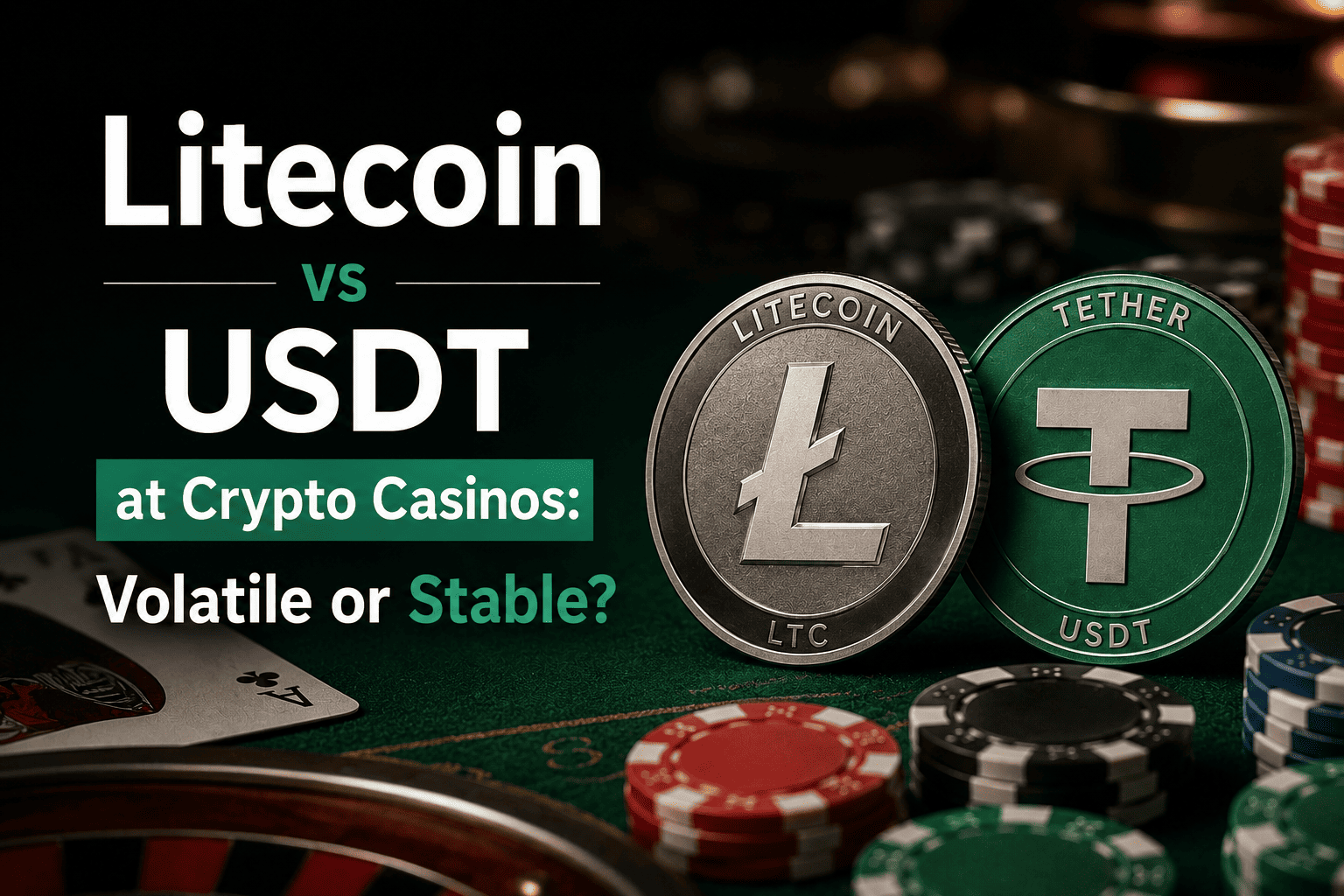
In a Litecoin vs USDT casino comparison, Litecoin runs on one blockchain with one send process. USDT is a token that exists on several blockchains, and choosing the wrong one when you send it can lose the transaction permanently. Litecoin carries price exposure that USDT does not. USDT carries a network selection step that Litecoin does not. Which matters more depends on how you play.
Litecoin vs USDT: What Actually Differs?
They are different kinds of things, and almost everything else follows from that.
Litecoin is a coin with its own blockchain. There is one Litecoin network, and LTC only moves across it. Send LTC to an LTC address and there is nothing else to configure.
USDT is a token issued on top of other blockchains. The same USDT exists on Tron, Ethereum, Solana, BNB Chain, Polygon and TON among others. Each version is real USDT, but they are not interchangeable in transit. Sending across one network to an address on another does not work.
That structural difference produces the practical tradeoffs below. If you want the wider context on how either coin fits into casino play, our guide to LTC casino platforms covers the deposit and withdrawal flow.
Which Moves Money Faster, Litecoin or USDT?
Litecoin targets a block roughly every 2.5 minutes. Casinos typically wait for a set number of confirmations before crediting a deposit, so the real time depends on that policy rather than on the block time alone.
USDT speed depends entirely on the network carrying it:
| Network | Typical settlement |
| Solana (SPL) | 60 seconds |
| Tron (TRC-20) | 1 to 3 minutes |
| Ethereum (ERC-20) |
1 to 5minutes.
|
On its fastest networks USDT beats Litecoin. On Ethereum it does not.
There is a point worth holding onto here that applies to both. A casino withdrawal has two stages: operator approval, then on-chain settlement. If the approval sits in a queue for an hour, the coin you chose is irrelevant. Any Litecoin vs USDT casino speed comparison only describes the second stage.
What Does Each One Cost to Send?
Litecoin network fees run to fractions of a cent under normal conditions, often around $0.01 per transaction.
USDT costs vary by network. Tron is consistently cheap. Ethereum can be expensive during busy periods, and on a small deposit that fee is a meaningful share of what you sent.
This is where LTC vs stablecoin gambling stops being an abstract comparison. On a $20 deposit, a $0.01 fee is nothing. A $5 network fee is a quarter of the deposit. The coin matters less than the network you send it across, and Litecoin only has one.
The Wrong Network Problem USDT Has and Litecoin Does Not
This is the difference most comparisons skip, and it is the one that actually loses people money. It is also part of the Litecoin vs USDT casino question that has nothing to do with price.
Because USDT exists on multiple chains, every send requires you to pick the right one. The casino’s cashier will specify which networks it accepts. Select a different one and the funds go to an address that does not exist on that chain. Recovery is rarely possible through support and sometimes is not.
Litecoin has no equivalent step. One network, one process, nothing to select.
One clarification worth making, because it causes confusion. Litecoin addresses can start with L, M or ltc1. These are different address formats, not different networks. All three sit on the same Litecoin blockchain and all three receive the same LTC. This is not the same situation as USDT on Tron versus USDT on Ethereum, where the networks are genuinely separate.
For a player who deposits occasionally and reads carefully, the network step is a minor inconvenience. For anyone moving funds frequently, it is a recurring opportunity to make an expensive mistake.
Litecoin vs USDT: Side by Side
Every practical difference in the LTC vs stablecoin gambling choice, in one place.
| Factor | Litecoin | USDT |
| Type | Coin with its own blockchain | Token issued on other blockchains |
| Networks | One | Six or more |
| Network selection needed | No | Yes, every time |
| Wrong-network risk | None | Present |
| Block or settlement time | Around 2.5 minutes | Under 60 seconds to several minutes |
| Network fee | Around $0.01 | Depends on network |
| Price exposure | Yes | Pegged to the dollar |
| Address formats | L, M, ltc1, all one network | Varies by chain |
| Best suited to | Frequent, straightforward transfers | Holding a predictable balance |
Should You Deposit With Litecoin or USDT?
The volatile vs stable crypto casino question is usually framed as a risk preference. In a Litecoin vs USDT casino decision it is more useful to frame it as a duration question.
Litecoin suits you if you deposit, play, and withdraw within a short window. Price exposure over an hour is negligible, and you get one network, near-zero fees and no selection step. It also suits anyone who moves funds often enough that the network-choice step becomes a liability.
USDT suits you if your balance sits for a while, or you want deposits and withdrawals to track a predictable dollar figure. That predictability makes bankroll planning simpler, and if you are comfortable checking networks each time, the tradeoff is small.
One thing worth being clear about price exposure runs in both directions. If $200 of LTC drops 5% before you withdraw, you have $190. If it rises 5%, you have $210. Framing volatility as pure downside is inaccurate, though it is also not a reason to choose a coin. If you are picking a deposit method based on where you think the price is going, that is a separate activity from playing casino games and it deserves separate thought.
Whichever you choose, the size of the deposit matters more than the coin. Our guide to bankroll management covers that side of it.
One Network or One Price
The usual framing puts volatility at the centre of the Litecoin vs USDT casino comparison, and for most sessions it is the smaller of the two differences.
Litecoin asks you to accept price movement over the time your money is in play. USDT asks you to correctly identify a network every time you move funds. Over a short session the first costs you almost nothing. Over many transfers the second is where mistakes happen.
Pick based on how you actually move money rather than on which sounds safer.
Responsible Gambling Notice: This content is intended for players aged 18+ (or 21+ where required locally) and is informational only. The coin you deposit with does not affect the house edge on any game, the odds of any outcome, or how much you are likely to lose over time.