A VPN can help you get into a casino in some situations, but it won’t magically fix problems with access, legality, or account verification. It’s easy to remember that a VPN should help with privacy and connection security, but it shouldn’t change the rules of the casino or the laws of the country you’re in.
A VPN can be useful for gamers who travel, use public Wi-Fi, or want a more private connection. But if the goal is to get around location restrictions, ignore terms and conditions, or hide where you really live, that can put your account at risk. In this guide, we’ll break down when a VPN is useful, what country you should use, and what to avoid so you can make a smarter choice.
What to Know Before Using a VPN?
|
What a VPN Does for Casino Players?
A Virtual Private Network (VPN) is a safe way to connect your device to the internet. When you connect to one, all of your traffic is encrypted. This means that no one else, not even your internet service provider (ISP), hackers on the same Wi-Fi network, or surveillance tools, can read what you’re sending or receiving. The VPN also hides your real IP address by replacing it with the IP address of the VPN server you’re connected to. This way, websites see a different location than yours.
This combination gives casino players three main benefits.
- First, it keeps your private and financial information safe when you deposit or withdraw money. This is especially important if you play on your phone or laptop.
- Second, it stops ISPs from slowing down your connection speed while you’re gaming, which some do when they see a lot of high-bandwidth activity.
- Third, it makes your betting activity less visible to advertisers and data brokers, adding another layer of privacy.
When to Use a VPN for a Casino?
There are clear, practical situations where running a VPN while gambling makes sense. If you are traveling abroad and want to continue playing at your home-country casino without triggering location-based account flags, a VPN can keep your connection consistent with your registered account country. When playing on public Wi-Fi at hotels, airports, or cafés, a VPN is almost essential, your login credentials, payment details, and session data are otherwise exposed to anyone on the same network.
Privacy-conscious players at live crypto casino platforms also benefit, as VPN encryption prevents ISPs or network administrators from seeing that you are gambling at all. Crypto casinos in particular have grown alongside VPN adoption, as players want both financial privacy and data security in the same session. In all these cases, the VPN is used as a security tool, not as a workaround, that distinction is critical.
What Country Should You Use?
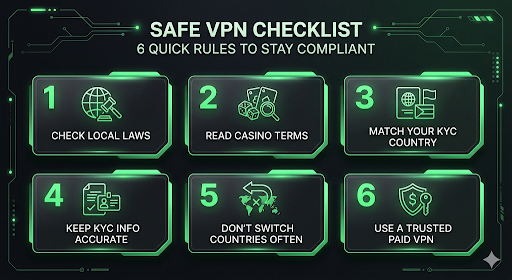
This is the most important decision when using a VPN at an online casino. The safest and most recommended choice is to connect to your real home country, the one that matches your verified account and KYC (Know Your Customer) documents. If your account is registered in the UK, Canada, Germany, Malta, New Zealand, or Curaçao, and your ID reflects that, setting your VPN to that same country creates no contradiction in the casino’s records.
Where this becomes risky is when there is a mismatch. Casinos run sophisticated detection that cross-references your IP location against your browser fingerprint, time zone, language settings, and submitted ID. If your IP says one country but your passport says another, that inconsistency can trigger an account review or suspension.
| Country / Region | Licensing Body | Online Gambling Status | VPN Safe to Use If KYC Matches? | Notes |
| United Kingdom | UKGC (UK Gambling Commission) | Fully legal and regulated | ✅ Yes | Strict KYC enforcement; IP must match registered address |
| Canada | Provincial bodies (e.g., iGaming Ontario) | Legal in most provinces | ✅ Yes | Regulations vary by province; confirm local rules |
| Germany | GGL (Gemeinsame Glücksspielbehörde) | Regulated since 2021 | ✅ Yes | Tight compliance rules; consistent IP location required |
| Malta | MGA (Malta Gaming Authority) | Fully legal and regulated | ✅ Yes | One of the most respected gambling licenses globally |
| Curaçao | Curaçao Gaming Control Board | Offshore license, widely used | ✅ Yes | Less strict than UKGC/MGA but VPN-country match still needed |
| New Zealand | Department of Internal Affairs | Legal for offshore play | ✅ Yes | Domestic online casinos restricted; offshore play is common |
| United States | State-by-state (e.g., NJDGE, Nevada GCB) | Legal in select states only | ⚠️ Conditional | Legal in NJ, NV, PA, MI; banned in HI, UT, and others |
| The Golden Rule: Your VPN country should match your real documents. If it doesn’t, you are creating a compliance problem, not solving one. |
When You Should NOT Use a VPN?
There are several situations where using a VPN for online gambling is a bad idea because it can create legal, account, and payout problems. The core issue is that a VPN changes your apparent location, but it does not change who you are, where you are legally allowed to play, or what you agreed to in the casino’s terms.
If gambling is illegal where you are
If online gambling is not legal in your country, state, or province, a VPN does not make it legal. Casinos may only see the VPN server at first, but your identity still has to be verified through KYC documents, payment methods, and sometimes device or fraud checks. If your real location is in a restricted place, using a VPN can expose you to account closure, confiscated funds, or worse, depending on local law.
A common mistake is assuming “hidden IP” means “safe to play.” It does not. The legal risk comes from the actual jurisdiction you are in, not just the IP address shown on the screen.
If the casino bans VPN use
Many regulated casinos explicitly prohibit VPNs, proxies, emulators, or any tool that hides your real location. This is usually written in the terms and conditions, and once you accept those terms, you are expected to follow them. If the casino detects a VPN later, it may flag the account for review even if you already deposited and played.
The consequences can be serious. They may freeze the account, delay withdrawals, void bonuses, or even cancel winnings if they believe you misrepresented your location. In some cases, even innocent-looking use, such as switching networks while traveling, can create enough suspicion to trigger a manual review.
If you are trying to bypass geo-blocks
Using a VPN to access a casino that is not allowed in your region is one of the riskiest uses. Casinos often restrict access by country because of licensing rules, tax rules, or regulatory obligations. If you get around that restriction, you are not just “changing servers”; you are potentially breaching a legal and contractual boundary.
This is especially important if the casino operates under a license that only allows service in certain jurisdictions. Even if you can sign up, deposit, or play for a while, the operator may later detect the mismatch through IP history, browser data, payment details, or identity verification. That can lead to winnings being withheld or the account being permanently closed.
If you are avoiding self-exclusion or verification
A VPN should never be used to get around self-exclusion tools, responsible gambling restrictions, or KYC checks. Self-exclusion is designed to help people pause gambling activity, and trying to bypass it undermines that protection. It also often fails in practice, because exclusion programs are usually tied to your name, documents, phone number, and payment details, not only your IP.
Trying to dodge verification is equally risky. Casinos use KYC to confirm age, identity, and source of funds, and they may stop withdrawals until verification is complete. If your VPN location does not match your documents, the casino may treat it as a fraud signal, which can delay or deny access to your balance.
Final Verdict: Should You Use a VPN for Online Casinos?
A VPN can improve privacy and security when gambling online, especially on public Wi-Fi or while traveling. However, it is not a tool to bypass casino rules, legal restrictions, or verification checks. The safest approach is to use a VPN only for protection and always match your real country and documents. Misusing it can lead to account suspension or lost winnings. In short, use VPNs for security, not shortcuts. For beginners learning how to play slots, it’s straightforward: pick a slot game, set your bet, spin the reels, and aim for matching symbols based on the paytable. Keep it simple, play responsibly, and use VPNs for protection, not shortcuts.