Virtual reality has come a long way from a futuristic concept to an integrated part of today’s digital entertainment including casino-style gaming. What is a VR casino explained in simple terms? It’s a virtual gambling environment accessed through a VR headset where players navigate a 3D casino, interact with tables and slots, and use avatars instead of standard screen controls.
While many games use the same systems as regular online casinos, the immersive environment creates a very different experience. Even so, VR gambling remains far smaller than mobile or desktop gaming. That leaves an important question for the industry: will virtual reality gambling become mainstream, or remain a niche experience for a smaller audience?
Inside the Future of VR CasinosVR casinos replace flat screens with immersive 3D casino spaces viewed through a headset, where players move and interact as avatars instead of clicking menus. What is a VR casino at its core? It is a regular online casino backend for accounts, RNG, and payments, wrapped in a VR front end that adds presence, spatial audio, and gesture‑based controls. VR adoption is still modest compared with mobile, so VR gambling remains a niche but growing segment. This makes it likely that VR will sit alongside desktop, mobile, and live dealer formats rather than replace them, offering an extra option for players who already enjoy virtual reality experiences. |
What Is VR Casino?
What is a VR casino beyond the marketing phrase? It is an online casino accessed through a virtual reality client, where the lobby, slots, and tables exist inside a 3D space that surrounds you when you put on a headset. You still create an account, manage a balance, and choose from a game library, but instead of clicking on a flat screen, you appear in a virtual hall, see rows of machines and tables, and move by walking in your room or using teleport controls.
When you sit at a table, you use hand controllers to place chips and interact with a dealer while the underlying game logic and odds remain the same as standard online versions. What is VR casino trying to achieve with this layout is a return to the atmosphere of a physical casino, with ambient sounds, visual depth, body language, and casual interactions between players, while still keeping the convenience and accessibility of playing online from home.
| The global market for VR gambling adds another layer to this growth story. It was estimated at US$40.4 Billion in 2025 and is projected to reach US$125.7 Billion by 2032, growing at a CAGR of 17.6% from 2025 to 2032, reflecting increasing interest in immersive betting environments and virtual casino experiences. |
How VR Casinos Work Behind the Scenes?
Even though VR casinos feel futuristic, the underlying system is familiar. If you understand how online casinos actually work, you already know most of the structure.
Behind the scenes, VR casinos rely on established systems such as account management, RNG game engines, payment processors, and compliance frameworks including licensing, KYC, and fraud detection.
On top of this, VR adds a specialised client built with a game engine to deliver:
- 3D environments that render inside a headset
- Motion tracking for head and hand movements
- Spatial audio that creates positional sound effects
- Avatar systems for shared player presence
- Voice chat or gesture-based interaction
In simple terms, VR casinos keep the core gambling infrastructure unchanged and only reframe how players experience it visually and socially.
This structure is similar to how live casino games work, where real-time game systems run behind a front-end experience designed to simulate physical casino interaction.
What Is VR Casino Like to Play?
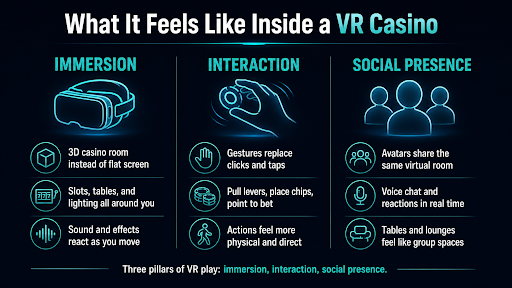
From the player’s viewpoint, three aspects stand out: immersion, interaction, and social presence.
Where AI and VR Meet
Artificial intelligence is already changing how platforms recommend games, manage risk, and personalise bonuses. In a VR context, that can go further.
If AI in gambling and online casinos is already reshaping how digital platforms operate, VR could become the environment where those changes become visible through adaptive layouts, contextual prompts, and subtle tools that encourage safer play inside a 3D casino experience.
Is VR Gambling the Future?
VR clearly adds something flat screens cannot provide, such as presence, body language, and shared spatial context, but most players still prioritise ease of access. Phones and laptops are always nearby, while headsets are not.
What VR casinos are likely to become over the next decade is a strong alternative for players who already enjoy VR, social virtual spaces, and immersive games, sitting alongside desktop, mobile, live dealer, and other formats rather than replacing them.
This shift will also influence the future of slot games, as developers explore more immersive, interactive, and socially driven formats beyond traditional screen-based play.