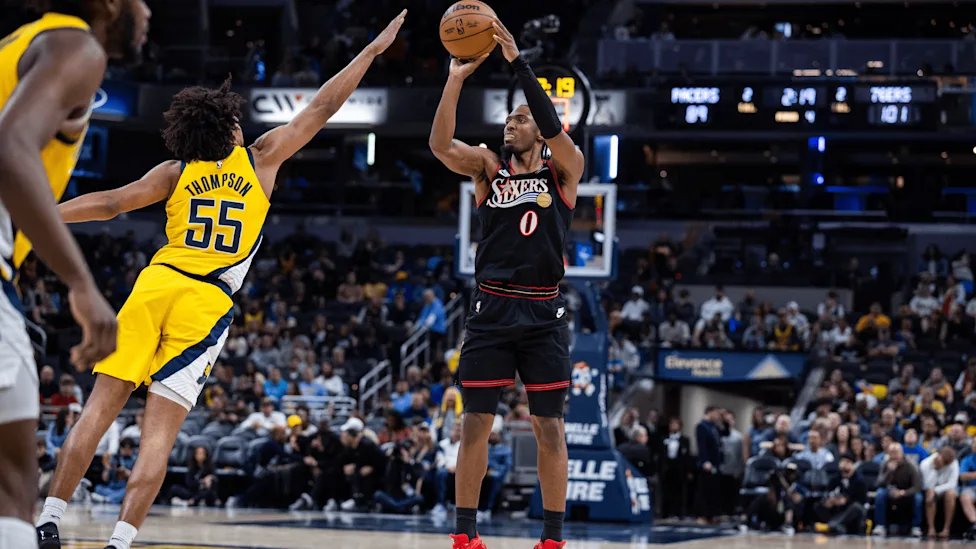
NBA player props let you bet on an individual player’s performance instead of the final game result. Common markets include points, rebounds, assists, three-pointers, steals, blocks, turnovers, and combined statistics such as points + rebounds + assists (PRA).
The key to understanding player props is knowing what the line measures, how the odds work, and which basketball conditions can influence the result. This guide explains NBA player props, the most common markets, how to read lines and prices, how to research a prop, and how to manage risk.
For a broader introduction to basketball markets, see our guide to Bet on basketball.
NBA Player Props Explained: What Are You Actually Betting On?
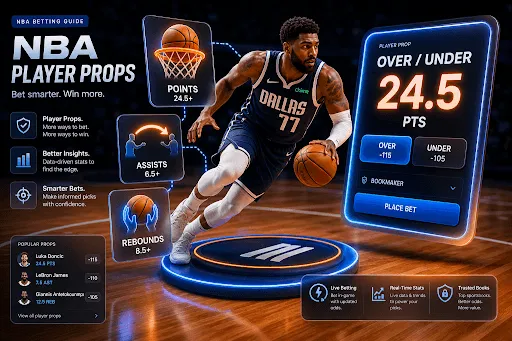
An NBA player prop is a wager based on an individual player’s statistical performance during a specified game or period.
Instead of predicting whether the Los Angeles Lakers or Boston Celtics will win, for example, a player prop could ask whether a selected player will score more than 24.5 points.
The sportsbook sets a statistical line and a price. The player’s official performance determines how the market settles according to the sportsbook’s rules. For team-based NBA markets, see NBA Betting.
How NBA Player Props Work
Most player props follow four basic components:
| Component | What it means | Example |
| Player | The athlete whose performance is measured | Player A |
| Statistic | The category being measured | Points |
| Line | The required statistical total | 24.5 |
| Price | The odds attached to the outcome | Over -110 |
For an Over 24.5 points prop, the player needs at least 25 official points for the Over to win. If the player finishes with 24 or fewer, the Under wins.
The exact settlement rules can differ for specialized markets, so the market description should always be checked before placing a bet.
Player Props vs. Traditional NBA Bets
Traditional NBA bets usually focus on a team or the entire game. Player props narrow the question to one athlete.
| NBA market | What you are predicting |
| Moneyline | Which team wins |
| Point spread | Whether a team wins or loses by a specified margin |
| Game total | Whether combined team scoring goes Over or Under a number |
| Player points | Whether a player reaches a scoring line |
| Player rebounds | Whether a player reaches a rebounding line |
| Player assists | Whether a player reaches an assist line |
| PRA | Whether a player reaches a combined points, rebounds and assists line |
A player prop can therefore win even when the player’s team loses. The player’s individual statistic determines the result of the prop.
The Main NBA Player Prop Markets
NBA sportsbooks can offer a wide selection of player markets. The most common categories are based on official box-score statistics.
Points Props
Points props measure a player’s total scoring during the specified period.
Points can come from:
- Two-point field goals
- Three-point field goals
- Free throws
A player’s scoring opportunities can depend on shot volume, offensive role, minutes, free-throw attempts, and how the opposing defense is structured.
Rebounds Props
Rebound props measure the number of rebounds credited to a player.
They can include:
- Offensive rebounds
- Defensive rebounds
- Total rebounds
Rebounding opportunities depend partly on missed shots and positioning. A center who spends most possessions near the basket has a different rebounding profile from a guard who operates around the perimeter.
Assists Props
Assists measure passes that receive official assist credit when they directly lead to a made basket.
Assist production can depend on:
- Ball-handling responsibility
- Passing opportunities
- Teammate shot-making
- Offensive system
- Minutes played
A player can create several scoring opportunities without recording the same number of official assists if teammates fail to convert the attempts.
Three-Pointer Props
Three-point props usually focus on making three-point field goals.
For example, an Over 2.5 threes requires three or more made three-pointers.
Three-point markets combine opportunity and shooting accuracy. A player may consistently receive attempts but still finish below the line because made shots naturally vary from game to game.
Steals, Blocks and Turnovers
These defensive and possession-based markets are usually lower-count statistics, meaning individual plays can have a large effect.
| Prop | What is counted |
| Steals | Officially credited steals |
| Blocks | Officially credited blocked shots |
| Turnovers | Officially recorded turnovers |
| Blocks + Steals | Combined blocks and steals were offered |
Always check the sportsbook’s settlement definition because specialized statistical markets can have specific rules.
First-Basket, First-Scorer and Other Specialist Props
Some sportsbooks also offer specialist player markets based on specific events rather than a player’s full-game statistical total. First-basket markets ask which player scores the first basket of the game, while first-scorer markets may focus on the first player to score. Other options can include first-half, quarter, or milestone markets.
These props involve fewer possessions and therefore can be highly variable. Check the exact market definition, game period, and settlement rules before selecting one.
What Are PRA and Other Combination Props?
Combination props combine multiple statistics into one line.
| Market | Components | Example |
| PRA | Points + rebounds + assists | 34.5 |
| PR | Points + rebounds | 28.5 |
| PA | Points + assists | 31.5 |
| RA | Rebounds + assists | 15.5 |
Suppose a player records:
- 20 points
- 9 rebounds
- 7 assists
Their PRA total would be 36.
Combination props are particularly relevant for players who contribute in several areas rather than relying on one statistical category.
Double-Doubles, Triple-Doubles and Milestone Props
Milestone props focus on whether a player reaches a specific statistical achievement during a game. The most common are double-doubles and triple-doubles, usually based on points, rebounds, and assists.
A double-double means a player records 10 or more in two statistical categories. A triple-double means they reach 10 or more in three categories.
| Player Statistics | Result | Why |
| 22 points, 11 rebounds, 8 assists | Double-double | 10+ points and 10+ rebounds |
| 22 points, 11 rebounds, 10 assists | Triple-double | 10+ in all three categories |
| 9 points, 12 rebounds, 10 assists | Double-double | 10+ rebounds and 10+ assists |
For example, if a player enters the fourth quarter with 9 assists and finishes with 10, that final assist can turn a non-triple-double into a triple-double.
Some sportsbooks also offer other milestone markets, such as 20+ points, 10+ rebounds, or 5+ assists. Always check the market description because qualifying statistics and settlement rules can vary by sportsbook.
How to Read an NBA Player Prop Line
An NBA player prop line tells you exactly what performance you are betting on and the number the player must reach. To read it correctly, identify the player, statistic, line, Over or Under, and odds.
For example:
Player A – Points – Over 24.5 – -110
Here is what each part means:
| Part | What to Look For | Example |
| Player | Whose performance is being measured | Player A |
| Statistic | What is being counted | Points |
| Line | The statistical target | 24.5 |
| Selection | Whether you choose Over or Under | Over |
| Odds | The price of your selection | -110 |
1. Identify the Player
First, check the player’s name. The prop is settled using that player’s official statistics for the specified game or period.
For example:
Stephen Curry – Points – Over 27.5
This means the market is based on Stephen Curry’s points, not his team’s total score.
2. Identify the Statistic
Next, check what statistics the prop measures. Common examples include:
- Points
- Rebounds
- Assists
- Made three-pointers
- Steals
- Blocks
- Turnovers
- PRA (points + rebounds + assists)
The statistic tells you what the player’s performance will be compared against.
3. Find the Line
The line is the target number set by the sportsbook.
For example:
Over 24.5 points
The number 24.5 is the line. The player must finish above that number for the Over to win.
Because NBA points are recorded as whole numbers:
- 25 or more points → Over wins
- 24 or fewer points → Over loses
The same principle applies to other statistics. An Over 8.5 rebounds prop requires at least 9 rebounds.
4. Check Over or Under
The Over/Under tells you which side of the line you are selecting.
Suppose the line is 6.5 assists:
| Selection | Required Result |
| Over 6.5 assists | 7 or more assists |
| Under 6.5 assists | 6 or fewer assists |
The line itself does not mean the player is expected to finish exactly at that number. It creates a threshold that separates the two possible outcomes.
5. Read the Odds
The number next to the Over or Under is the betting price. For example:
Over 24.5 points (-110)
The 24.5 is the statistical line, while -110 is the American odds price. They have different purposes.
The line tells you what the player needs to achieve. The odds tell you the financial return attached to that selection.
6. Check the Game Period
Always confirm whether the prop applies to the full game, first half, quarter, or another specified period.
For example:
- Player A Over 24.5 points – Full Game
- Player A Over 12.5 points – First Half
These are different markets even though they involve the same player and statistic.
Example of Reading a Complete Prop
Consider:
Player A – Rebounds – Over 8.5 – -115 – Full Game
You would read this as:
Player A needs to record at least 9 rebounds during the full game, and the selected Over is priced at -115.
The easiest way to read any NBA player prop is:
Player → Statistic → Line → Over/Under → Odds → Game Period
Check each element before selecting a market, because changing even one part can create a completely different prop.
How NBA Player Prop Odds Work
The odds determine the financial return attached to the selected outcome.
American odds are common in the United States.
Negative American Odds
A price of -110 means 110 units are required to make 100 units of profit.
For example:
| Odds | Amount selected | Profit | Total returned |
| -110 | 110 units | 100 units | 210 units |
| -150 | 150 units | 100 units | 250 units |
Positive American Odds
Positive odds show the potential profit from a 100-unit amount.
| Odds | Amount selected | Profit | Total returned |
| +100 | 100 units | 100 units | 200 units |
| +120 | 100 units | 120 units | 220 units |
| +200 | 100 units | 200 units | 300 units |
These examples are mathematical illustrations. Actual returns depend on the displayed price, amount selected, currency, and applicable sportsbook terms.
How to Calculate NBA Prop Implied Probability
Implied probability converts American odds into a percentage representation of the listed price.
For negative American odds:
Implied probability = odds ÷ (odds + 100)
At -110:
110 ÷ (110 + 100) = 52.4%
For positive American odds:
Implied probability = 100 ÷ (odds + 100)
At +120:
100 ÷ (120 + 100) = 45.5%
| American odds | Implied probability |
| -110 | 52.4% |
| -150 | 60.0% |
| +100 | 50.0% |
| +120 | 45.5% |
| +200 | 33.3% |
These percentages describe the price rather than guaranteeing the actual probability of the player’s performance.
What Determines an NBA Player Prop Line?
A player-prop line reflects the market’s expectation for a particular performance under a particular set of circumstances.
The main basketball inputs include:
- Expected minutes
- Offensive responsibility
- Recent role
- Opponent
- Pace
- Team lineup
- Player availability
- Statistical production
These factors should be considered together rather than treated as independent predictions.
Minutes Are the Foundation of Counting Stats
Counting statistics requires playing time. More minutes generally provide more opportunities to accumulate points, rebounds, assists, steals, blocks, and other statistics.
However, minutes should not be interpreted alone. A player can receive 35 minutes but have a smaller offensive role, while another player can produce heavily in fewer minutes because of a larger role.
Role Determines Opportunity
A player’s role describes how they are used within the offense and defense.
A primary ball handler may have more opportunities to score and create assists. A center may receive more chances around the basket and on the defensive glass. A perimeter specialist may generate a larger share of their attempts from three-point range.
The important question is not simply how good the player is, but what the player is expected to do in this game.
Matchup Changes the Statistical Environment
Different opponents create different conditions.
| Prop type | Useful matchup considerations |
| Points | Defensive coverage, rim protection, shot profile |
| Rebounds | Frontcourt size, missed-shot environment, positioning |
| Assists | Ball pressure, help defense, teammate finishing |
| Threes | Perimeter coverage, shot opportunities, defensive closeouts |
| Blocks | Rim attempts and defensive role |
| Steals | Opponent ball handling and defensive assignment |
A matchup should therefore be evaluated in relation to the specific prop rather than through one overall defensive ranking.
Pace Influences Possession Volume
Pace describes how quickly teams generate possessions.
More possessions can create additional opportunities for counting statistics, while a slower game can reduce the total number of possessions available.
Pace is best treated as a game-environment factor rather than a standalone reason to choose an Over or Under.
Rest, Travel and Back-to-Backs
Rest and travel can affect player availability, workload and expected minutes. Back-to-back games may create additional uncertainty, particularly for players managing heavy workloads. Travel schedules can also influence the overall game environment. These factors should not be treated as automatic reasons to choose an Over or Under, but they are worth checking when evaluating a player’s expected role and playing time.
How to Research an NBA Player Prop
Good prop research starts by defining the question clearly: what needs to happen for this player to reach the line?
Step 1: Establish the Expected Workload
Review the player’s expected role and normal rotation.
Look at:
- Starting status
- Recent minutes
- Rotation position
- Injury limitations
- Expected workload
The goal is to establish a reasonable minutes assumption before looking at the final statistical projection.
Step 2: Examine Statistical Opportunity
- Production should be separated from opportunity.
- For scoring, review shot attempts and free-throw opportunities.
- For assists, consider ball-handling and potential passing opportunities.
- For rebounds, consider playing position and available rebound opportunities.
- For three-pointers, consider attempts as well as makes.
- This helps distinguish a sustainable role from a short-term statistical result.
Step 3: Compare Recent Games With the Larger Sample
Recent games can reveal a change in role, but they can also contain unusual circumstances.
| Recent result | Question to ask |
| Higher scoring | Did shot volume increase? |
| More assists | Did ball-handling responsibility change? |
| More rebounds | Did lineup size or opponent shooting change? |
| More threes | Did attempts increase or simply shooting percentage? |
| Fewer minutes | Was there an injury, foul trouble or game blowout? |
The objective is to identify why the numbers changed rather than assuming the latest result will repeat.
Step 4: Check the Current Opponent
Once the player’s opportunity is understood, apply the matchup.
Look specifically at the statistic being evaluated. A favorable scoring matchup does not automatically mean a favorable rebounding matchup.
Step 5: Compare the Projection With the Market
Only after reviewing workload, opportunity and matchup should the sportsbook line be considered.
For example:
| Your estimated range | Sportsbook line | Interpretation |
| 22–24 points | 24.5 | Requires a higher-end outcome |
| 25–27 points | 24.5 | Line falls near the lower end of estimate |
| 28–30 points | 24.5 | Line is below the estimated range |
A projection is still an estimate. It should not be treated as a guarantee.
How to Compare NBA Player Prop Lines
The same player can appear at different prices or thresholds across sportsbooks.
For example:
| Sportsbook | Player points line | Price |
| Book A | Over 24.5 | -110 |
| Book B | Over 24.5 | -115 |
| Book C | Over 25.5 | -105 |
These are not identical markets.
The first comparison should always be the player, statistic, line and game period. Only after those matches should the price be compared.
A half-point difference can be more important than a small odds difference because the statistical threshold itself has changed.
How to Evaluate Over vs. Under
An Over requires the player’s production to exceed the listed line. An Under requires the player’s production to finish below it.
The decision should come from the expected distribution of outcomes rather than from whether the player is generally considered good or bad.
Factors That Can Support an Over
Depending on the market, potential Over-supporting factors may include:
- Increased minutes
- Greater offensive responsibility
- More expected possessions
- Additional shot attempts
- A larger passing role
- A favorable statistical matchup
Factors That Can Support an Under
Potential Under-supporting factors may include:
- Reduced workload
- Lower usage
- A returning teammate
- Difficult defensive coverage
- Slower expected pace
- Blowout-related minutes uncertainty
None of these factors guarantees an outcome. They simply describe conditions that can affect opportunity.
When to Pass on an NBA Player Prop
Not every NBA player prop presents a clear betting opportunity. Sometimes the better decision is to pass when important information is uncertain or the available price does not justify the risk.
Consider passing when:
- The player’s availability or injury status is unclear.
- Expected minutes are difficult to estimate.
- A major lineup change could significantly alter the player’s role.
- The sportsbook line has moved substantially without a clear reason.
- You do not have enough information to make a reasonable assessment.
- The available odds do not offer enough value for the expected outcome.
Passing is a normal part of disciplined betting. You do not need to have a position on every NBA player prop.
NBA Player Props by Position and Role
Position alone does not determine a player’s prop profile. Modern NBA offenses frequently give players responsibilities outside traditional positions.
| Player role | Commonly relevant props |
| Primary creator | Points, assists, turnovers, PRA |
| Scoring guard | Points, threes, PRA |
| Two-way wing | Points, rebounds, steals, PRA |
| Stretch forward | Points, threes, rebounds |
| Traditional center | Rebounds, points, blocks, double-double |
| Defensive specialist | Steals, blocks, rebounds |
The player’s actual role should take priority over the label attached to their position.
NBA Player Props and Game Script
Game script describes how the game develops and how the score affects player usage.
A competitive game may keep core players on the floor for longer. A large lead can create the possibility of reduced minutes for starters.
This is particularly relevant to counting-stat props because a player cannot accumulate statistics while sitting on the bench.
Game script is inherently uncertain. Pre-game expectations about the margin should therefore be treated as one source of risk rather than a fixed prediction.
NBA Same-Game Parlays With Player Props
A same-game parlay combines multiple selections from the same game.
For example, a fictional combination might include:
- Player A Over 24.5 points
- Player B Over 5.5 assists
- Team A moneyline
Each selection must satisfy its individual settlement condition for the parlay to win.
Correlation Between Player Props
Selections in the same game can be related.
A faster game may create additional opportunities for several players. A major lineup change can increase one player’s usage while reducing another’s.
This relationship is known as correlation.
However, related outcomes do not make a parlay certain. One unexpected event can affect multiple selections simultaneously.
Why More Legs Increase Complexity
Adding selections means adding conditions that must all be successful.
| Number of legs | Requirement |
| 2 | Both selections must win |
| 3 | All three must win |
| 4 | All four must win |
| 5 | All five must win |
The displayed payout may become larger as more legs are added, but the combined selection also becomes harder to complete.
NBA Player Prop Futures
Not every player market is tied to one game. Futures can cover an entire season.
Examples may include:
- MVP
- Rookie of the Year
- Defensive Player of the Year
- Statistical leader
- Other player achievement markets
Season-long markets involve a different type of uncertainty because circumstances can change over many months.
Injuries, trades, coaching decisions, team performance and changes in playing time can all affect a player’s eventual statistical or award outcome.
NBA Player Prop Research: Useful Data
Reliable information can make prop research more structured.
Game Logs
Game logs provide historical information such as:
- Minutes
- Points
- Rebounds
- Assists
- Shot attempts
- Three-point attempts
- Starting status
They are useful for identifying patterns and changes in role.
Advanced Statistics
Depending on the market, useful metrics can include:
- Usage rate
- Assist percentage
- Rebound percentage
- Pace
- Shot attempts
- Three-point attempts
- Potential assists
- Lineup data
Advanced metrics should explain a basketball role rather than simply provide more numbers.
Injury and Lineup Reports
Current player availability is particularly important because one lineup change can alter several players’ responsibilities.
A reliable report can change the interpretation of:
- Expected minutes
- Shot volume
- Ball handling
- Rebounding responsibility
- Defensive assignments
Unconfirmed information should not be treated as established fact.
Common NBA Player Prop Mistakes
- Using a Season Average as the Entire Analysis: A season average describes past production across many different circumstances. It does not automatically represent the player’s current role or today’s matchup.
- Ignoring the Difference Between Attempts and Results: A scorer making five of eight three-pointers had a different statistical process from a scorer making one of eight. Separating opportunity from conversion helps identify whether a recent result was driven by volume, efficiency, or both.
- Comparing Different Lines as if They Were Identical: Over 24.5 points and Over 25.5 points are different markets. Always compare the actual threshold before comparing the odds.
- Treating Recent Form as a Guarantee: A player who exceeded a line several times in a row can still finish below it in the next game. Historical results provide information, not certainty.
- Building Parlays Without Understanding Each Leg: Every parlay selection introduces another condition. A player can perform well overall while missing one specific statistical threshold.
A Simple NBA Player Prop Analysis Framework
For readers who want a repeatable process, use this five-part framework:
| Step | Question |
| 1. Workload | How much playing time is reasonably expected? |
| 2. Role | What responsibilities will the player have? |
| 3. Opportunity | How many chances should that role create? |
| 4. Matchup | How does the opponent affect those opportunities? |
| 5. Price | Does the sportsbook line and price reflect the situation? |
This framework keeps the analysis focused without relying on one statistic or one recent performance.
NBA Player Props in 2026
NBA player props in 2026 cover far more than basic points and rebounds markets. Depending on the sportsbook, bettors may find individual lines for points, assists, rebounds, three-pointers, steals, blocks and turnovers, along with combination markets such as PRA, PR and PA. Alternate lines, double-doubles, triple-doubles and other milestone markets can also give bettors different ways to evaluate the same player’s performance.
The wider selection does not necessarily make every market easier to assess. Each prop measures a different part of a player’s role, so the information that matters for a points prop may be different from what matters for an assists or rebounds prop. For example, a points prop may require closer attention to shot volume and scoring opportunities, while an assists prop may depend more heavily on ball-handling responsibility and teammate shot conversion.
What Matters Most When Evaluating NBA Props in 2026
The most useful starting point is the player’s expected role for the specific game. A player’s season average can provide historical context, but it does not fully explain what to expect when minutes, teammates or responsibilities change.
Before evaluating a line, consider:
- Expected minutes: More playing time generally creates more opportunities to accumulate counting statistics.
- Current role: A change in ball-handling, shot attempts or defensive responsibility can affect several prop markets at once.
- Teammate availability: Missing starters or rotation players can redistribute shots, assists and rebounds.
- Opponent matchup: Defensive style, rebounding opportunities and perimeter coverage can affect different statistics in different ways.
- Game environment: Expected pace and possession volume can influence how many opportunities are available.
- Market line and price: A player’s recent production still needs to be compared with the actual threshold and odds being offered.
This makes NBA player-prop research a situation-based exercise rather than a simple comparison between a player’s average and the sportsbook’s number.
Why Lineup News Matters
Lineup information can be particularly important for player props because one roster change can alter several players’ responsibilities. If a high-usage teammate is unavailable, another player may take more shots or handle the ball more often. A replacement center could also change the team’s rebounding distribution.
However, a larger role does not automatically mean every statistic will increase. A player receiving more offensive possessions may benefit in points and assists while seeing little change in rebounds. The effect of a lineup change should therefore be connected to the specific prop being evaluated.
Compare the Market, Not Just the Player
NBA sportsbooks can post different thresholds and prices for the same player. For example, one sportsbook might offer Over 24.5 points while another lists Over 25.5 points. Those markets should not be treated as identical simply because they involve the same player.
When comparing available props, check the:
| Factor | What to Confirm |
| Player | Is it the same player? |
| Statistic | Points, rebounds, assists, PRA, etc. |
| Line | Is the statistical threshold identical? |
| Game period | Full game, half, quarter or another period? |
| Price | Which sportsbook offers the more favorable odds? |
| Rules | Are the settlement conditions the same? |
This comparison is especially important when a small difference in the line can change the number of outcomes needed for the Over or Under to win.
If you are interested in women’s basketball, our WNBA Betting guide explains the main WNBA markets and the factors that can influence them.
Responsible NBA Player Prop Betting
Player props involve uncertainty. A player can receive the expected minutes and still finish below a line because of shooting variance, missed opportunities, foul trouble, injury, coaching decisions or game flow.
- Set a personal entertainment budget before betting and never use money needed for essential expenses, bills, savings or emergencies.
- Do not increase the amount simply to recover a previous loss. A losing result does not make the next prop more likely to win.
- The purpose of research is to understand the market, not to create certainty. No NBA player prop is guaranteed.
- If betting becomes difficult to control or stops feeling like entertainment, take a break and use an appropriate responsible-gambling support service.