La Liga betting starts with a football-specific fact: a match can finish with a home win, draw, or away win. From there, markets can focus on the result, goal margin, total goals, both teams scoring, player events, match incidents, or season outcomes. Before entering a La Liga market, confirm the starting lineups, suspensions, schedule context, and settlement terms. This guide explains how to read La Liga odds, understand the most relevant football markets, and place a bet within a set entertainment budget.
La Liga Betting: Odds, Markets, and Spanish Football Explained
|
What La Liga Is and How a Season Is Settled
La Liga is Spain’s highest domestic men’s football division. Twenty clubs play each opponent twice, once at home and once away, giving every team 38 league fixtures and the competition 380 matches in a standard season. A win earns three points, a draw earns one, and a loss earns none. The club that finishes first is the champion.
For a betting guide, the main point is that league position comes from a long season rather than one match. A title future, top-four market, relegation market, or team-points line therefore remains exposed to injuries, transfers, fixture changes, suspensions, and tactical changes over many months.
The Points at Both Ends of the Table
The title race is only one reason a La Liga fixture can matter. Clubs can also be pursuing European qualification, trying to avoid relegation, or attempting to improve their final position. These circumstances can influence selection choices and match context late in a season.
Context is not a prediction. A team needing points can still lose, and a team with less obvious league pressure can still perform strongly. Check current standings, squad availability, and the match price rather than assuming motivation alone decides an outcome.
La Liga’s Calendar and Match Rhythm
A La Liga campaign generally runs from late summer into spring. League matches can sit alongside Copa del Rey ties, UEFA fixtures, international breaks, and domestic travel. The schedule can affect recovery time, rotation decisions, and who is available for a particular match.
A midweek European fixture does not automatically make a team a poor selection. It is a reason to check the prior lineup, minutes played, travel, and the manager’s likely rotation before treating an opening price as current.
From 1929 to Today: History That Shapes La Liga Markets
A National League Built Around Regional Rivalries
La Liga began in 1929 with ten clubs. The national competition paused during the Spanish Civil War before resuming in 1939/40. Over time, major regional rivalries, historic clubs, and high-profile derbies have made the league one of football’s most watched domestic competitions.
A derby or a famous club can draw more attention to a market, but history cannot decide the next score. Current team selection, tactical matchup, venue, rest, and the odds available are more relevant to a match bet than a trophy won decades ago.
Every Club to Win La Liga
Nine clubs have won La Liga. The title counts below include the completed 2025/26 season, when FC Barcelona won its 29th league championship. Real Madrid remain the record title holders with 36.
| Club | La Liga titles | Most recent title | Historical context |
| Real Madrid | 36 | 2023/24 | Record title winner and a defining club in the competition’s modern history |
| FC Barcelona | 29 | 2025/26 | Won the inaugural 1929 season and remain one of the league’s two most decorated clubs |
| Atlético de Madrid | 11 | 2020/21 | Spain’s third-most successful league club by title count |
| Athletic Club | 8 | 1983/84 | A major force in the competition’s early decades |
| Valencia CF | 6 | 2003/04 | Won titles across multiple periods, including the early 2000s |
| Real Sociedad | 2 | 1981/82 | Won back-to-back league titles in 1980/81 and 1981/82 |
| Deportivo La Coruña | 1 | 1999/2000 | Won one title during a highly competitive late-1990s and early-2000s era |
| Sevilla FC | 1 | 1945/46 | Won one league championship in the post-war period |
| Real Betis | 1 | 1934/35 | Won one league title before the Civil War interruption |
Historical title counts explain public profile and rivalry. They do not decide a current 1X2, handicap, or goals market.
La Liga’s All-Time Top Goalscorers
La Liga’s leading scorers combine long careers with central roles at major clubs. Messi remains the all-time record holder on 474 league goals; Cristiano Ronaldo follows with 311, while Telmo Zarra is third with 251.
| Rank | Player | La Liga goals | Main La Liga clubs |
| 1 | Lionel Messi | 474 | FC Barcelona |
| 2 | Cristiano Ronaldo | 311 | Real Madrid |
| 3 | Telmo Zarra | 251 | Athletic Club |
| 4 | Karim Benzema | 238 | Real Madrid |
| 5 | Hugo Sánchez | 234 | Atlético de Madrid, Real Madrid |
| 6 | Raúl González | 228 | Real Madrid |
| 7 | Alfredo Di Stéfano | 227 | Real Madrid, Espanyol |
| 8 | César Rodríguez | 221 | FC Barcelona and other clubs |
| 9 | Quini | 219 | Sporting Gijón, FC Barcelona |
| 10 | Pahiño | 212 | Celta Vigo, Real Madrid, Deportivo La Coruña |
These records provide historical context for top-goalscorer and player-event markets. For a current anytime-scorer, shots, or season-goals market, the more relevant checks are starting status, expected minutes, role, penalty duty, opponent, and the specific market rules.
What a Club’s History Does Not Tell You
Famous clubs may attract more public attention, especially Real Madrid, Barcelona, Atlético, Athletic Club, Valencia, Sevilla, and Real Betis. Public interest can influence market activity, but it does not make a current selection right or wrong.
A historic reputation cannot replace current information. Before looking at a match result or goals market, review the available players, likely system, schedule, venue, and price.
La Liga Betting Statistics: Numbers That Should Shape Your Market Decisions
Before committing to any La Liga market, understanding how Spanish football behaves as a competition gives you a more accurate starting point than reputation, recent form, or assumptions carried over from other leagues. The five sections below are built from 1,900 matches played across five La Liga seasons. None of this predicts individual results. All of it gives a factual foundation for the markets most bettors engage with regularly.
Does Home Advantage in La Liga Work the Way Most Bettors Think?
Home advantage in La Liga is real, but it operates differently from what most bettors assume when they first approach Spanish football.
La Liga full-time results by season:
| Season | Matches | Home Win | Draw | Away Win |
| 2018/19 | 380 | 44.2% | 28.9% | 26.8% |
| 2019/20 | 380 | 45.8% | 27.6% | 26.6% |
| 2020/21 | 380 | 41.6% | 28.7% | 29.7% |
| 2021/22 | 380 | 43.4% | 29.2% | 27.4% |
| 2022/23 | 380 | 47.9% | 23.4% | 28.7% |
| Total | 1900 | 44.6% | 27.6% | 27.8% |
La Liga Has the Highest Halftime Draw Rate in Europe. What Does That Actually Mean?
Walk into any La Liga match and the most likely scoreline at the break is 0-0 or 1-1. The halftime draw rate in Spanish football sits at 45.3% across five seasons, the highest figure recorded across all seven major European leagues in this comparison and noticeably above the group average of 40.1%.
Halftime results by league: 2018/19 to 2022/23
| League | Matches | HT Home Win | HT Draw | HT Away Win |
| La Liga | 1900 | 32.1% | 45.3% | 22.6% |
| Primeira Liga | 1530 | 32.9% | 41.5% | 25.6% |
| Ligue 1 | 1799 | 33.7% | 39.7% | 26.6% |
| Serie A | 1900 | 33.0% | 39.4% | 27.6% |
| Premier League | 1900 | 34.2% | 38.8% | 26.9% |
| Bundesliga | 1530 | 34.4% | 38.0% | 27.6% |
| Eredivisie | 1456 | 36.2% | 37.0% | 26.9% |
| Seven-league average | 12015 | 33.7% | 40.1% | 26.2% |
La Liga home teams lead at the break in fewer than one in three matches. Visiting teams hold a halftime lead in fewer than one in four. A level score going into the second half is not just the most common outcome – it is almost 13 percentage points more common than the next most frequent halftime state.
La Liga halftime results by season:
| Season | Matches | HT Home Win | HT Draw | HT Away Win |
| 2018/19 | 380 | 31.8% | 42.6% | 25.5% |
| 2019/20 | 380 | 30.0% | 48.2% | 21.8% |
| 2020/21 | 380 | 31.6% | 44.2% | 24.2% |
| 2021/22 | 380 | 32.9% | 46.1% | 21.1% |
| 2022/23 | 380 | 34.2% | 45.5% | 20.3% |
| Total | 1900 | 32.1% | 45.3% | 22.6% |
La Liga also generates fewer goals in the opening 45 minutes than any other league in this comparison. Home teams average 0.62 first-half goals per match and away teams average 0.48, combining for a halftime average of just 1.10 goals. The seven-league average across the same period is 1.24.
Average first-half goals by league:
| League | Matches | Home HT Goals | Away HT Goals | HT Avg Goal Diff |
| Eredivisie | 1456 | 0.77 | 0.61 | +0.16 |
| Bundesliga | 1530 | 0.76 | 0.62 | +0.14 |
| La Liga | 1900 | 0.62 | 0.48 | +0.14 |
| Premier League | 1900 | 0.70 | 0.58 | +0.12 |
| Ligue 1 | 1799 | 0.67 | 0.55 | +0.12 |
| Primeira Liga | 1530 | 0.64 | 0.52 | +0.11 |
| Serie A | 1900 | 0.67 | 0.58 | +0.09 |
What this tells you before you pick a market: Three specific market types are directly affected by this data. First-half 1X2 selections backing the home side to lead at the break are going against a halftime state that only materialises in 32.1% of La Liga matches. In-play markets that open from a level halftime score are starting from the statistically normal position in Spanish football, not a neutral or surprising one. First-half under totals carry historical support from a league that averages barely above one goal before the interval.
What Is the Most Common Winning Margin in La Liga?
La Liga produces closer scorelines more consistently than any other major European league. Tight, one-goal results are the defining characteristic of Spanish top-flight football when viewed through the lens of five seasons of match data.
The one-goal margin accounts for 39.8% of all La Liga results, which is higher than the seven-league average of 37.4%. At the opposite end, matches ending with a three-or-more goal difference in either direction occur in only 12.4% of Spanish top-flight games, against a group average of 16.8%.
Combined home and away two-goal margins cover around 20.2% of La Liga matches, just below the group average of 21.2%. Combined margins of three or more goals in either direction total only 12.4%, a figure that is 4.4 percentage points below the group average and the lowest in the comparison.
How Often Do La Liga Matches Finish Over 2.5 Goals?
Spanish top-flight football is the lowest-scoring major European league in terms of over 2.5 goal outcomes. Across five seasons, three or more goals appeared in only 45.7% of La Liga matches. Every other major European league in this comparison produced a higher over 2.5 rate, and the group average across all seven leagues stands at 52.8%.
How Often Do Both Teams Score in La Liga?
Both teams find the net in 50.5% of La Liga matches, the second lowest rate recorded among the seven major European leagues in this comparison. Only Portugal’s Primeira Liga, at 47.5%, sits lower.
The La Liga BTTS split across five seasons is essentially level. Yes at 50.5% and No at 49.5% are separated by just one percentage point. That near-equal distribution is entirely different from the Bundesliga, where BTTS Yes leads No by 19 percentage points, and from Serie A, where the gap is over 13 points. In La Liga no meaningful historical edge exists at the league level for either outcome.
How La Liga Odds Work: American, Decimal, and Fractional Formats
A La Liga 1X2 board prices three separate results: the home win, the draw, and the away win. American, decimal, and fractional formats are different ways of displaying those same prices. They do not change the match, the selection, or the possible result. For a deeper look at how odds work across all sports, the guide to sports betting odds covers the full mechanics.
Coastline FC vs Mountain United: One Board, Three Formats
| Full-time selection | American price | Decimal price | Fractional price | Market-implied chance | Profit from $100 | Return from $100 |
| Coastline FC win | -120 | 1.83 | 5/6 | 54.5% | $83.33 | $183.33 |
| Draw | +250 | 3.50 | 5/2 | 28.6% | $250.00 | $350.00 |
| Mountain United win | +320 | 4.20 | 16/5 | 23.8% | $320.00 | $420.00 |
These three implied percentages add to 106.9%. The amount above 100% is the bookmaker margin, commonly called vig or overround. It is part of the price offered on the market, not a statement that any result is certain.
American Odds: Which Side Is Priced Shorter?
American odds use plus and minus signs to show the return relationship. A minus price marks the shorter-priced selection: it states the amount needed to make $100 profit. A plus price marks the longer-priced selection: it states the profit made from a $100 bet.
For Coastline FC at -120, $120 makes $100 profit if Coastline wins. The full return is $220. The draw at +250 works in reverse: $100 makes $250 profit, producing a $350 return if the match finishes level.
Use these calculations:
- Negative price profit = bet amount × 100 ÷ the number after the minus sign.
- Positive price profit = bet amount × the number after the plus sign ÷ 100.
Example: A $48 bet on Coastline FC at -120 gives:
$48 × 100 ÷ 120 = $40 profit.
$48 + $40 = $88 total return.
Decimal Odds: The Number That Includes Your Bet
Decimal odds show the complete amount returned for every unit placed. Unlike American odds, there is no separate step needed to add the original bet back because the decimal figure already includes it.
For the draw at 3.50, every $1 placed returns $3.50 if the match ends level. A $48 draw bet therefore produces:
$48 × 3.50 = $168 total return.
$168 − $48 = $120 profit.
Decimal odds can be useful when comparing identical 1X2 prices because the larger decimal number provides the larger return. Confirm that the same match period, settlement rules, and result market are being compared first.
Fractional Odds: Read the Ratio Before the Result
Fractional odds place the potential profit before the slash and the amount needed to earn it after the slash. They show profit only, so the original bet must be added to find the return.
The draw at 5/2 means every $2 placed produces $5 profit if the match finishes level. With a $48 bet:
$48 × 5 ÷ 2 = $120 profit.
$48 + $120 = $168 total return.
The same draw price appears as +250 in American format and 3.50 in decimal format. Different presentation, same underlying 1X2 price.
Market-Implied Chance: Turning the Price Into a Percentage
Implied probability converts an odds price into the percentage represented by the market before the bookmaker margin is removed. In football, the home win, draw, and away win are all included in this calculation.
Use the formula that matches the format shown:
- Negative American price: absolute price ÷ (absolute price + 100) × 100.
- Positive American price: 100 ÷ (positive price + 100) × 100.
- Decimal price: 1 ÷ decimal price × 100.
- Fractional price: denominator ÷ (numerator + denominator) × 100.
For Coastline FC at -120:
120 ÷ (120 + 100) × 100 = 54.5%.
For the draw at +250:
100 ÷ (250 + 100) × 100 = 28.6%.
The percentage helps explain why the home win has the shortest price and the away win has the longest. It does not account for what may change before kick-off, such as a late suspension, a starting-XI surprise, or an injury update.
The La Liga Betting Markets
La Liga matches offer a wider range of market types than many bettors expect when they first start exploring how to bet on football. The table below maps the full market range from one hypothetical match.
Core La Liga Betting Market Map
| Market | Example selection | What it measures | Winning outcome |
| 1X2 match result | Draw | Which 90-minute result occurs | Match finishes level |
| Draw no bet | Mountain United | Team win with draw protection | Mountain United win; draw normally returns original amount |
| Double chance | Coastline FC or draw | Two of three result paths | Home win or draw |
| Asian handicap | Mountain United +0.25 | Goal-adjusted result with split settlement on some lines | Draw leads to half win and half return |
| European handicap | Coastline FC -1 | Three-way result after a goal adjustment | Coastline win by 2 or more |
| Match total | Under 2.5 goals | Combined match goals | Zero, one, or two total goals |
| Team total | Coastline FC over 1.5 goals | One team’s scoring total | Coastline score two or more |
| Both teams to score | No | Whether both teams score | At least one team fails to score |
| Anytime goalscorer | Coastline forward | Named player scoring event | Named player scores within stated settlement period |
| Shots on target | Coastline winger over 1.5 | Player attacking volume | Winger records two or more qualifying shots on target |
| Corners | Over 9.5 | Match corner count | Ten or more qualifying corners |
| Cards | Over 4.5 | Match card count | Five or more qualifying cards |
| Same-match multiple | Coastline win + under 3.5 goals | Linked outcomes in one match | Every selection wins |
| Live market | Draw at 60 minutes | Current game state | Result settles under the live market’s terms |
| Season future | Coastline top four | Final league position | Team meets the market-defined finishing position |
1X2, Draw No Bet, and Double Chance
1X2 asks for one exact full-time result: home win, draw, or away win. Draw no bet removes the draw from the win-or-lose decision. If Mountain United are selected, draw no bet and the match ends level, the original amount is normally returned. Mountain United must win for the selection to succeed.
Double chance covers two result paths. The main choices are 1X, meaning home win or draw; X2, meaning away win or draw; and 12, meaning either team wins. Covering two outcomes normally leads to a lower potential return than selecting one exact 1X2 outcome.
These markets do not answer the same question. Choose the one that matches the match scenario you are assessing rather than choosing based only on a larger possible return.
Asian Handicap: A Goal Line With Draw Treatment Built In
Asian handicap markets adjust the score by a stated goal line. Whole-goal, half-goal, and quarter-goal lines can settle differently.
| Asian line | If the match ends in a draw | Settlement concept |
| Mountain United +0.5 | Win | Draw is covered |
| Mountain United 0 | Return | Draw-no-bet treatment |
| Mountain United -0.25 | Half loss | Half bet amount returns at 0; half loses at -0.5 |
| Mountain United +0.25 | Half win | Half bet amount returns at 0; half wins at +0.5 |
A +0.5 selection wins if the chosen team wins or draws. A 0 line commonly acts like draw no bet. Quarter lines split the amount across two nearby handicap positions, which is why a draw can create a half-win or half-loss rather than a full settlement.
European Handicap: The Handicap Draw Remains Available
European handicap markets keep three possible outcomes after applying the goal adjustment: home handicap win, handicap draw, or away handicap win.
With Coastline FC -1:
- Coastline wins by two or more: Coastline handicap selection wins.
- Coastline won by exactly one: handicap draw.
- Mountain United draw, win, or lose by no more than the adjusted margin: Mountain United +1 selection wins.
This is different from an Asian -1 handicap. On Asian -1, a one-goal Coastline win would normally return the original amount. In a European -1 market, it creates a separate handicap-draw result.
Goal Markets: Totals, Team Goals, and Both Teams to Score
Goal totals count every qualifying goal scored by both teams. Under 2.5 goals wins with zero, one, or two goals. Over 2.5 wins with three or more. Half-goal lines avoid pushes; whole-goal lines can return the original amount when the final total lands exactly on the number.
A team total isolates one club’s scoring. Coastline FC over 1.5 wins if Coastline scores at least twice, regardless of Mountain United’s final total.
Both teams to score asks whether each side scores at least once. BTTS Yes wins at 1-1, 2-1, and 3-2. BTTS No wins at 0-0, 1-0, 2-0, or 0-2. A high total does not automatically mean BTTS Yes, and a low total does not automatically mean BTTS No.
Player Event Markets: Goals Are Not the Only Option
Anytime goalscorer markets settle when a named player scores during the stated match period. Starting status, expected minutes, penalty responsibility, set-piece role, and tactical role are more useful than historic reputation when assessing a current player market.
Shots, shots on target, assists, tackles, cards, and other player events can offer a different view of involvement. A player can generate several shots without scoring, while another can score from one chance. Check whether the player must start, whether substitutes are covered, and how voids are handled under the operator’s terms.
Match Events: Corners, Cards, and Penalties
Corner markets can be linked to wide attacking play, blocked shots, crosses, sustained pressure, and territorial dominance. Card markets can be influenced by the referee, pressing style, defensive matchups, disciplinary history, and derby intensity.
Penalty and red-card markets are event-based and high variance. They should not be approached as certainties, even where a fixture has an aggressive history or a referee has a particular record.
Accumulators and Same-Match Multiples
An accumulator combines selections into one ticket. A same-match multiple combines selections from the same fixture. Every leg normally needs to win for the bet to settle as a winner.
A Coastline win, under 3.5 goals, and a named player to record a shot on target are three separate conditions. A larger potential return reflects more conditions being required, not a higher likelihood of success. Operators may restrict or reprice selections that are strongly related.
Live La Liga Markets
Live markets update after kick-off. Goals, red cards, injuries, substitutions, time elapsed, shots, territory, and the current score can all change prices. A live price can refresh before the bet is accepted, so check the line and odds on the final bet slip.
A red card changes the match but does not make one live outcome certain. Assess the score, time remaining, substitutes available, tactical response, and the new price rather than reacting only to the event.
Season & Future Markets: Title, Europe, Relegation, and Goalscorer Futures
La Liga futures can include champion, top-four finish, European qualification, relegation, team points, top goalscorer, and final-position markets where available. These bets can remain open for most of the season.
Injuries, transfers, managerial changes, fixture congestion, and player roles can all change a future’s outlook. Check the operator’s rules for ties, player transfers, participation, dead heats, and settlement before entering a season market.
The Match Details That Can Change a La Liga Price
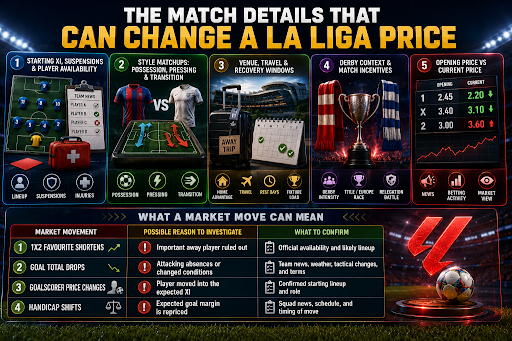
Starting XI, Suspensions, and Player Availability
Confirmed team selection can matter in every market. A missing goalkeeper, central defender, striker, primary creator, or set-piece taker can affect the match result, handicap, goals, and player-event prices in different ways.
Check official team news close to kick-off. A player being available does not guarantee that they will start, and a player returning from injury may not be expected to complete 90 minutes.
Style Matchups: Possession, Pressing, and Transition
Football styles can create different match environments. A possession-heavy side may face an opponent that defends deep and attacks on transition. Another fixture may involve aggressive pressing, wide overlaps, frequent crosses, and more corner opportunities.
Style is relevant to totals, both-teams-to-score, shots, corners, cards, and player events. It should be assessed with the actual lineups, not only broad labels such as “attacking” or “defensive.”
Venue, Travel, and Recovery Windows
Home venue, travel, rest days, midweek UEFA fixtures, domestic-cup matches, and international breaks can affect preparation and selection. These factors are most useful when they connect to an identifiable change in minutes, lineup, or tactical approach.
A home match does not guarantee a home win, and a midweek fixture does not guarantee a poor result. Use the schedule as a check on team news and the current price.
Derby Context and Match Incentives
Derbies, title races, European qualification battles, and relegation matches can create a different emotional setting around a fixture. They can influence public attention and may affect tactical caution or risk-taking during a match.
Narrative should not replace research. Review the starting XI, style matchup, suspensions, referee assignment where relevant, and current market price before assuming a derby or league position decides the result.
Opening Price Versus Current Price
A market move is an information trail. It can follow team news, a suspension update, a lineup change, betting activity, or a revised market view. It does not tell you which side is correct.
| Market movement | Possible reason to investigate | What to confirm |
| 1X2 favourite shortens | Important away player ruled out | Official availability and likely lineup |
| Goal total drops | Attacking absences or changed conditions | Team news, weather, tactical changes, and terms |
| Goalscorer price changes | Player moved into the expected XI | Confirmed starting lineup and role |
| Handicap shifts | Expected goal margin is repriced | Squad news, schedule, and timing of move |
Where to Place Your La Liga Bets: What to Look for in a Platform
Choosing where to place a La Liga bet is a practical decision that affects which markets are available, how competitive the pricing is on draw-heavy markets, and how clearly settlement terms are explained before you commit.
Four criteria separate the more useful platforms from the rest when it comes to Spanish football specifically.
Range of markets across all 380 La Liga matches: High-profile games involving Real Madrid and Barcelona will appear on almost every platform. The real test of a sportsbook’s La Liga coverage is the depth of markets available for mid-table and relegation-zone matches. Asian handicap, European handicap, team totals, player props, corners, and card markets on a Tuesday night La Liga game between two unfamiliar clubs tells you more about a platform’s actual coverage than its El Clasico offering does.
In-play betting quality: With 45.3% of La Liga matches level at halftime, in-play markets carry significant relevance for anyone who follows matches rather than setting bets before kick-off. Platforms that update live lines quickly across the full range of La Liga games give meaningfully more flexibility than those that limit live access to a handful of weekend fixtures.
Draw market pricing: A draw occurs in 27.6% of La Liga matches. Over a full season that adds up to around 105 draws across 380 games. The odds available on 1X2 draw selections, draw no bet pricing, and Asian handicap lines where a draw determines part of the settlement become consequential across that volume. Comparing draw prices across platforms before committing to one for your regular La Liga activity is worth the time.
Settlement terms that are clear before you commit: La Liga markets carry specific questions that vary between platforms: whether own goals contribute to BTTS settlement, how a match abandoned before 90 minutes is handled, and how player prop markets are resolved when a named player takes no part. These are not edge cases. They arise regularly over a full La Liga season. A platform with clearly documented answers to these questions removes the uncertainty that costs bettors money when results are being settled.
Responsible Betting Around La Liga Matches
Betting should be treated as entertainment, not as an income plan. No market, history, statistic, short price, derby, or recent run of form guarantees a result.
Set a money limit and time limit before the match starts. Do not chase losses or increase an amount to recover a previous bet. If betting causes stress or becomes difficult to control, take a break and seek support.
For independent help and practical tools, visit:
- International Center for Responsible Gaming offers research and education on gambling-related harm and responsible play.
- Gamblers Anonymous provides peer-support meetings for people who want help stopping gambling.
- National Council on Problem Gambling connects individuals and families with gambling education, helpline support, and treatment resources.