Signup is where most players judge a casino, but withdrawals are where the real difference between KYC and no-KYC platforms actually shows up. A no KYC casino site can promise fast, document-free play at registration and still hold your payout hostage behind a verification wall the moment you try to cash out. This blog breaks down the actual mechanics, timelines, and trade-offs of both models side by side, so you know exactly what to expect before you click withdraw. Whether you can withdraw without KYC often depends less on the platform’s marketing and more on how much you’re trying to take out.
The Payout Breakdown in No KYC Casino
|
What Happens During a KYC Withdrawal?
A KYC withdrawal takes place through a series of steps centered around documentation that most online casinos as well as some crypto sites are using as their core payout strategy. In contrast to a wallet check, a KYC withdrawal considers each withdrawal request to be a separate compliance procedure that is the reason why this process is so time-consuming.
Document Submission and Review Queue
As soon as the withdrawal request is sent, the platform usually puts a pause on making any payments until all required documents are presented. Once the documents have been submitted, each of them is added to a manual review queue that a compliance officer goes through rather than an automated software.
- Government-issued identity document such as a passport, driving license, or national ID proving one’s name and DOB
- Proof of address, usually a utility bill or bank statement not older than three months from the deadline of the platform
- A selfie holding the submitted ID, used to confirm the document belongs to the actual account holder
- Confirmation of payment method used, can be either a screenshot or partial card picture showing that deposit matches withdrawal request
Typical Approval Timelines
Since approval is based on whether the individual actually reviews the files, timelines differ dramatically among different platforms and even among different days at the same platform. While a few hours is a realistic timeframe when the queue is light and there is enough staffing of the compliance department, a few business days becomes much more common the moment volume picks up and there is a need to double-check the documents.
- Weekend and holiday submissions almost always take longer, since most compliance teams operate on standard business hours only
- A Friday night withdrawal request might not get reviewed until Monday morning, adding two to three days by default
- Same-day approval claims hold up only when documents are clear, current, and match account details exactly
- Any imperfection in a submission, even a minor one, pushes the timeline out immediately rather than triggering a partial approval
Platforms that advertise same-day approval aren’t necessarily lying, but that promise depends entirely on document quality and whether any red flags surface during the initial review pass.
Common Reasons for Rejection or Delay
The most frequent reason a KYC withdrawal stalls isn’t fraud, it’s something mundane that trips up an otherwise legitimate request. A few patterns show up repeatedly across platforms:
- Name mismatches between the ID and the account, often caused by a middle name, maiden name, or a simple typo made at signup
- Blurry or low-resolution document photos that fail automated or manual legibility checks
- Expired IDs submitted without the account holder realizing the document had lapsed
- Proof-of-address documents older than the platform’s cutoff, commonly rejected if dated more than three months back
- Payment method mismatches, where the withdrawal destination differs from the original deposit source, flagged as a potential fraud signal
Can you Withdraw without KYC?
A no-KYC withdrawal skips the document stage entirely by default, relying on blockchain and wallet activity to stand in for traditional identity checks.
Wallet-Based Verification Instead of Documents
Instead of a passport scan, the platform reads a handful of signals pulled directly from the blockchain and account history to assess risk automatically.
- Wallet address history, checking whether the withdrawal address has any prior activity on the account or appears for the first time
- Deposit-to-withdrawal consistency, confirming the wallet used to fund the account matches the one requesting the payout
- Transaction pattern analysis, flagging unusual timing, frequency, or amounts compared to the player’s typical behavior
- Withdrawal size relative to deposit history, since a payout far larger than any prior deposit tends to draw automatic attention
If the withdrawal wallet matches the deposit wallet and the amount falls within normal limits, the payout usually clears without any manual intervention at all. This is the exact mechanism that makes a genuine no kyc casino functionally different from a KYC platform at the withdrawal stage specifically, the check still happens, it’s just automated and invisible to the player rather than manual and document-based.
Typical Processing Speed
Standard no-KYC withdrawals commonly process within minutes to a few hours once blockchain confirmation completes, which is why some platforms qualify as an under one hour withdrawal casino for typical payout amounts. Speed isn’t uniform across every transaction though, and a few factors determine how fast a specific withdrawal actually clears.
- Network congestion for the chosen cryptocurrency, since a busy network slows confirmation regardless of the casino’s own systems
- Whether the platform batches withdrawals into groups or processes each one individually as it comes in
- The specific coin used, with BTC and ETH generally confirming faster on well-optimized platforms than less common altcoins
- Time of day and overall withdrawal volume on the platform, since high-traffic periods can still create minor queuing even without manual review
BTC and ETH withdrawals tend to confirm faster on well-optimized platforms compared to less common altcoins, simply because those networks have more validator activity and lower average confirmation times.
Why It Feels Instant (and When It Isn’t)
The “instant” feel comes from removing the manual review step for standard withdrawals, not from some technical shortcut unique to crypto itself. It’s a process design choice, not a fundamentally different technology, and that distinction matters once a withdrawal doesn’t behave the way a player expects.
- Withdrawals within normal size and pattern ranges skip review entirely and clear as fast as the blockchain allows
- Withdrawals crossing an internal risk threshold get paused, even on platforms that market themselves as fully no-KYC
- A paused withdrawal can trigger a request for the exact same documents a KYC casino would ask for upfront, ID, proof of address, or payment verification
- This exception isn’t a bug or a broken promise, it’s a built-in safeguard most no-KYC platforms rely on to manage fraud risk
Side-by-Side Comparison
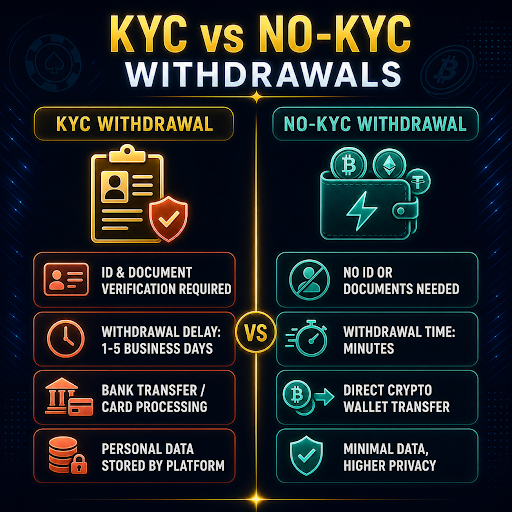
| Factor | KYC Withdrawal | No-KYC Withdrawal |
| Document requirement | ID, proof of address, sometimes selfie | None by default, wallet activity used instead |
| Average processing time | A few hours to several business days | Minutes to a few hours for standard amounts |
| Withdrawal threshold before extra checks | Applies from the first withdrawal | Often flagged only above a set dollar amount |
| Rejection risk | Higher, tied to document mismatches | Lower by default, rises if flagged for review |
| Consistency across amounts | Similar process regardless of size | Can shift entirely once a threshold is crossed |
When No-KYC Withdrawals Still Require Verification?
A no kyc casino isn’t permanently verification-free, it simply defers the check to specific triggers instead of applying it universally.
Large Withdrawal Thresholds
While the thresholds vary among platforms, the typical internal limit is between a few thousand and ten thousand dollars, beyond which the system automatically flags withdrawals for a review process. The purpose of this threshold is to spot any major instances of fraudulent activities while avoiding unnecessary processing of most smaller withdrawals.
Suspicious Activity Flags
A fast cycle of deposits and withdrawals, a number of accounts associated with one device, and gambling habits similar to bonus abuse will lead to a review regardless of the amount of the withdrawal. Changing the wallet address when withdrawing the funds compared to depositing is one of the most common single triggers.
Jurisdiction-Based Exceptions
Some countries require licensed gambling operators to verify identity regardless of the platform’s general policy, meaning a player in one region might face a request that someone elsewhere never sees. This variance means a no kyc casino’s actual behavior can differ meaningfully depending on where the player is located, even on the exact same platform.
Which Process Is Actually Safer?
Safety in this context isn’t about which process feels faster, it’s about which one offers real recourse when something goes wrong.
Consumer Protection Differences
KYC withdrawals, despite the friction, generally come with a documented paper trail and are more likely to be backed by licensing bodies that can intervene in a dispute. No-KYC withdrawals on lightly regulated platforms often lack that same regulatory backstop, meaning a denied or frozen payout has fewer formal channels for appeal.
Regulatory Risk for Operators
Operators offering no-KYC withdrawals face growing scrutiny from financial regulators tightening anti-money-laundering enforcement around crypto gambling. This pressure is pushing many platforms to quietly build in risk-based verification triggers rather than removing checks entirely, which is why almost no operator runs a truly zero-verification model at every withdrawal tier.
Note: Before trusting either model blindly, check whether the platform holds any gambling licence at all and read its withdrawal terms directly. A fast payout history on small amounts doesn’t guarantee the same speed once you’re withdrawing at scale.
Faster Payouts, Fewer Roadblocks
Whether you’re comparing KYC and no-KYC withdrawals to decide where to play, the real differentiator is consistency, not just speed on a good day. No forms, no waiting, just connect a wallet and start playing at Twinqo in under a minute, with crash games, live tables, and slots ready the moment your deposit clears.
Keep more of what you win, crypto payouts skip the fees and delays banks tack onto every transfer. Play now and see for yourself.