Knowing how to convert betting odds helps you read the same market across sportsbooks, calculate potential returns, and assess the implied probability behind each price. American, decimal, and fractional odds present the same value in different formats. For example, American odds of +150, decimal odds of 2.50, and fractional odds of 3/2 each produce a $150 profit from a $100 winning stake, with a total return of $250. Recognizing these equivalents makes it easier to compare prices before placing a wager.
A Betting Odds converter gives an immediate conversion, but knowing the formulas lets you check displayed payouts, spot differences between lines, and calculate parlay returns with greater confidence. This guide explains the conversion methods for all three formats, outlines the formulas behind each calculation, and shows how converted odds support more informed price comparisons. It also helps readers learning how to bet on sports understand every quoted line more clearly.
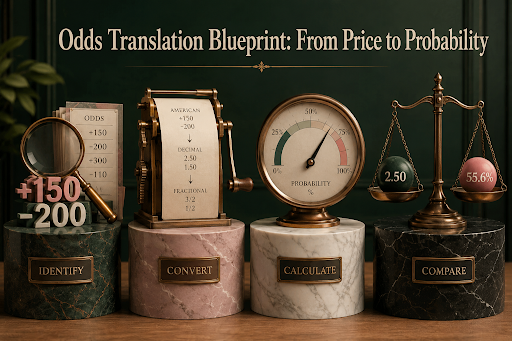
Odds Translation Blueprint: From Price to Probability
|
Understanding Odds Before You Convert Them
Betting odds show the potential return from a wager and the implied probability attached to the outcome. They are not a guarantee that a bet will win. Instead, they are the price offered by a sportsbook, including its built-in margin.
The first step is identifying the odds format. American odds use a plus or minus sign. Decimal odds show the full amount returned for every unit staked. Fractional odds show the possible profit relative to the stake. Once you identify the format, you can calculate a potential payout, translate the price into another format, or find the implied probability.
For example, decimal odds of 2.50 mean every $1 staked returns $2.50 in total if the selection wins. The profit is $1.50 because the original $1 stake is included. The equivalent prices are +150 in American odds and 3/2 in fractional odds. Each price represents a 40% implied probability.
Understanding sports betting odds helps bettors compare like-for-like markets instead of choosing a price only because the number looks higher. Always check the event, market type, selection, and settlement conditions before comparing odds.
How to Convert Betting Odds Across All Three Formats
American, decimal, and fractional odds describe the same betting price in different notation. Each format can be converted using straightforward formulas.
American Odds Explained and Converted
American odds work on a $100 baseline. Positive odds show how much profit a $100 stake can return. Negative odds show how much you need to stake to make $100 profit.
Examples:
- +200: A $100 bet earns $200 profit and returns $300 in total.
- -150: You must stake $150 to earn $100 profit, returning $250 total.
Converting American odds to decimal:
- Positive odds: (Odds ÷ 100) + 1
Example: +200 becomes (200 ÷ 100) + 1 = 3.00. - Negative odds: (100 ÷ Absolute Odds) + 1
Example: -150 becomes (100 ÷ 150) + 1 = 1.67.
Converting American odds to fractional:
- +200 becomes 200/100, simplified to 2/1.
- -150 becomes 100/150, simplified to 2/3.
Decimal Odds Explained and Converted
Decimal odds represent the total return per unit staked, including the original stake. A line of 2.50 on a $100 bet returns $250 total, meaning $150 profit.
Converting decimal odds to American:
- If decimal odds are 2.00 or higher: (Decimal Odds – 1) × 100
Example: 2.50 becomes +150. - If decimal odds are below 2.00: -100 ÷ (Decimal Odds – 1)
Example: The exact decimal equivalent of -150 is 1.6667, usually rounded to 1.67.
Converting decimal odds to fractional:
Subtract 1 from the decimal number and simplify the answer:
- 2.50 – 1 = 1.50.
- 1.50 becomes 3/2.
Fractional Odds Explained and Converted
Fractional odds show profit compared with stake. A line of 5/1 means five units of profit for every one unit staked. A line of 1/2 means one unit of profit for every two units staked.
Converting fractional odds to decimal:
(Numerator ÷ Denominator) + 1
- 5/1 becomes 6.00.
- 1/2 becomes 1.50.
Converting fractional odds to American:
- If the fraction is 1 or higher, multiply the fraction by 100.
Example: 5/1 becomes +500. - If the fraction is below 1, divide -100 by the fraction.
Example: 1/2 becomes -200.
These conversion formulas are the standard method for moving between American, decimal, and fractional odds.
Implied Probability Across All Three Formats
Every odds format carries an implied probability, which is the percentage chance represented by the sportsbook price. Comparing implied probability with your own estimate can help you assess whether a line is worth further consideration.
Implied Probability by Format
-
Positive American odds:
100 ÷ (Odds + 100) × 100
Example: +150 equals 40%. -
Negative American odds:
Absolute Odds ÷ (Absolute Odds + 100) × 100
Example: -200 equals 66.7%. -
Decimal odds:
1 ÷ Decimal Odds × 100
Example: 2.50 equals 40%. -
Fractional odds:
Denominator ÷ (Numerator + Denominator) × 100
Example: 3/2 equals 40%.
A betting odds converter can show implied probability automatically, but knowing the formula helps you understand whether the displayed price reflects a favorite, an underdog, or an even market.
The Betting Odds Converter at Work: Format Comparison Table
The table below shows how the same probability appears across all three odds formats.
| Implied Probability | American Odds | Decimal Odds | Fractional Odds | Payout on $100 |
| 40% | +150 | 2.50 | 3/2 | $250 total |
| 50% | +100 | 2.00 | 1/1 | $200 total |
| 66.7% | -200 | 1.50 | 1/2 | $150 total |
| 25% | +300 | 4.00 | 3/1 | $400 total |
| 80% | -400 | 1.25 | 1/4 | $125 total |
A bettor familiar with American odds can see decimal odds of 4.00 and recognize that they equal +300. The same price also appears as 3/1 in fractional odds and implies a 25% chance.
This is where a betting odds converter becomes useful. It helps you compare equivalent prices quickly when sportsbooks use different formats.
Format Conventions by Region and Platform
Odds formats can vary based on a sportsbook’s regional audience and display settings. American odds are common in US-facing sportsbooks, decimal odds are widely used internationally, and fractional odds remain familiar in UK and Irish markets.
The Regional Logic Behind Format Differences
The format changes, but the underlying price does not. A bettor who understands all three formats can compare markets without manually recalculating every line from the beginning.
Decimal Odds as the Calculation Standard
Decimal odds are often the easiest format for calculating payouts and parlays. Multiply the stake by the decimal price to find the total return. For parlay calculations, multiply every decimal selection together.
Using the Betting Odds Converter Accurately
A betting odds converter is only as reliable as the numbers entered. Sportsbook prices include vig, which is the margin that pushes combined implied probability above 100%.
Removing the Vig From Converted Odds
To estimate no-vig probability:
- Convert both sides into implied probability.
- Add the implied probabilities together.
- Divide each implied probability by the combined total.
Example: Two -110 sides each imply 52.38%.
52.38%+52.38%=104.76%52.38\% + 52.38\% = 104.76\%52.38%+52.38%=104.76%
To estimate the no-vig probability:
52.38÷104.76=50%52.38 \div 104.76 = 50\%52.38÷104.76=50%
The additional 4.76% is the market overround, commonly called vig
Parlays and Multi-Leg Calculations
To estimate no-vig probability:
- Convert both sides into implied probability.
- Add the implied probabilities together.
- Divide each implied probability by the combined total.
Example: Two -110 sides each imply 52.38%.
52.38%+52.38%=104.76%52.38\% + 52.38\% = 104.76\%52.38%+52.38%=104.76%
To estimate the no-vig probability:
52.38÷104.76=50%52.38 \div 104.76 = 50\%52.38÷104.76=50%
The additional 4.76% is the market overround, commonly called vig
Odds Conversion and the Bigger Picture of Value Betting
Converting odds is a mechanical skill. Using converted prices to compare betting markets is the practical goal.
Finding Value Through Conversion
- Convert the sportsbook price into implied probability.
- Estimate the real probability using your own research.
- Compare your estimate with the implied percentage.
- Consider the price only when the difference is meaningful.
A +150 line has a 40% implied probability. It may be worth considering only if your research indicates the outcome has a better than 40% chance of winning.
Cross-Platform Line Shopping
Line shopping is where conversion knowledge becomes especially useful. A +150 line at one sportsbook is the same price as 2.50 at another or 3/2 at a third.
When using online sports betting, compare the same event, market, selection, and settlement rules. A higher equivalent price offers a better potential payout.
Reading Any Odds Format With Confidence
Understanding odds conversion is not only about memorizing formulas. It is about recognizing the price, calculating potential returns, and comparing matching markets accurately. A betting odds converter helps standardize American, decimal, and fractional prices, while implied probability shows what each line suggests about the outcome.
Treat odds as market prices, not promises. Compare like-for-like selections, check settlement rules, and use the format that makes your calculations easiest.