

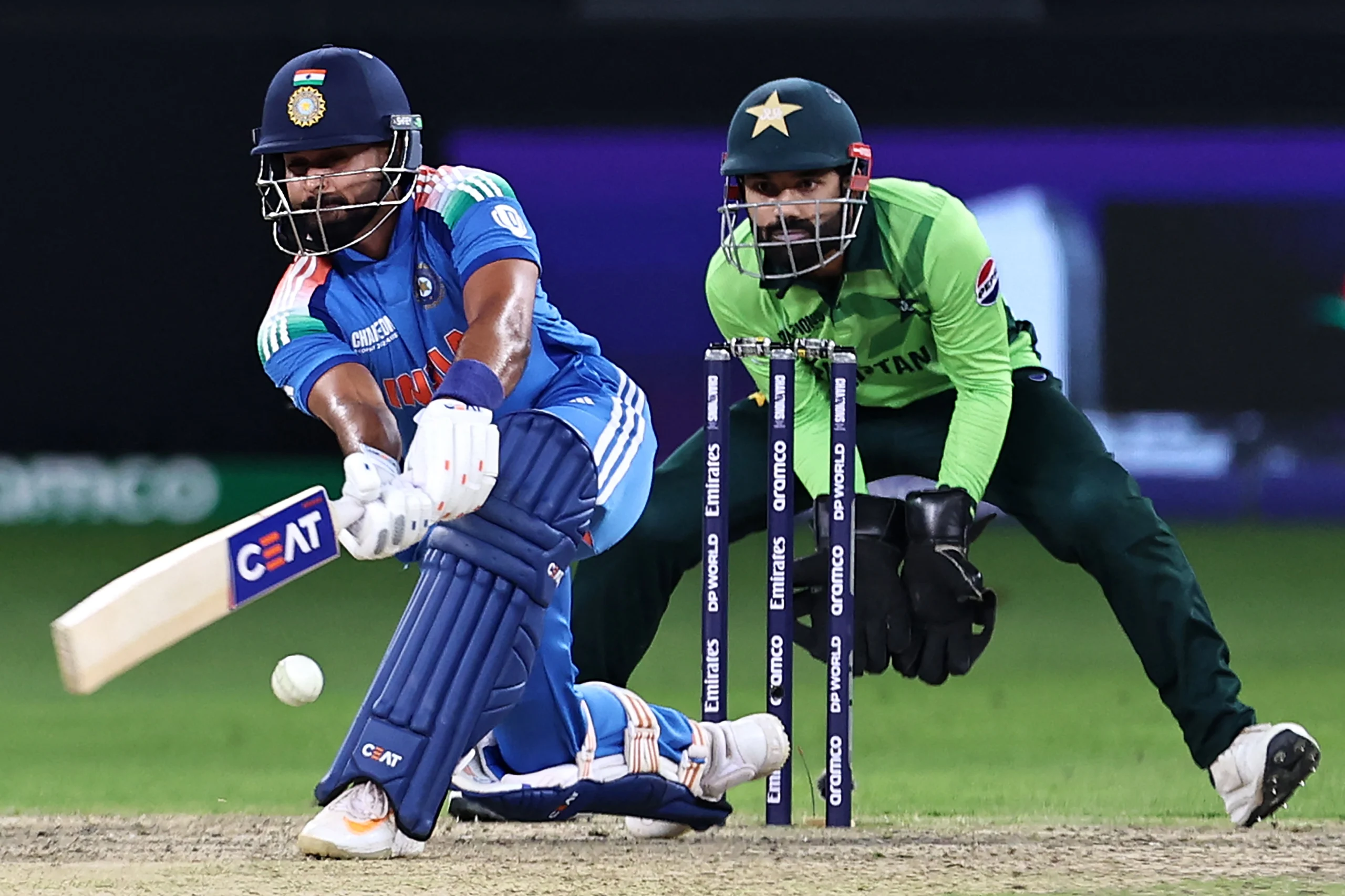
Cricket has grown from an early English bat-and-ball game into a global sport played across multiple formats, from five-day Tests to fast-paced T20 matches. The first recorded international cricket match took place between the United States and Canada in New York in 1844, showing that the sport’s international history began long before today’s major tournaments.
Modern cricket offers many betting markets because every format creates different scoring patterns, player roles, and match conditions. This guide explains cricket basics, odds formats, and popular betting options, using India vs Australia examples to make each market easier to understand.
Cricket Betting Essentials
|
Cricket Basics to Understand Before You Bet
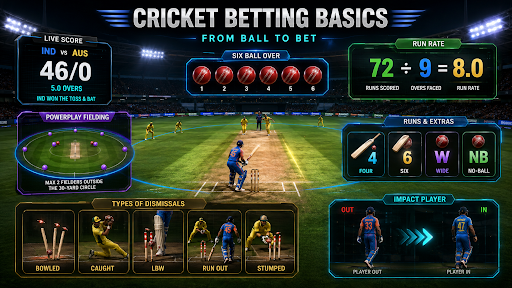
Cricket is played between two teams of 11 players. One team bats to score runs, while the other team bowls and fields to stop runs and dismiss batters.
The team with the highest score usually wins. However, the number of innings, overs, and possible results can change depending on whether the match is a T20, ODI, or Test.
Runs, Boundaries and Batting
A batting team scores runs in several ways:
- Batters can run between the wickets after hitting the ball.
- A ball that reaches the boundary after bouncing usually gives four runs.
- A ball that crosses the boundary without bouncing gives six runs.
- Wides and no-balls give extra runs to the batting team.
For example, if India scores 46 runs in five overs without losing a wicket, its score is written as 46/0. The first number is the total runs, while the second number is the number of wickets lost.
Wickets and Dismissals
A wicket is lost when a batter is dismissed. Common ways a batter can get out include:
- Bowled: The ball hits the stumps.
- Caught: A fielder catches the ball before it touches the ground.
- LBW: The ball hits the batter’s leg when it would likely have hit the stumps.
- Run out: A fielder breaks the wicket before the batter reaches the crease.
- Stumped: The wicketkeeper removes the bails while the batter is outside the crease.
A team can lose up to 10 wickets in one innings. Once 10 batters are dismissed, only one remains, so the innings is over.
Overs, Powerplays and Run Rate
An over consists of six legal balls delivered by a bowler. A wide or no-ball does not count as one of the six legal deliveries, so the bowler must deliver another ball.
The powerplay is the early part of a limited-overs innings where fewer fielders are allowed outside the inner circle. This often gives batters more chances to score boundaries.
Run rate shows how quickly a team is scoring.
For example:
Run rate shows how quickly a team is scoring during an innings. To work it out, divide the total number of runs scored by the number of overs completed.
Run Rate = Total Runs Scored ÷ Overs Completed
If Australia scores 72 runs in 9 overs, its run rate is 8 runs per over.
What Is an Impact Player?
An Impact Player is a substitute used in certain domestic T20 competitions. The team can bring in a substitute during the match to replace a player already in the starting XI, subject to the competition’s rules.
The Impact Player can change a match because a team may bring in:
- An extra batter while chasing a large target.
- A specialist bowler on a surface helping bowlers.
- A spin bowler if the pitch begins to turn.
- A power hitter for the final overs.
This matters for betting because a team’s likely batting depth or bowling options can change after the game begins. Before betting on player props or live markets, check whether the competition uses an Impact Player rule and how that team usually uses it.
Different Formats of Cricket: T20, ODI and Test Cricket
| Format | Innings per team | Overs per innings | Usual match length | Main betting focus |
| T20 | 1 | 20 | Around three hours | Powerplays, sixes, quick scoring and late wickets |
| ODI | 1 | 50 | One day | Batting depth, bowling phases and chasing targets |
| Test | 2 | No fixed limit | Up to five days | Pitch wear, weather, draw chances and long innings |
T20 and ODI matches usually have a clear winner, although ties and no-results can occur. Test matches can end in a team win, a draw, or a tie.
Cricket Betting Odds: How to Read Odds
Cricket odds show the return you may receive if your prediction is correct. They also show how the sportsbook has priced each team, player, or market.
The same selection may be shown in three formats:
- US moneyline odds
- Decimal odds
- Fractional odds
The price does not change just because the format changes. It only changes how the potential return is displayed.
India vs Australia Odds Example
Imagine India and Australia are playing a T20 match.
| Team | American odds | Decimal odds | Fractional odds |
| India | -135 | 1.74 | 20/27 |
| Australia | +115 | 2.15 | 23/20 |
India is the favourite in this example because it has the minus price. Australia is the underdog because it has the plus price.
These odds are equivalent across the three formats. For example, India at -135, 1.74, and 20/27 represents the same chance and the same payout level.
US Moneyline Odds Explained
US moneyline odds use a plus (+) or minus (-) sign to show how a team or player is priced. A minus sign usually means that selection is the favourite, or the outcome the sportsbook considers more likely. The number beside the minus sign shows how much you would need to bet to make $100 profit.
For India at -135:
- A $135 bet would make $100 profit.
- A $27 bet would make $20 profit.
- A $13.50 bet would make $10 profit.
A plus sign means the team is not favoured. The number tells you how much profit a $100 bet would make.
For Australia at +115:
- A $100 bet would make $115 profit.
- A $20 bet would make $23 profit.
- A $10 bet would make $11.50 profit.
| Selection | Odds | Example bet | Profit if successful | Total return |
| India | -135 | $27 | $20 | $47 |
| Australia | +115 | $20 | $23 | $43 |
The total return always includes the original bet.
Decimal Odds Explained
Decimal odds show the total amount you receive from a winning bet, including your original bet and the profit. They are easy to understand because the odds appear as one number, such as 1.75, 2.00, or 3.40.
To calculate your total return, multiply the amount you bet by the decimal odds.
Total Return = Bet Amount × Decimal Odds
To calculate only the profit, take the total return and subtract the amount you originally bet.
Profit = Total Return − Bet Amount
| Selection | Decimal odds | Bet | Calculation | Total return | Profit |
| India | 1.74 | $25 | $25 × 1.74 | $43.50 | $18.50 |
| Australia | 2.15 | $25 | $25 × 2.15 | $53.75 | $28.75 |
If you place $25 on Australia at decimal odds of 2.15 and Australia wins, the full return is $53.75. Since the $25bet is included, the profit is $28.75.
Fractional Odds Explained
Fractional odds show the possible profit in relation to the amount placed on a selection. The first number represents the potential profit, while the second number shows the amount needed to earn it. If the bet wins, the original amount is returned as well.
For India at 20/27:
- A $27 bet makes $20 profit.
- A $54 bet makes $40 profit.
- A $13.50 bet makes $10 profit.
For Australia at 23/20:
- A $20 bet makes $23 profit.
- A $10 bet makes $11.50 profit.
- A $40 bet makes $46 profit.
| Selection | Fractional odds | Bet | Profit | Total return |
| India | 20/27 | $27 | $20 | $47 |
| Australia | 23/20 | $20 | $23 | $43 |
Fractional odds show profit only. You need to add the bet to see the full return.
Why Cricket Odds Change
Cricket prices can move before a match begins and during the game.
The odds may change because of:
- The final playing XI
- An Impact Player option in a qualifying competition
- An injury or player rest
- The toss result
- The captain’s decision to bat or bowl
- A pitch report
- Rain or humidity
- Dew in an evening match
- A change in batting order
- An early wicket or quick partnership
- A player leaving the field because of injury
For example, India may be priced at -135 before the toss. If India wins the toss, chooses to chase, and dew is expected later, its odds may shorten. If India then loses two wickets in the powerplay, the price may move again.
Cricket Bets That Follow Every Moment
Cricket markets can also be grouped by when the bet is placed or what the selection focuses on. Live betting happens during a match, futures cover outcomes that settle later, and proposition betting focuses on a specific player or match event.
| Category | What it covers | India vs Australia example | When it settles |
| Live betting | Markets placed after the match begins | India to win while chasing 74 from 54 balls | During or at the end of the match |
| Futures betting | Long-term tournament or series selections | India to win a five-match series against Australia | After the series or tournament ends |
| Proposition betting | Specific player or match events | Australia to score over 47.5 powerplay runs | When the selected event is completed |
Live Cricket Betting
Live cricket betting allows you to place a selection after the match has started. Prices change as runs are scored, wickets fall, overs are completed, or conditions such as rain and dew affect the game.
For example, India may be chasing 174 against Australia and need 74 runs from 54 balls. A live match-winner market will consider wickets remaining, current batters, required run rate, and the Australian bowlers who still have overs available.
Live betting can include match winner, team totals, player runs, next wicket, and powerplay markets. Since prices move quickly, it is important to assess the full match position instead of reacting only to one boundary or wicket.
Cricket Futures Betting
Futures betting covers an outcome that will be decided later, rather than during one match. These markets are usually available before a tournament, series, or season begins, although prices may change while the event is underway.
For example, you may select India to win a five-match series against Australia. Other futures markets can include the tournament winner, team to reach the final, leading run scorer, or leading wicket taker.
A futures selection stays open until the tournament or series is completed. Before choosing one, consider team depth, fixture schedule, player availability, injuries, likely playing conditions, and the possible route through the competition.
Cricket Proposition Betting
Proposition betting, often called prop betting, focuses on a particular event instead of the final match result. It can be linked to a player, an innings, a partnership, or a specific stage of the game.
For example, you might select Australia to score over 47.5 runs during the powerplay against India. Other cricket props can include a batter’s runs, a bowler’s wickets, total sixes, first-wicket partnership, or the score after a certain number of overs.
Many of the individual markets already covered in this guide, including player runs, player wickets, top batter, and top bowler, can be considered proposition bets. Always confirm exactly what is being measured, which innings applies, and how the market is settled before placing a selection.
Cricket Bet Types Explained
The table below gives a quick view of common cricket betting markets. The detailed explanations after the table show exactly what each bet means.
| No. | Bet type | What you are predicting | India vs Australia example |
| 1 | Match winner | Which team wins | India to beat Australia |
| 2 | Test match result | India win, Australia win or draw | Draw in India vs Australia Test |
| 3 | Team total runs | One team’s final score | India over 171.5 runs |
| 4 | Match total runs | Combined score of both teams | Over 326.5 match runs |
| 5 | First-innings total | Score of the side batting first | Australia under 164.5 runs |
| 6 | Top batter | Leading run scorer in the listed market | India top batter: Player A |
| 7 | Top bowler | Leading wicket taker in the listed market | Australia top bowler: Player B |
| 8 | Player runs | One batter’s individual score | Player A over 33.5 runs |
| 9 | Player wickets | One bowler’s individual wickets | Player B over 1.5 wickets |
| 10 | Player of the Match | Official award winner | Player A to be Player of the Match |
1. Match Winner
A match winner bet means selecting the team you believe will win the cricket match. It is one of the simplest markets because the selection is based on the final result rather than individual player statistics or scoring phases.
Example: India to beat Australia
If India wins, the bet is successful. If Australia wins, the bet loses.
Before placing this market, check if the sportsbook treats a tied match, a Super Over, or a rain-shortened game in a special way.
2. Test Match Result
This market is mainly used for Test cricket because a Test can end in three ways:
- India win
- Australia win
- Draw
A draw happens when the scheduled match ends without a winning result. It does not mean the teams have exactly the same score.
When reviewing this market, consider the five-day weather forecast, the condition of the pitch, the amount of time remaining, and whether either side has a bowling attack capable of taking 20 wickets.
3. Team Total Runs
A team total market asks whether one team will score more or fewer runs than a line set by the sportsbook. It focuses on one batting side only, so the opponent’s final score does not matter.
Example: India over 171.5 runs
For this bet to win, India must score at least 172 runs.
Example: Australia under 158.5 runs
For this bet to win, Australia must score 158 runs or fewer.
This market is useful when you have a view on one batting lineup, the pitch, the boundary size, and the opposition bowling attack.
4. Match Total Runs
A match total market counts the combined runs scored by both teams. Instead of deciding which team will win, you are predicting whether the complete match will be higher or lower scoring than the listed line.
Example: Over 326.5 total runs
The combined score of India and Australia must reach 327 or more for the over to win.
Example: Under 326.5 total runs
The two teams must combine for 326 runs or fewer.
This market can be affected by the pitch, weather, early wickets, big partnerships, rain, and whether the match reaches its full number of overs.
5. First-Innings Total
A first innings total market only uses the score made by the team batting first. The second innings does not affect the result, which makes this market easier to settle once the first batting side has completed its innings.
Example: Australia under 164.5 runs
If Australia bats first and scores 164 or fewer, the bet wins. If Australia scores 165 or more, it loses.
This market becomes easier to assess after the toss because you know which side will set the target.
6. Top Batter
A top batter market asks you to select the player who will score the most runs within a specific group. The market may apply to one team, both teams in a match, or an entire tournament, so always read the market title carefully.
This could mean:
- The top run scorer for India
- The top run scorer for Australia
- The top scorer across both teams
- The leading run scorer across a full tournament
For example, if you choose an India opener as the top India batter, that player must score more runs than every other India batter in that market.
Check the batting position before betting. An opener usually has more time to score, but they also face the new ball. A middle-order batter may get fewer balls but can score quickly if the top order creates a strong base.
7. Top Bowler
A top bowler market asks you to choose the player who will take the most wickets in a listed group. Like top-batter markets, it may apply to one team, the entire match, or a tournament.
For example, if you select an Australian fast bowler as Australia’s top bowler, that player must take more wickets than the other Australia bowlers in the market.
Look at the bowler’s role:
- Does the player bowl in the powerplay?
- Will they bowl at the death?
- Does the pitch suit pace or spin?
- How many overs are they likely to bowl?
- Does the opposition struggle against that bowling type?
A bowler who delivers in attacking phases may have more wicket chances than a player who mainly bowls defensive middle overs.
8. Player Runs
A player runs market is an over/under bet on the individual score of one batter. Unlike a top-batter bet, the player does not need to score more than teammates; they only need to cross or remain below the listed line.
Example: India batter over 33.5 runs
The batter must score 34 or more runs for the over to win.
Example: Australia batter under 27.5 runs
The batter must score 27 or fewer runs for the under to win.
This is different from a top-batter bet. A player can score 40 runs and still lose a top-batter market if a teammate scores 55. However, that player would win an over-33.5 runs bet.
9. Player Wickets
A player wickets market is an over/under bet on the number of wickets taken by one bowler. This is different from a top-bowler market because the bowler only needs to cross a set wicket line rather than finish above all teammates.
Example: Australia bowler over 1.5 wickets
The bowler needs at least two wickets.
Example: India bowler under 1.5 wickets
The bowler must take zero or one wicket.
Before placing this market, confirm the player is in the starting XI and likely to bowl their normal number of overs. A bowler’s chances can also change if conditions favour batters or if an Impact Player changes the bowling options.
10. Player of the Match
A Player of the Match bet asks you to predict the player who will receive the official award after the game. The winner is decided by the official panel, so this market is not settled only by one statistic.
A batter may win after scoring a major total. A bowler may win after taking important wickets. An all-rounder may win after making a useful contribution with both bat and ball.
This market is more subjective than a player-runs or wickets bet because the official panel chooses the winner.
Read the Match Setup Before You Bet
The match setup is what surrounds the game before the first ball. It can help you understand why a team is favourite, why a total is high or low, and why certain player markets are priced the way they are.
The Toss and the First Decision
The captain who wins the toss decides whether to bat or bowl first.
A captain may choose to bat first when the pitch is expected to deteriorate. A captain may bowl first when early cloud cover could help fast bowlers or when dew may help the chase later.
The toss gives useful information, but it should not be treated as a reason to blindly back one team.
Pitch and Boundary Conditions
A good betting review includes the actual match surface.
Look for:
- Flat pitch: Often supports run scoring.
- Green pitch: May help fast bowlers early.
- Dry pitch: Can help spin bowlers.
- Slow pitch: Can make hitting boundaries harder.
- Short boundaries: Can increase the chance of fours and sixes.
- Large boundaries: Can make running and catching more important.
A venue may have a reputation for high totals, but the pitch used on match day can play very differently.
Weather, Rain and Dew
Weather can affect both performance and settlement.
Cloudy weather can help seam bowling. Dry heat can help a pitch become slower and aid spin. Dew can make the ball wet in evening matches, which may make bowling and fielding harder.
Rain may reduce the number of overs. In some cases, the DLS method changes the target for the team batting second. This is why it is important to check weather forecasts before betting on totals, team scores, and live chases.
Team News, Batting Roles and Impact Players
Team news can change the market before the match starts.
Always review:
- The confirmed playing XI
- Injuries or player rest
- Batting order changes
- Expected opening pair
- Specialist bowlers
- All-rounders
- Impact Player options where the rule applies
If a batter moves from number six to number three, they may get more time to score. If a team uses an Impact Player to add an extra bowler, it could affect player-wickets markets and opposition team totals.
Understand How a Cricket Innings Develops
A cricket innings has different stages. Understanding these stages can make market prices easier to read.
The Powerplay: Fast Starts and Early Wickets in T20
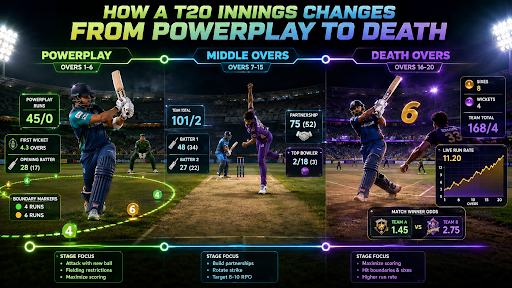
The powerplay is the early part of a limited-overs innings. Fielding restrictions often give batters more room to attack, but the new ball can also help fast bowlers.
Markets connected to this period include:
- Powerplay total runs
- First wicket partnership
- Wickets lost in the powerplay
- First wicket taker
- Opening batter runs
The Middle Overs: Control, Spin and Partnerships
In the middle overs, teams often use spin bowlers and try to control the run rate. Batters may focus on keeping wickets in hand while rotating the strike.
This stage can affect team totals, player runs, partnerships, and top-bowler markets.
For example, a team at 79/2 after 10 overs may still be in a strong position if its best batters are settled and strong finishers remain.
The Death Overs: Late Boundaries and Pressure Bowling
The death overs are the final overs of a limited-overs innings. Batters usually attack more, while bowlers use yorkers, slower balls, and other variations.
This stage can sharply affect:
- Team total runs
- Match total runs
- Sixes markets
- Bowler wicket markets
- Live match-winner odds
A team at 126/3 after 15 overs may finish above 180 if established batters stay in. If wickets fall quickly, it may struggle to cross 160.
Live Cricket Betting: Look Beyond the Score
Live cricket betting allows you to bet after the match starts. Odds will change with every wicket, boundary, over, weather delay, and change in match conditions.
Do not make a decision based only on the score.
A Simple Chase Checklist
Imagine India needs 69 runs from 48 balls against Australia.
Imagine India needs 69 runs from 48 balls against Australia. The target may look reachable, but the score alone does not show the complete situation. Check the number of wickets remaining, whether the batters are settled, and the strength of India’s lower order.
Also consider which Australian bowlers still have overs left. If their strongest death bowlers are yet to bowl, the final overs may become more difficult. Dew, rain risk, boundary size, and the required scoring rate can also change how manageable the chase looks.
A chase that looks easy can become difficult if two wickets fall. A difficult chase can become manageable if a strong batter is settled and the weaker bowlers have overs remaining.
Rain, DLS and Bet Settlement Rules
Rain is a major factor in cricket betting because it can shorten the game or change the target.
If a limited-overs match is interrupted, the DLS method may be used to give the team batting second a revised target. The new target depends on how many overs and wickets remain.
Before placing a cricket bet, check the sportsbook’s settlement rules for:
- Rain-shortened matches
- DLS results
- No-result matches
- Abandoned matches
- Reserve days
- Super Overs
- Players who do not start
- Tied top-batter or top-bowler markets
Some markets may be void if a match does not reach a required number of overs. Other markets may still settle if the result is already clear.
Bet With Better Match Awareness
Cricket betting is easier to understand when you know how the format, odds, match conditions, and player roles work together. Whether you choose a match winner, team total, player runs, or bowling market, take time to review the toss, pitch, weather, confirmed lineups, and possible game changes. Live markets can move quickly, so avoid decisions based only on one wicket or boundary. Most importantly, set a clear budget, use sensible limits, and treat every cricket bet as entertainment.
Responsible Gambling Support
Gambling should be treated as entertainment, not as a way to earn money or recover losses. Set a clear budget and time limit before you play, and never use money needed for daily expenses. If gambling feels difficult to control, take a break, use available account limits, or seek confidential support from a responsible gambling organization.
International Center for Responsible Gaming offers research and education on gambling-related harm and responsible play.
Gamblers Anonymous provides peer-support meetings for people who want help stopping gambling.
National Council on Problem Gambling connects individuals and families with gambling education, helpline support, and treatment resources.