Online casinos never close, but they are never evenly busy either. As evening rolls across the map, a wave of player activity moves with it, changing what you encounter when you log in: which live dealer tables are staffed, how fast withdrawals clear, when bonuses drop, and how responsive the site feels. Understanding online casino time zones matters less for your odds and more for your experience.
Understanding Online Casino Time Zones
|
Do Time Zones Change Your Odds of Winning?
No. This is worth stating plainly before anything else, because it is the question underneath most of this topic.
How RNG Certification Works
Licensed slots and table games run on Random Number Generators, or RNGs. These systems are built and independently tested to produce outcomes that are statistically random and have no relationship to the clock. A slot does not loosen up at 2am, and it does not tighten at 9pm. The certified payout configuration behind a game is locked in place and only changes through a documented, regulator visible process, not in response to how many people happen to be logged in at once.
The Claim That RTP Rises During Peak Traffic
A specific claim keeps circulating: that RNGs quietly increase their return to player percentage during high traffic hours to keep more people engaged. This is not how regulated RNG games work. Return to player is a fixed, certified figure tied to a specific game configuration, tested by independent labs before release, and it cannot shift on the fly based on how busy the site is. Treat this claim as a myth rather than a strategy.
How Time Zones Create a Rolling Wave of Online Casino Activity?
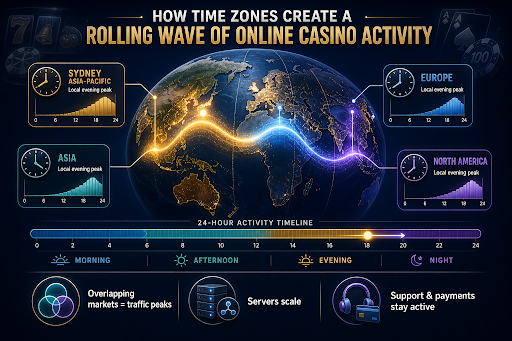
Here is the core mechanic behind online casino time zones. When it is nine in the evening in London, it is early afternoon in New York and already the next morning in Sydney. A global platform never experiences one clean daily peak the way a single time zone business would. Instead, it experiences a continuous band of activity that circles the globe as different regions move through their evenings.
This creates a few predictable effects on online casino activity by time zone. Two large markets can overlap and produce a double peak when their evenings coincide. A platform licensed primarily in one region may see a genuine quiet stretch when that region is asleep, even if players elsewhere are still active. And because support teams, payment processing, and server capacity are usually built around this rolling pattern rather than any single region’s clock, the experience of using the same platform can feel noticeably different depending on when you log in relative to your own region’s evening hours.
Typical evening leisure windows by region
The table below does not measure casino traffic data, since that would require proprietary analytics access this article does not have. It applies the general pattern already established above, a local peak roughly 4pm to 11pm and a local quiet stretch roughly 2am to 11am, against each region’s standard UTC offset. Treat it as a starting reference, not a precise operator report, and note that daylight saving shifts these figures by about an hour for part of the year in most of these regions.
| Region | Local peak window | Local quiet window | Approximate UTC peak |
| UK and Ireland | 4pm to 11pm local | 2am to 11am local | 16:00 to 23:00 UTC |
| Central Europe | 4pm to 11pm local | 2am to 11am local | 15:00 to 22:00 UTC |
| US Eastern | 4pm to 11pm local | 2am to 11am local | 21:00 to 04:00 UTC (next day) |
| US Pacific | 4pm to 11pm local | 2am to 11am local | 00:00 to 07:00 UTC (next day) |
| Australia and NZ | 4pm to 11pm local | 2am to 11am local | 06:00 to 13:00 UTC |
| South and Southeast Asia | 4pm to 11pm local | 2am to 11am local | 08:00 to 17:30 UTC (varies, region spans UTC+5:30 to UTC+8) |
| Latin America | 4pm to 11pm local | 2am to 11am local | 19:00 to 05:00 UTC (varies, region spans UTC-3 to UTC-6) |
What Actually Changes When Traffic Peaks?
None of this touches the odds, but several practical things do shift with online casino peak hours:
- Live dealer tables. Studios run staffed shifts. A language specific table, say Turkish or Hindi speaking, might only be staffed for part of the day rather than around the clock.
- Server responsiveness. Heavier traffic can mean slightly slower page loads or the occasional hiccup on live products, though this varies a great deal by operator.
- Support wait times. Chat queues generally follow the traffic wave. Off peak hours often mean a faster response, even with a smaller support team on duty.
- Withdrawal and verification speed. Manual review teams typically work business hours in the operator’s own licensing jurisdiction, not the hours of wherever you happen to be.
- Tournament and leaderboard competition. Prize pools fill faster and rankings are harder to hold onto during genuinely busy windows.
- Jackpot and drop timers. Time limited mechanics usually reset on the operator’s clock, most often UTC or the license jurisdiction’s local time, not your own.
Why Live Dealer Tables Disappear at Certain Hours?
This is one of the more confusing parts of playing across time zones. Live dealer studios are staffed operations, not always on software. Dealers work shifts, and language specific tables are scheduled around when the audience for that language is actually online. A table might run a full day cycle, or it might only live for a handful of hours tied to a specific region’s evening.
This mirrors how physical casinos schedule certain games or tables only during particular hours. The practical fix is simple: check the lobby schedule directly rather than assuming a favorite table will always be there, especially if you are logging in outside your own region’s typical evening window.
How Time Zones Affect Bonuses and Promotions?
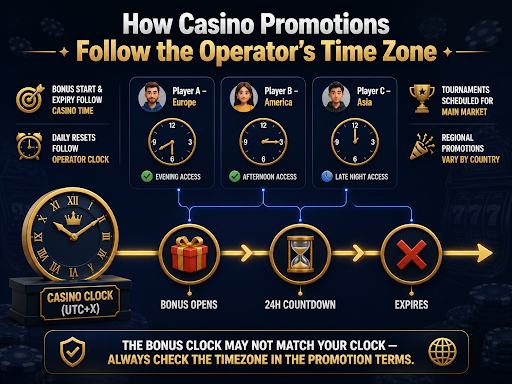
Promotional timing is one of the clearest places where the clock actually matters to a player. A “daily reload” or “Friday bonus” is set against the operator’s declared timezone, not yours. That means a promotion advertised as starting Friday could, from your perspective, actually open Thursday evening, depending on the offset.
A few things worth checking in the terms before assuming a promo window: what timezone a “daily reset” or expiry is measured against, whether a 48 hour expiry counts from when a bonus was credited or claimed, and which calendar the operator uses to define a “weekend” bonus window.
Tournaments follow the same logic. A leaderboard event is usually built around a primary market’s evening hours, which can leave players in other regions competing at an inconvenient time relative to their own schedule. Holiday calendars add another layer too, since operators often run separate promotional pushes around regional holidays rather than a single global calendar.
One more wrinkle worth knowing: crypto deposits do not care about banking hours, since blockchain confirmation is not tied to a business day. But network congestion still follows human activity patterns, and manual withdrawal review is still handled by people working specific hours, so a fast payment rail does not guarantee an instant review process behind it.
Reading a promo terms clock
| Term as written | What it usually means | What to check |
| “Daily reload from 00:00” | Operator local time or UTC, not the player’s local time | The timezone declaration in the terms and conditions |
| “48 hour expiry” | Counted from when the bonus was credited, not from when it was claimed | The exact timestamp in your account history |
| “Weekend bonus” | The operator’s own calendar weekend, which may open earlier than expected | Which hour on Friday the window actually opens |
Does Playing at Night Actually Affect Your Results?
This is the part of the topic that matters most for the player rather than the platform.
Fatigue and Decision Quality
Playing while tired affects judgment the same way it affects any other decision making task. A late night session after a long day is a different mental state than a clear headed afternoon, even though the game itself is identical either way.
Why Online Play Loses Track of Time
A physical venue has closing times and other environmental cues that naturally signal a session should wrap up. Online, none of that exists by default, which is exactly why time limit tools exist in the first place.
When Habit Becomes a Pattern
A few questions worth asking yourself honestly: are sessions landing in the same window most days? Does play tend to start later than planned and run into what would otherwise be sleep time? Are weekend sessions consistently running longer than intended? None of these questions relate to odds. They relate to whether a flexible, occasional activity is quietly turning into a fixed routine.
Setting Time Limits Across Time Zones
Most licensed operators offer built in tools for exactly this, usually found in an account’s responsible gambling section:
- Session limits, which cap a single sitting
- Daily or weekly limits, which cap cumulative play over a longer window
- Reality check reminders, which simply surface how long a session has actually run
A useful asymmetry to know: reducing a limit typically takes effect immediately, while increasing one often triggers a cooling off period, intentional friction designed to prevent an impulsive decision from taking effect right away.
There is also a trap specific to this topic. Because limits and self exclusion periods generally reset on the operator’s clock rather than the player’s, someone playing from a region eight hours offset might find their “daily” limit resets in the middle of their own afternoon rather than at midnight where they are. It is worth checking this directly in account settings rather than assuming.
Pairing a time limit with a deposit or loss limit tends to work better than relying on either alone, since time and money are the two levers that matter most in keeping a session within its intended bounds.
What Is the Best Time to Play Online Casino Games?
There is no single universal answer, because “best” depends entirely on what you are optimizing for, not on odds. A few common myths are worth clearing up first: a win is not “due” after a losing streak, since RNG outcomes have no memory of previous spins. Casinos do not pay out more on payday. And early morning play does not carry better odds just because fewer people are online, even though it might mean shorter queues for support or a quieter live table.
With those out of the way, here is a more useful way to think about the best time to play online easy casino games, based on what you actually want out of a session.
Goal based timing
| Your goal | Best window | Why |
| Fastest support response | Off peak hours in your operator’s primary market | Chat queues shrink outside the traffic wave, even with a smaller team on duty |
| Fullest live dealer lobby | Local evening hours | Language specific tables are typically staffed during their audience’s peak hours |
| Lowest tournament competition | Outside your operator’s primary market’s peak evening window | Leaderboards fill fastest when the primary market is online |
| Fastest withdrawal processing | Business hours in the operator’s licensing jurisdiction | Manual review teams work those hours, not the player’s local hours |
| Best server performance | Off peak hours generally | Less concurrent load means fewer slowdowns on live products |
| Clearest decision making | Whenever you are rested, regardless of clock time | Fatigue affects judgment the same way at any hour |
This same logic extends to picking days, not just hours. If you are weighing the best days to go to a casino, whether online or in person, weekday sessions tend to be shorter, more predictable, and less crowded, while weekends bring longer, less structured windows that are easier to let run past what was originally intended.
Playing on Your Clock, Not Theirs
Most of what feels confusing about online casino activity by time zone comes down to one simple fact: you and the platform are usually not on the same clock. Knowing your own offset from the operator’s declared timezone explains bonus timing, limit resets, table availability, and support hours all at once. It will not change your odds on any given spin, but it will change how smoothly a session runs, and whether the best time to play online casino games ends up being a matter of convenience or a matter of habit you did not quite plan for.
This article is for informational purposes only. Online gambling is 18+ (21+ in some regions), and availability depends on local laws. If gambling stops feeling fun, free support is available through organizations such as the National Council on Problem Gambling or GambleAware.