If you’ve already decided to play at a no KYC casino, there are real mechanics worth understanding before that first deposit clears. Getting into a casino without knowing why the model works the way it does, or where its limits actually sit, sets you up for confusion the moment a large withdrawal behaves differently than a small one. This blog breaks down both practical steps from signup to payout, and the genuine economic and regulatory forces shaping this corner of iGaming right now. We’ll also get specific about where the “no KYC” label holds up and where it quietly doesn’t, since 2026 has brought real regulatory pressure that’s changing how these platforms operate.
The No KYC Snapshot
|
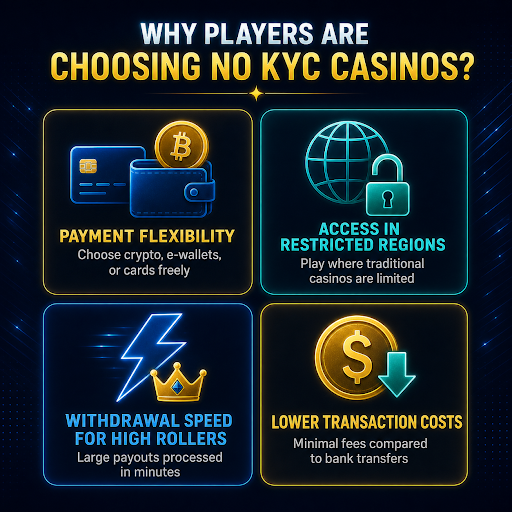
Why Players Are Choosing No KYC Casinos?
The appeal of a no KYC crypto casino isn’t really about disliking forms, it’s a response to specific structural frictions that fiat platforms and even some KYC-based crypto sites still carry. Independent testing and player community data from 2025 and 2026 point to a consistent set of drivers, and each one holds up under scrutiny differently.
Payment Flexibility
Platforms operating under the no KYC model routinely support a wide spread of coins, letting players deposit whatever they already hold instead of converting into a single accepted currency first. This matters in practice because conversion between coins usually carries a spread cost, and skipping that step preserves more of a player’s original deposit. Community feedback on several no KYC platforms consistently cites BTC, ETH, and LTC support as standard, with average withdrawal times reported under 10 minutes by real users sharing their own cash-out experiences.
Access in Restricted Regions
In markets where local banks block gambling related transactions outright, or where currency controls limit how much money can leave the country through standard channels, crypto rails function as one of the only practical routes into online gambling at all. A no KYC crypto casino removes the intermediary bank from that equation entirely, which explains why adoption tends to run higher in regions with tighter banking oversight compared to markets with open financial access.
Withdrawal Speed for High Rollers
Traditional platforms often slow down precisely when withdrawal amounts get large, since that’s exactly when internal compliance teams start asking questions. Live testing across major instant withdrawal casinos in 2026 found payout speeds varying dramatically, with one operator processing a withdrawal in roughly 3 seconds while another took nearly 48 hours for a comparable amount. That gap is the entire reason high rollers gravitate toward platforms with a documented track record of fast large-withdrawal processing rather than trusting marketing claims alone.
Lower Transaction Costs Vs Fiat Casinos
Crypto transactions typically avoid the currency conversion fees, wire transfer charges, and multi-day processing delays that come with fiat banking. Standard crypto withdrawals across the sector are commonly reported in the 1 to 24 hour range once approved, compared to the 3 to 7 business days banks often require for equivalent fiat transfers. A no KYC crypto casino inherits that cost and speed advantage automatically, and it compounds meaningfully for players who withdraw frequently.
How to Use a No KYC Crypto Casino Step by Step?
Getting started with a no KYC crypto casino is designed to be fast, but a few decisions early on determine whether the experience stays smooth through to withdrawal.
Choosing a Reliable Platform
Start by checking whether the platform holds any gambling licence at all, even an offshore one, since unlicensed operators have no regulatory body forcing them to honor a disputed payout. Read the withdrawal section of the terms of service specifically, because that’s usually where a casino discloses the dollar threshold that can trigger a verification request later.
Setting Up a Wallet or Email Signup
Registration on a genuine no KYC crypto casino should take well under two minutes based on documented signup flows across major platforms. An email address or a connected crypto wallet is typically the entire form, no phone verification step, no document upload, no waiting screen. If a platform’s signup process includes anything beyond that, it’s worth questioning how strictly it actually follows the no KYC model it’s advertising.
Making Your First Crypto Deposit
Once registered, deposit using a supported cryptocurrency, commonly BTC, ETH, USDT, or LTC across most platforms in this space. Using the same wallet address consistently for both deposits and withdrawals is worth doing deliberately, since mismatched addresses between the two are one of the most frequently cited triggers for an unexpected verification request. Claim a welcome bonus at this stage if one’s available, since most offers activate automatically once the deposit clears blockchain confirmation.
Playing and Withdrawing Without ID
From here, gameplay opens up immediately across slots, live tables, or crash games, with no waiting period tied to account review under normal circumstances. Withdrawals on a genuinely reliable no KYC crypto casino for standard amounts often clear within minutes to a few hours, based on the 1 to 24 hour range reported across the sector for approved crypto payouts. Larger withdrawals are where the model gets tested, which the next section covers directly.
No forms, no waiting, just connect a wallet and start playing at Twinqo in under a minute.
Risks and Limits to Understand
A no KYC crypto casino sounds simple on paper, but the actual mechanics behind that label carry real limitations that 2026’s regulatory shift has made more relevant, not less.
| Read the fine print before depositing anything significant. Most platforms advertising zero KYC actually mean no verification at signup, not zero verification ever. |
Surprise KYC After Big Wins
Common triggers that flip on identity checks include withdrawal thresholds often sitting between $2,000 and $10,000 dollars, unusual betting patterns, bonus abuse flags, and mismatched wallet addresses between deposits and withdrawals. Once triggered, withdrawals get held until verification completes, and live testing across the sector shows this process can stretch from a few hours to nearly 48 hours depending entirely on the operator’s internal review speed.
Frozen or Denied Withdrawals
If a player can’t or won’t provide requested ID after a trigger, the casino can deny the withdrawal outright and retain the deposit, since lightly licensed offshore operators often have no regulator forcing a payout on disputed claims. The global gambling industry paid roughly $184.4 million in regulatory fines in 2024 alone tied specifically to KYC and AML failures, a figure that signals just how seriously enforcement bodies now treat verification gaps.
Some no KYC operators have withheld significant sums indefinitely under vague “security review” language, a pattern documented across multiple industry comparisons of platforms with poor payout reliability.
Regulatory Tightening
The regulatory environment shifted meaningfully in April 2026, when a U.S. regulator published its most consequential anti-money-laundering rulemaking in decades, explicitly extending Bank Secrecy Act obligations to cover crypto-accepting gambling operations for the first time. That proposal targets the structural weaknesses baked into no-KYC business models directly, rather than chasing isolated low-value violations, and it exposes operators to both federal AML liability and state-level enforcement for unlicensed activity simultaneously.
Regional compliance rules add a parallel layer for operators serving players in other markets, and even offshore-licensed casinos based in lighter-touch jurisdictions face growing scrutiny under this tightening framework.
Operator-Side Risk
From the operator’s side, genuine zero-verification is essentially untenable long-term. Off-ramp partners, meaning the exchanges or banks that convert crypto into usable fiat, run their own AML checks and freeze untraceable flows regardless of what the casino itself requires internally. As licensing bodies increasingly mandate AML controls as a condition of renewal, platforms with zero verification become natural targets for launderers and fraudsters, raising operational risk the casino ultimately has to absorb somehow.
Play Freely, No Paperwork Attached
A no KYC crypto casino works best when expectations match reality: fast signup, quick standard withdrawals, and the understanding that verification can still surface once a payout crosses a platform’s own risk threshold. No forms, no waiting, just connect a wallet and start playing in under a minute, with crash games, live tables, and thousands of slots ready the moment your deposit clears.