The German Super League T10 is a domestic ten-over cricket competition organised by the Deutscher Cricket Bund, Germany’s national cricket federation, and staged across separate city legs rather than one continuous season. In 2026, the format ran through Berlin, Hamburg, and Frankfurt, each hosting roughly two weeks of ten-club, forty-three-match action built around local cricket clubs instead of imported franchise rosters. Reading German Super League T10 odds correctly across each regional leg is the first real step toward placing an informed bet.
Germany’s Regional T10 Betting Landscape
|
What Is German Super League T10 Betting?
German Super League T10 betting means placing wagers on outcomes within the GSL, Germany’s domestic ten-overs-a-side cricket competition run by the Deutscher Cricket Bund across separate regional editions rather than one continuous season. That covers everything from picking a match winner to backing an individual batter’s run total or a bowler’s wicket haul within a single fixture.
What sets this apart is the source of the action itself. GSL fixtures are contested by established amateur and semi-professional German clubs, not recruited international stars, competing in short, region-specific windows like Berlin, Hamburg, Frankfurt, or North Rhine-Westphalia. That changes how research works too, form has to be read within one edition’s group stage, since clubs in different regions never actually play each other.
The format also shapes the betting itself. A full ten-over fixture wraps up in around ninety minutes, compressing the window toward faster-resolving pre-match and live markets alike.
How Did a Decade of Domestic Growth Lead to the German Super League?
Cricket in Germany traces back to 1912, when a first version of the DCB formed but didn’t survive. The modern federation was established in 1988, joining the ICC as an Affiliate Member in 1991 and Associate Member in 1999.
Growth since then has been steady: the DCB now oversees six regional associations, over 100 clubs, and close to 3,000 registered players, driven largely by migration from cricket-playing nations and expanding junior programmes.
That growth is what made a competition like the GSL viable. Running on a modest budget of roughly €220,000 a year, mostly from ICC grants, the DCB built its first branded T10 league in 2026 around existing clubs rather than costly city franchises, matching the scale of the domestic base it actually had.
Which Clubs Competed, and Who Won Each Leg in German Super League
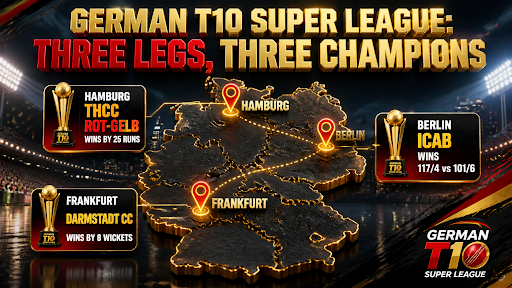
All three regional legs listed here have finished. Here’s the final club lineup for each, plus the confirmed champion.
Berlin leg (Maifeld, June 8-19, completed): BSC Rehberge, Internationale Cricket-Akademie Berlin, Berlin CC, Berliner Sportverein, Berlin Cricket Academy, USG Chemnitz, SG Einheit Halle, Rugby Cricket Dresden, SC Naumburg, Berlin Eagles CC.
Winner: Internationale Cricket-Akademie Berlin (ICAB), who beat BSC Rehberge in the final, posting 117/4 against Rehberge’s 101/6.
Hamburg leg (July 20-31, completed): THCC Rot-Gelb Hamburg, VfB Fallersleben, SG Findorff, MTV Herrenhausen, VfB Oldenburg, United XI Jägerhof, Kummerfelder Sportverein, Masroor Sports Club, Harburger Turnerbund, Moorburger Turn und Sportverein.
Winner: THCC Rot-Gelb Hamburg, who beat VFB Fallersleben in the final by 25 runs, scoring 160/3 to Fallersleben’s 135/9.
Frankfurt leg (August 11-22, completed): FCA United Stars, Darmstadt CC, Darmstadt Sultans, SKG Erfelden Strikers, HCA Royals, SV Wiesbaden Hawks, FCC White, FC Germania Gustavsburg, MSC Frankfurt, FC Alsbach.
Winner: Darmstadt CC, who chased down FCA United Stars’ 120/7 in just 4.5 overs, finishing at 123/2 for an 8-wicket win in the final.
How Do Decimal, American, and Fractional Odds Work in Ten-Over Cricket?
Cricket odds boards typically display the same underlying price in one of three formats, and understanding the conversion between them matters more in a fast-moving ten-over match, where lines can shift quickly between overs. To illustrate, consider a purely hypothetical Berlin-leg fixture between Berlin Eagles CC and SC Naumburg, with Berlin Eagles priced as the modest favourite. None of the figures below reflect an actual posted line for either club.
| Club | Decimal | American | Fractional |
| Berlin Eagles CC | 1.70 | -145 | 7/10 |
| SC Naumburg | 2.30 | +130 | 13/10 |
Decimal Odds
Decimal odds show the total payout, stake included, for every single unit wagered. A decimal price is simply multiplied against the stake to get the full return.
Decimal example: Picture placing 100 units on Berlin Eagles CC at a decimal price of 1.70. If they win, the sportsbook returns 170 units in total, which breaks down as your original 100-unit stake plus 70 units of clear profit. Now flip to Naumburg at 2.30. The same 100-unit stake returns 230 units total if the underdog pulls off the win, meaning 130 units of profit. The decimal figure always represents your full return per single unit staked, stake included, which makes it the easiest format for quickly estimating a payout without any extra arithmetic beyond one multiplication.
American Odds
American odds use a plus or minus sign against a fixed 100-unit benchmark. A minus figure shows how much must be staked to profit 100 units, while a plus figure shows how much profit a 100-unit stake would earn.
American example: This format anchors everything to a 100-unit reference point rather than showing a direct multiplier. Berlin Eagles CC at -145 tells you the favourite requires a larger outlay relative to the profit on offer, specifically that a bettor must stake 145 units just to walk away with 100 units of profit if the pick wins. Naumburg at +130 works the other way around, since the underdog tag means a smaller 100-unit stake already nets 130 units of profit on a successful bet. The minus and plus signs immediately tell you which side is favoured before you even look at the size of the numbers.
Fractional Odds
Fractional odds write profit as a ratio against the stake, separated by a slash, showing how many units of profit are earned for every set number of units risked.
Fractional example: Fractional odds express the same relationship as a ratio written against your stake, separated by a slash. Berlin Eagles CC at 7/10 means that for every 10 units risked, a winning bet profits 7 units, so a 100-unit stake nets exactly 70 units of profit, matching the decimal and American figures precisely. Naumburg at 13/10 means every 10 units risked profits of 13 units, so the same 100-unit stake would return 130 units of profit if the underdog wins, again identical to the other two formats once converted.
Here’s the full markets section, combined with the table and all 13 individual explanations, ready to drop into the document as one complete block.
What Betting Markets Suit a Ten-Over Format?
The compressed nature of a ten-over match still supports a wide spread of betting markets, from simple pre-match wagers to rapid over-by-over live bets, even though some phase-specific lines common in longer formats carry less meaning once an entire innings lasts only ten overs. Anyone learning to bet on cricket for the first time will find this format’s market spread more approachable than a full T20 or Test board, simply because there’s less time for a match to develop.
| Market | Category | What It Covers |
| 2-Way Match Winner | Pre-Match | Which club wins the fixture outright, with a Super Over deciding ties |
| Toss Winner | Pre-Match | A near-even wager on which captain wins the coin toss |
| Match Handicap (Runs/Wickets) | Pre-Match | Betting on a team with a virtual scoring advantage or disadvantage applied to their final total |
| Runs off Next Delivery | Live In-Play | Whether a specific upcoming ball scores above or below a tiny threshold, such as 1.5 runs |
| Next Over Total Runs | Live In-Play | An Over/Under line on how many runs the next six-ball sequence produces |
| Over Runs (Odd/Even) | Live In-Play | Whether a specific over’s combined total finishes as an odd or even number |
| Method of Next Dismissal | Live In-Play | How the batter currently at the crease will get out, whether caught, bowled, LBW, or run out |
| Total Match Sixes/Fours | Team Totals | Whether the combined boundary count across both innings lands above or below a posted line |
| Fall of First Wicket (Over/Under) | Team Totals | How many total runs will be on the board before a team loses its first wicket |
| Total Team Wickets | Team Totals | How many batters a bowling side dismisses across the opposition’s innings |
| Top Team Batsman | Player Props | Which player on a selected roster scores the most runs in the match |
| Top Team Bowler | Player Props | Which bowler on a selected roster takes the most wickets in the match |
| Batter Total Match Runs | Player Props | An Over/Under line on a specific batter’s individual run total for the match |
2-Way Match Winner
This market asks which of the two competing clubs wins the fixture outright, with no draw outcome available since a tied result in T10 immediately triggers a Super Over. It settles the moment both ten-over innings are complete and one side has posted the higher total. For example, a bettor backing Darmstadt CC against FCA United Stars wins this bet the instant Darmstadt’s final score exceeds their opponent’s, whether the winning margin ends up being a single run or fifty runs.
Toss Winner
This is close to a genuine coin-flip market, asking simply which team’s captain wins the pre-match toss and gets to choose whether to bat or field first. Neither captain has any real skill-based influence over the outcome, which keeps this market’s pricing close to even odds regardless of either club’s form or reputation. For example, if Berlin Eagles CC’s captain correctly calls the coin toss before facing SC Naumburg, any wager placed on Berlin Eagles to win the toss settles as a winner immediately, before a single ball is bowled.
Match Handicap (Runs/Wickets)
This market applies a virtual scoring adjustment to one team, either a runs deficit or a wickets disadvantage, before the match begins, letting bettors back a strong favourite at a more appealing price or support an underdog with a built-in cushion. It’s especially useful in T10 given how quickly a heavy favourite can otherwise price out casual bettors. For example, a handicap giving Darmstadt CC a virtual minus-15-run adjustment against FCA United Stars means the bet only pays out if Darmstadt’s actual winning margin exceeds 15 runs.
Runs off Next Delivery
This live market zooms in on a single upcoming ball, asking whether it produces more or fewer runs than a tiny posted threshold, often set around 1.5 runs. It’s one of the fastest-resolving bets available in cricket, settling within seconds of the delivery being bowled. For example, if the line for the next ball is set at Over/Under 1.5 runs and the batter strikes it for a boundary worth four runs, any Over bet settles as an immediate winner the moment that delivery is completed.
Next Over Total Runs
This market extends the same short-window logic across a full six-ball over rather than a single delivery, asking whether the combined runs scored in that over land above or below a set line. Because T10 batters accelerate early, these totals can swing dramatically between consecutive overs. For example, a line set at Over/Under 9.5 runs for an upcoming over settles as an Over if the batting side scores 10 runs or more off those six balls, and as an Under at 9 runs or fewer.
Over Runs (Odd/Even)
This market strips away the specific total-count question and instead asks only whether a given over’s combined runs finish as an odd or even number, a simple binary outcome independent of how large or small the total actually is. It functions almost like a coin-flip market layered on top of live cricket action. For example, if a bowler concedes exactly 7 runs across an over, any Odd bet on that over settles as a winner, while an Even bet on the same over would lose.
Method of Next Dismissal
This market asks specifically how the batter currently facing the bowling will lose his wicket, choosing between options such as caught, bowled, leg before wicket, or run out. Only the exact specified method settles the bet as a winner, regardless of how unexpectedly or quickly the dismissal happens. For example, a wager on the next dismissal being bowled only pays out if the batter’s stumps are actually struck, so if he’s instead caught in the outfield attempting a big shot, that same bet loses.
Total Match Sixes/Fours
This market combines the boundary count from both teams’ innings into a single number, and bettors wager on whether that combined total lands above or below the posted line. Because ten-over batting relies heavily on boundary-hitting rather than accumulated singles, this total tends to run proportionally higher relative to overall scoring than in longer formats. For example, a combined sixes-and-fours line set at 18.5 across a full match settles as an Over if both teams together hit 19 or more boundaries, and as an Under at 18 or fewer.
Fall of First Wicket (Over/Under)
This market asks how many total runs a team posts on the scoreboard before its opening partnership is broken by the first wicket. It matters more in T10 than in longer formats, since an early dismissal eats into a much smaller pool of just sixty available deliveries. For example, a line set at 22.5 runs for THCC Rot-Gelb Hamburg’s innings settles as an Over if their opening pair adds 23 runs or more before either batter is dismissed, and as an Under at 22 runs or fewer.
Total Team Wickets
This market asks how many of the ten possible batters a bowling side actually dismisses across the opposition’s full ten-over innings, independent of the eventual match result. Because T10 bowlers only get one or two overs each, defending wickets under immediate pressure becomes a bigger factor than in longer formats. For example, a Total Team Wickets line set at 4.5 for a bowling side settles as an Over if they take 5 or more wickets during that innings, and as an Under at 4 or fewer.
Top Team Batsman
This market asks which named player on a selected club’s roster finishes the match with the highest individual run total, regardless of whether that player’s team actually wins the game. It settles purely on individual scoring output compared against teammates, not opponents. For example, if a named opening batter for Berlin Eagles CC finishes with the highest score among his own teammates in a given fixture, any wager placed on him for Top Team Batsman settles as a winner, even if Berlin Eagles loses the match overall.
Top Team Bowler
This market mirrors Top Team Batsman but focuses on wickets taken rather than runs scored, asking which named bowler on a selected roster finishes with the most dismissals credited to his name during the match. Since T20 or T10 bowlers are capped at a small number of overs each, this market can carry noticeable variance. For example, a named FCA United Stars bowler taking three wickets across his allotted overs would settle any Top Team Bowler wager on him as a winner, provided no teammate matched or exceeded that total.
Batter Total Match Runs
This market assigns a specific numerical line to one named batter’s individual run total for the entire match, and bettors wager on whether his actual score lands above or below that number. It isolates a single player’s output completely from the team result or any other batter’s performance. For example, a Batter Total Match Runs line set at Over/Under 21.5 for a named Berlin Eagles CC opener settles as an Over if he finishes with 22 runs or more, and as an Under if he’s dismissed or the innings ends with him on 21 or fewer.
Upcoming NRW Edition Matches: Predictions of German Super League 10
Unlike the earlier Berlin, Hamburg, and Frankfurt legs of the 2026 German Super League, which each fielded ten clubs, the North Rhine-Westphalia edition uses a smaller eight-club format split into two groups of four.
Group A features Westfalen Royals, Düsseldorf Blackcaps, SC Krefeld, and DJK Germania Lenkerbeck. Group B features VfB 09/13 Gelsenkirchen, TV & TBV Lemgo, Aachen Rising Stars, and Cricket Club Köln.
What Matches Are Coming Up?
| Date | Time | Match | Group |
| Sept 4, 2026 | 10:00 | Westfalen Royals vs Düsseldorf Blackcaps | A |
| Sept 4, 2026 | 12:00 | Düsseldorf Blackcaps vs SC Krefeld | A |
| Sept 4, 2026 | 14:00 | Westfalen Royals vs DJK Germania Lenkerbeck | A |
| Sept 4, 2026 | 16:00 | Düsseldorf Blackcaps vs DJK Germania Lenkerbeck | A |
| Sept 5, 2026 | 08:00 | VfB 09/13 Gelsenkirchen vs TV & TBV Lemgo | B |
| Sept 5, 2026 | 10:00 | VfB 09/13 Gelsenkirchen vs Aachen Rising Stars | B |
| Sept 5, 2026 | 12:00 | Cricket Club Köln vs TV & TBV Lemgo | B |
| Sept 5, 2026 | 14:00 | TV & TBV Lemgo vs Aachen Rising Stars | B |
| Sept 5, 2026 | 16:00 | Cricket Club Köln vs Aachen Rising Stars | B |
Times listed are local German time (CEST). Remaining group matches beyond September 5 will follow, with the group stage concluding September 9.
Who Are the Favourites in Group A?
Düsseldorf Blackcaps hold the strongest institutional pedigree in this leg, with six NRW league titles and a 2017 German Bundesliga championship, giving them a clear depth advantage.
SC Krefeld and DJK Germania Lenkerbeck have a documented rivalry, and history favours Lenkerbeck, having won two prior meetings.
Westfalen Royals enter with real momentum after a dominant tournament-opening win over Moers Cricket Club, making them a confident dark horse rather than a clear underdog.
Who Are the Favourites in Group B?
VfB 09/13 Gelsenkirchen enters with the clearest recent-form edge, having defeated Aachen Rising Stars by 9 wickets in a documented prior meeting. TV & TBV Lemgo and Cricket Club Köln remain the group’s wildcards, entering without a clear historical edge over each other, which makes their head-to-head matchups some of the most open fixtures of this group stage.
How Should Bettors Read Form Across the German Super League’s Regional Editions?
The German Super League doesn’t run as one continuous season with a single table. Instead, the DCB (Deutscher Cricket Bund) splits it into four standalone regional editions, Berlin, Hamburg, Frankfurt, and North Rhine-Westphalia, each with its own group stage and its own set of clubs. That structure changes how form should actually be read.
Why Form Doesn’t Carry Over Between Editions
Each edition is a closed bracket. The clubs competing in Berlin never play the clubs competing in NRW, so there’s no shared result linking the two groups together.
This creates a real problem for tracking team form across the season:
- No common opponents: a club’s strong run in Berlin says almost nothing about how a completely different set of clubs will perform months later in NRW, since neither group ever meets the other.
- Time gaps between editions: several weeks can pass between one regional edition ending and the next beginning, and squad availability, fitness, and match sharpness can all shift in that gap.
- Same club, different results leg to leg: a club that dominates its group in one edition can look completely different in another, since pitch conditions, travel, and the specific mix of rival clubs in that regional bracket all vary. A team’s identity doesn’t change, but its actual on-field performance can swing noticeably from one leg to the next.
A concrete example makes this clear. Darmstadt CC’s strong results in the Frankfurt edition have no direct bearing on how Aachen Rising Stars or Westfalen Royals perform in the NRW group, because the two sets of clubs are competing in entirely separate brackets that never intersect, and even Darmstadt CC itself could look sharper or shakier once it faces a new set of rivals in a future edition.
Where Form Tracking Actually Works: Individual Players
Team form resets with every new edition, but individual player form doesn’t have to. The DCB maintains official season-long statistics that span all four 2026 regional editions rather than resetting per edition, covering:
- Total runs scored across the full season, with Ahmed Hamid Warda of SGF currently leading with 392 runs.
- Wicket-taking totals using the same combined, season-wide scope.
- Fielding contributions, including catches and run-outs, across all editions.
- Overall player rankings, blending batting, bowling, and fielding into a single performance view.
A batter or bowler who sits near the top of these combined statistics has been performing consistently regardless of which regional group he’s playing in, which makes individual form the more reliable signal across editions.
The Practical Rule for Bettors
Split form reading into two separate questions, and answer each one differently:
- For individual player performance, lean on the season-long combined statistics, since that data holds up across editions.
- For team-level questions, like which club is currently the strongest side, stay inside a single edition. Clubs play a tight run of matches against the same rivals within a short ten-to-twelve-day window, and that self-contained set of results is the only fair basis for comparing team form, precisely because the same club can play very differently from one regional leg to the next.
How Is T10 Betting Actually Different From T20 Betting?
Betting on ten-over cricket isn’t just watching a shorter version of a T20 match, the compressed structure changes how odds behave and what a sportsbook can realistically offer. The core reason comes down to sheer volume of data per fixture: a T20 match gives bettors 240 total deliveries to work with across both innings, while a T10 match gives only 120. That gap shows up in several concrete ways once you’re actually placing wagers rather than just watching:
- Odds move faster and more sharply. With half the deliveries available to absorb a shock, a single boundary or wicket shifts live win probability more dramatically in T10 than the same event would in a T20 match, since there’s proportionally less game left for a team to recover.
- Phase-specific markets shrink. T20 sportsbooks commonly split lines into powerplay, middle-overs, and death-overs markets. A ten-over innings barely has room for one meaningful phase distinction, so books typically offer fewer granular in-play markets, which is why a separate powerplay-runs line rarely appears on a T10 board.
- In-play betting windows are shorter. A full T10 fixture, both innings combined, often wraps up in around ninety minutes versus roughly three hours for T20, leaving live bettors far less time to react between decision points before the match ends outright.
- Variance per bet tends to run higher. Because fewer deliveries decide the outcome, a single over carries disproportionate statistical weight, which is part of why T10 totals and prop markets often show wider swings from the pre-match line than their T20 equivalents.
- Chase difficulty escalates faster. A target of 90 or more in ten overs demands a run rate that would be considered exceptional across a full T20 innings, so in-play prices on a chasing side can crash or spike more abruptly than in longer formats.
The underlying markets themselves aren’t fundamentally different, Match Winner, Total Runs, Total Sixes, and Player of the Match all exist in both formats, but the compressed structure changes how sportsbooks price them and how much time bettors realistically have to act on new information before a match is already decided.
Betting Disclaimer
This content is for informational purposes only and does not constitute betting advice or a guarantee of any match outcome. You must be 18 years or older (or the legal gambling age in your jurisdiction, if higher) to participate in sports betting, and betting is void where prohibited by local law. Past team or player performance in the German Super League does not guarantee future results, and all wagering decisions and their outcomes remain your own responsibility.
Responsible Gambling Notice
Ten-over cricket’s rapid pace and frequent match turnaround can make it easy to place bets faster than intended. Set deposit and loss limits before following a leg, take breaks between matches, and treat every wager as entertainment rather than a source of income. If gambling stops feeling enjoyable, support is available through:
- Responsible Gambling Council: offers education, prevention programs, and support resources for players and their families.
- GamCare: provides free confidential advice, support, and a dedicated helpline for anyone affected by problem gambling.
- BeGambleAware: funds free treatment and support services and offers self-assessment tools to help you understand your gambling habits.