
Two roulette tables, same rules, same bet sizes, same dealer speed, but one wheel quietly costs you almost twice as much over time simply because of a single extra pocket. That’s the reality most players never stop to consider before spinning the wheel. Understanding roulette odds reveals a game that looks like pure luck on the surface but actually runs on precise, calculable math, where every payout is set slightly below the true probability of winning, and that small gap is exactly where the house edge lives.
This guide breaks down roulette wheel odds in plain terms, compares European Roulette against its American counterpart, and shows you which bets actually make sense based on the numbers, so you can walk up to any table, or open any free online European Roulette game, with a clear picture of what you’re actually up against.
Understanding Roulette Odds Better
|
How Does the Wheel in Roulette Actually Work?
Before comparing the odds on roulette bets, it helps to understand how many pockets each wheel has. A wheel spins with numbered pockets, a ball drops in the opposite direction, and players bet on where it lands before the dealer calls “no more bets.” Numbers 1 through 36 alternate between red and black in a pattern designed to keep colors evenly distributed around the wheel, and then there’s the green zero, or zeros, that quietly tip the math in the house’s favor on every single spin.
There are two main variants worth knowing well, along with a third that’s less common but worth understanding.
- European Roulette online game uses 37 pockets, numbers 1 to 36 plus a single 0, and carries a house edge of 2.7%.
- American Roulette adds a second green pocket, the notorious 00, bringing the total to 38 pockets and pushing the house edge up to 5.26%.
- French Roulette, meanwhile, typically uses the same single-zero wheel as the European version but adds specific rules that can lower the effective house edge even further on certain bets.
Why Does Roulette Wheel Layout Matters?
The physical layout also affects how the game feels, even if it doesn’t change your odds directly.
- European wheels arrange numbers to distribute red, black, odd, and even values as evenly as possible around the circumference.
- American wheels use a different arrangement, partly because the extra 00 pocket requires a different balancing approach.
- Neither layout changes probability, but understanding it helps if you ever watch a live dealer table.
- If you want a deeper breakdown of table layout differences, our dedicated guide on American Roulette covers this in more detail.
Roulette Odds Explained: Why Payouts Never Match Probability
Here’s the mechanic behind every casino’s edge, and once you understand it, the entire game makes a lot more sense. On a European wheel, a straight-up bet on one number has a 1-in-37 chance of hitting, roughly 2.7%. If payouts matched true odds exactly, a win would pay 36 to 1, meaning your original stake plus 36 times that amount. Instead, the house pays 35 to 1. That one-unit shortfall, repeated across every single bet type on the table, is where the house edge actually comes from.
The same principle applies on the American wheel, just with a bigger gap. A straight-up bet there wins 1 in 38 times, about 2.63%, but still only pays 35 to 1, creating the larger 5.26% edge.
What Does “House Edge” Actually Mean?
- A 2.7% house edge doesn’t mean you’ll lose exactly 2.7% of every bet you place.
- It means that, averaged across a large number of spins, the casino keeps 2.7% of all money wagered over time.
- Any single session can swing wildly in either direction since roulette outcomes are independent spin to spin.
- The long-run average always trends toward that built-in percentage, regardless of short-term results.
Roulette Odds Chart: Payouts vs Probability
| Bet Type | Payout | European Probability | American Probability |
| Straight-up (1 number) | 35:1 | 2.70% | 2.63% |
| Split (2 numbers) | 17:1 | 5.41% | 5.26% |
| Street (3 numbers) | 11:1 | 8.11% | 7.89% |
| Corner (4 numbers) | 8:1 | 10.81% | 10.53% |
| Six Line (6 numbers) | 5:1 | 16.22% | 15.79% |
| Dozen or Column (12 numbers) | 2:1 | 32.43% | 31.58% |
| Red/Black, Odd/Even, High/Low (18 numbers) | 1:1 | 48.65% | 47.37% |
The payouts shown here are generally the same on both wheels. European roulette odds of winning are higher because each bet has one fewer pocket to lose to.
European Roulette vs American vs French: The Numbers That Matter
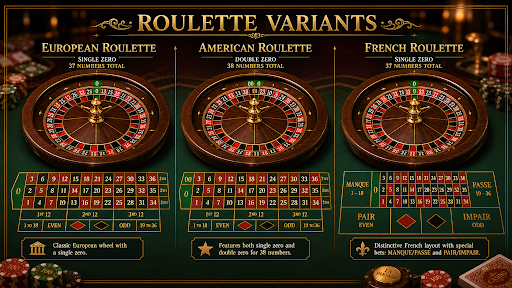
The core difference comes down to that one extra pocket, but the downstream effects are significant enough to shape an entire session’s outcome. French Roulette adds a third option into the mix, since it typically shares the same single-zero wheel as European Roulette but layers on rules that can push the house edge even lower on specific bets.
| Feature | European Roulette | American Roulette | French Roulette |
| Total pockets | 37 | 38 | 37 |
| Zero pockets | Single 0 | 0 and 00 | Single 0 |
| House edge | 2.70% | 5.26% | 1.35% (even-money bets with La Partage/En Prison) |
| Return to player | 97.30% | 94.74% | 98.65% (on even-money bets) |
| Even-money bet odds | 48.65% | 47.37% | 48.65% |
Why Does This Difference Add Up?
- Betting $10 per spin for 100 spins on European Roulette online results in an average expected loss of around $27.
- The same bet pattern on American Roulette nearly doubles that expected loss to roughly $53.
- On French Roulette, even-money bets carry a lower expected loss than European Roulette, since La Partage or En Prison rules return or protect half your stake when the ball lands on zero.
- Neither number guarantees a specific outcome in any single session, since variance can swing results either way.
- Over a long session, the wheel and rule set you choose has real, compounding financial consequences.
If you’re weighing European vs American vs French Roulette as options, it’s worth knowing that French Roulette’s wheel and base odds are identical to European Roulette, the only difference comes from the added La Partage and En Prison rules, which specifically target even-money bets like red/black, odd/even, and high/low.
La Partage and En Prison Explained
- La Partage returns half your even-money bet if the ball lands on zero.
- En Prison lets that same bet ride into the next spin instead of being lost outright, giving you a second chance to win it back.
- Both rules only apply to standard single-zero wheels, which is why they show up on French Roulette and occasionally on European tables that offer them as an added feature.
- A French table typically shares the same 37-pocket layout as its European counterpart, just with these extra player protections built in, making it the most favorable of the three wheels when these rules are active.
Which Bets Actually Make Sense?
Your roulette winning odds depend on how many numbers a bet covers. Inside bets cover fewer numbers and win less often; outside bets cover more numbers and win more often, but pay less.
Inside Bets
- Cover fewer numbers and pay out much higher, but come with steep odds against you.
- A straight-up bet on one number pays 35 to 1 but only wins 2.7% of the time on a European wheel.
- Splits, streets, corners, and six-line bets improve your odds slightly as you cover more numbers, with payouts scaling down accordingly.
- Appeal most to players chasing bigger swings rather than steady, frequent wins.
- Often used in combination, betting on a handful of numbers at once to slightly improve win frequency while still chasing a large payout.
Outside Bets
- Lower payouts, but far more frequent wins.
- Red or black, odd or even, and high or low all pay even money and win close to 48.65% of the time on a European wheel.
- Dozens and columns split the difference, covering 12 numbers each for a 2 to 1 payout and roughly a one-in-three chance of landing.
- Suit players who want their bankroll to last longer and prefer steadier, smaller wins over rarer big payouts.
Quick Reference by Risk Level
- Safest bets: red/black, odd/even, high/low, winning nearly half the time with even-money payouts
- Balanced bets: dozens and columns, winning about one in three spins for triple your stake
- High-risk bets: straight-up, split, and street bets, offering big payouts but much lower win probability
Many experienced players combine bet types within a single spin, placing a dozen bet alongside a couple of straight-up numbers, to balance frequent smaller returns against the chance of a larger payout landing simultaneously. This doesn’t change the underlying math, the house edge remains the same regardless of how you split your stake, but it can make sessions feel more engaging.
Roulette Strategy Systems
No betting system changes the underlying house edge, but structured approaches can help manage bankroll and add discipline to your sessions.
Martingale System
- Doubles your bet after every loss, aiming to recover previous losses with one win
- Long losing streaks can escalate bets quickly and hit table limits before a win ever materializes
- Looks appealing on paper but carries real risk of a single bad run wiping out a large portion of your bankroll
Fibonacci System
- Follows a gentler progression based on the sequence 1, 1, 2, 3, 5, 8, and so on
- Offers a slower climb than Martingale but still no protection against extended losing runs
- Bets increase more conservatively after each loss and step back down the sequence after a win
- Some players find it easier to manage psychologically, though the mathematical outcome remains unchanged
Flat Betting
- Wagers the same amount every spin regardless of previous results
- Simplest and safest option for anyone who wants their bankroll to last as long as possible
- Won’t produce dramatic recovery runs, but also won’t expose you to escalating risk
- Most sustainable approach for players who prioritize longevity over chasing quick recoveries
None of these systems beat the math. They’re tools for structure and discipline, not shortcuts to guaranteed profit.
Playing a Free Online European Roulette Game
One of the easiest ways to internalize all of this math is to play a free online European Roulette game before wagering real money. Demo versions let you place inside and outside bets, watch payouts land in real time, and get a feel for how often outside bets actually win compared to the excitement, and rarity, of hitting a straight-up number.
What You Can Learn From Free Play?
- Spread bets across several numbers and track how outcomes actually play out over dozens of spins
- Experiment with dozens and columns to see how a roughly one-in-three win rate feels in practice
- Track how many spins it takes before a chosen straight-up number actually lands
- Notice how long a “cold streak” can run even on bets with close to 50% odds
- Since European Roulette game odds are already the better long-term option compared to American, practicing on the single-zero version first makes sense before touching real stakes
Practical Tips for Smarter Play
- Choose European Roulette over American whenever both are available, since the difference in house edge compounds significantly over a long session
- Set a budget before you sit down and divide it into fixed units per spin to pace your play across a full session
- Lean on outside bets if you want your session to last longer, and save inside bets for when you’re comfortable with higher variance
- Bank some winnings when you’re ahead rather than letting a good session slide back to even through continued play
- Avoid chasing losses with bigger bets, since no single spin’s outcome is influenced by what came before it
- Treat roulette as entertainment with a built-in cost, not as a way to generate income, and set both time and money limits before you start
And if you’ve built confidence with roulette’s probability curve and want to explore a game where skill plays a bigger role, moving on to Blackjack for real money is a natural next step, since it’s one of the few table games where informed, strategic play meaningfully narrows the house’s advantage.
Playing Smarter on Roulette
If you take away one thing from this guide, it’s that the wheel you choose matters more than any betting system you’ll ever use. European Roulette’s single-zero wheel cuts the house edge nearly in half compared to American Roulette, and French Roulette pushes that advantage even further on even-money bets through La Partage and En Prison.
No strategy, whether Martingale, Fibonacci, or flat betting, changes the actual probability behind any spin, but choosing the right wheel and the right bet type genuinely does. Play the version with the best odds available to you, size your bets sensibly, and treat every session as entertainment with a built-in cost rather than a path to guaranteed profit.
If you’re exploring the wider world of table games, it’s worth reading up on Baccarat vs Blackjack to see how house edges and bet structures compare across different classics, since each game carries its own distinct risk profile and pacing.