Are online slots rigged is a question that often arises after extended losing streaks or bonus rounds that do not deliver expected returns. Licensed online slots are not rigged in the usual sense, but they are designed with a house edge, meaning outcomes are structured so the casino retains a long-term advantage. Fairness, randomness, and profitability are distinct concepts, and a game can be fair while still producing losses over time.
With regulated random number generation, results are not controlled but independently generated each spin. This article explores how online slots work, including RNG, RTP, licensing, common myths, and how to identify trustworthy casinos.
A Clear View of Online Slot Mechanics
|
Why Players Think Online Slots Are Rigged?
Online slots are built on randomness, but the experience of that randomness is not always easy to interpret. This is one of the main reasons the question are online slots rigged continue to appear across player discussions. Outcomes can feel inconsistent, especially when short-term results do not match expectations.
Losing Streaks Feel Suspicious
One of the main reasons people ask whether online slots are rigged is the experience of repeated losses. Random outcomes can create long dry spells, and when that happens, it is easy to feel that something is wrong. In reality, variance is a normal part of gambling, and it can produce results that look unusual even when the game is working as intended.
Players often expect randomness to feel balanced in the short term. That is not how it works. A fair slot does not smooth out wins and losses in a neat pattern. It can produce several losses in a row, then a small win, then another stretch of losses. That uneven rhythm is one reason the question of online slots being rigged keeps coming back.
Big Wins Create Unrealistic Expectations
Another reason players become skeptical is the way slot wins are presented. Promotional screens, feature highlights, and bonus round animations tend to focus on the biggest outcomes. That creates the impression that large wins happen more often than they actually do. In practice, jackpots and bonus features are designed to stand out because they are less common.
This can make ordinary play feel disappointing by comparison. A player may see frequent references to big payouts, then spend a session with small returns or no returns at all. That gap between expectation and reality often leads people to wonder again whether online slots are rigged, even when the game is simply behaving according to its design.
Casino Myths Spread Quickly
Myths about slot games spread fast because they are easy to repeat and hard to test in a single session. Claims like “slots stop paying after a win” or “games pay differently at certain times” sound convincing when someone has just had a frustrating run. They are usually based on isolated experiences rather than how the game engine actually works.
A slot does not remember what happened on the previous spin in the way many players assume. Each spin is meant to stand on its own. That is why stories built around patterns often miss the point of randomness. When people hear these claims often enough, the question are online slots rigged starts to feel more credible than it really is.
This perception gap becomes clearer when we compare what players feel during gameplay with how online slots actually work behind the scenes.
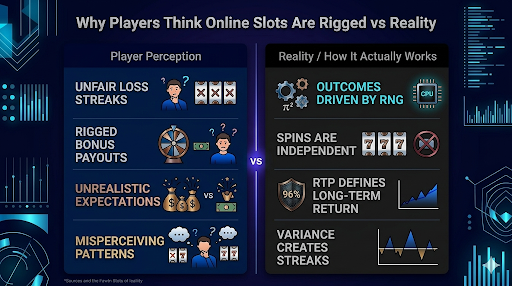
Understanding this difference also helps explain why bonus terms and gameplay rules are often misunderstood, especially when expectations are not aligned with how regulated slot systems operate.
Bonus Rules Can Make Players Suspicious
Bonus terms are another common source of doubt. Wagering requirements, withdrawal limits, and game restrictions can all feel frustrating, especially when the player expects a simple deposit and payout process. These terms are part of the casino offer, not the slot result itself, but they are often mixed together in the player’s mind.
That distinction matters. A confusing bonus rule can make an experience feel unfair even when the game is functioning properly. In other words, the issue may not be whether are online slots rigged, but whether the promotion terms were understood clearly before play began. That is why reading the rules is just as important as understanding the game.
How Licensed Online Slots Actually Work?
Licensed online slots operate on a structured mathematical system built to ensure randomness, consistency, and regulatory compliance. Understanding the mechanics helps explain why outcomes are not influenced by player behavior or casino decisions during gameplay.
What RNG Means?
A random number generator, commonly referred to as RNG, is the core system that drives every slot outcome. It is a software algorithm that continuously produces number sequences at high speed, even when no one is playing. When a spin is triggered, the system selects a number that corresponds to a specific reel outcome.
Each spin is independent. This means previous results have no effect on future spins, which is a key requirement in regulated online casino environments. Industry testing confirms that RNG systems are designed to prevent predictability and external influence, ensuring each result remains statistically random over time.
Understanding how RNG works in online casinos helps explain why outcomes cannot be influenced or predicted during play.
How the Game Decides a Result?
When a player presses spin, the RNG instantly locks in a result. What appears on screen as spinning reels is only a visual sequence. The actual outcome is determined at the moment the spin is activated, not when the reels stop.
For example, a slot may display reels slowing down or nearly aligning symbols, but these animations do not influence the final result. They are purely visual representations of a pre-determined outcome. This separation between result generation and animation is standard across licensed slot systems.
Casinos Do Not Control Individual Spins
Licensed casinos do not typically have access to or control over individual spin outcomes. Their role is to provide access to the games, manage accounts, and process transactions. The mathematical logic behind each slot is embedded in the game software and operates independently of the casino platform.
Regulatory frameworks in licensed markets require that game outcomes remain consistent across operators. This ensures that the same slot behaves identically regardless of where it is hosted, reinforcing system integrity and fairness standards.
Game Providers Build the Slot, Not the Casino
Slot games are developed by specialized software studios such as Pragmatic Play, Playtech, and Microgaming. These providers design the game structure, including reel layouts, payout logic, volatility settings, and RNG implementation.
Casinos then license these games and integrate them into their platforms without altering the core mechanics. This separation ensures that the underlying game logic remains intact across all licensed operators, while casinos focus on user experience, payments, and platform services.
In practice, this means the same slot title delivers the same mathematical behavior across different regulated casinos, even if the interface or bonuses vary.
Why Licensing and Regulation Matter?
A gambling license is a compliance framework, not just a label. In regulated markets such as the UK, Malta, and Gibraltar, operators must meet technical standards covering game fairness, RNG integrity, and payout transparency. These requirements are reviewed by regulators and supported through independent testing to ensure online casinos operate under verifiable conditions backed by independent testing rather than internal claims.
For example:
- The UK Gambling Commission requires all remote gambling software to undergo independent testing before being offered to players.
- The Malta Gaming Authority mandates technical certification of gaming systems before approval and during updates.
Did You Know?The UK Gambling Commission’s Remote Gambling and Software Technical Standards are divided into structured rule sets, including RTS 3, RTS 5, and RTS 7.
Together, these rules show that slot fairness is not a general promise, but a technically defined framework with specific compliance requirements for how games must operate. |
A License Means Oversight
A license places the operator under ongoing regulatory oversight. This includes the use of certified gaming software, verified RNG systems, and regular compliance checks. In some regulated markets, operators must also follow financial safeguards such as segregating player funds to ensure added protection.
A simplified comparison:
| Feature | Licensed Casinos | Unlicensed Casinos |
| RNG certification | Required | Not guaranteed |
| External audits | Regular | Rare or absent |
| Game approval | Mandatory | Unverified |
| Player fund protection | Often required | Not enforced |
Independent Testing Checks Fairness
Independent laboratories are responsible for validating whether games behave according to expected mathematical models.
Common testing bodies include:
- eCOGRA
- iTech Labs
- Gaming Laboratories International
Their checks focus on RNG behavior, RTP accuracy, and whether the game functions as designed across platforms.
What Auditors Look For?
Audits focus on whether the game behaves exactly as designed under controlled statistical conditions. Key areas include:
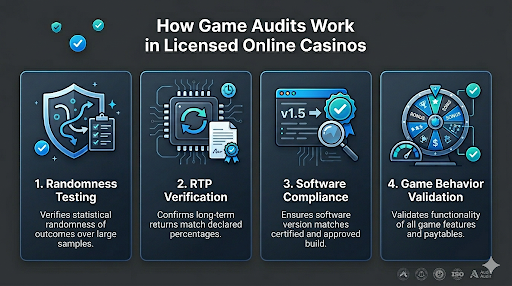
In regulated environments, these checks are part of maintaining approval rather than a one-time approval step.
RTP and House Edge Explained Simply
Return to player, or RTP, refers to the theoretical percentage of total money wagered that a slot game is designed to return to players over a very large number of spins. For example, a 96% RTP means the game is structured to return 96 for every 100 wagered over time.
House edge is the opposite of RTP and represents the casino’s built-in statistical advantage. It is calculated as 100 minus RTP. In a 96% RTP game, the house edge is 4%.
This does not affect individual spins. Each spin is independent and random. RTP and house edge instead describe long-term mathematical behavior, where outcomes move closer to the expected statistical average over time.
Understanding what RTP and volatility mean in slots helps explain why results can vary significantly even when games follow the same mathematical structure.
RTP Is Long-Term, Not Session-Based
RTP does not describe what will happen in a single session. It is a statistical average that only becomes meaningful over thousands or even millions of spins. In practice, this means a player can experience short-term losses or winning streaks that differ significantly from the expected long-term return, even when the game is fair and operating as designed.
This variation is a normal part of regulated slot systems and is driven by randomness rather than any adjustment in gameplay. It also helps explain why players lose money in online casinos, even when short-term sessions include occasional wins.
Volatility Shapes the Player Experience
Volatility describes how outcomes are distributed during play. It does not change RTP, but it changes how RTP is experienced.
- Low volatility slots tend to deliver smaller, more frequent wins, creating a steadier flow of results
- High volatility slots tend to produce fewer wins, but with the potential for larger payouts when they occur
Because of this, two games with identical RTP values can feel very different during play. High volatility slots in particular can feel more unpredictable due to longer gaps between wins.
RTP Can Differ by Game Version
Some slot games are offered in multiple RTP configurations depending on operator settings and regulatory approval. This means the same game title can have slightly different RTP values across different casinos.
This is why transparent information matters. Reputable online casinos usually display RTP details within the game rules or information panel so players can understand the version being played before starting.
What Actually Makes a Casino Trustworthy?
Trust in online casinos is not only about the games themselves but also about how the platform is operated. Even when slots are built on certified RNG systems and regulated frameworks, the overall experience depends on whether the casino follows transparent and responsible practices. Understanding what makes an online casino safe helps players evaluate platforms more clearly beyond just game fairness.
Signs of a Reliable Casino
A trustworthy online casino typically shows clear and verifiable operational standards. Some of the most common indicators include:
- Clearly displayed licensing information from recognized regulators
- Transparent terms and conditions that are easy to access and understand
- Secure payment methods that support safe deposits and withdrawals
- Accessible customer support with responsive communication channels
These elements help confirm that the casino operates within regulated expectations rather than unclear or hidden structures.
Reputation Still Matters
Beyond technical compliance, reputation plays an important role in assessing trust. Player reviews, long-term operator presence, and consistent service quality can help indicate whether a platform is stable and reliable over time.
Even when individual games are fair and independently tested, the overall experience can still vary depending on how the casino manages payments, communication, and user support. This is why platform trust remains an important factor alongside game fairness.
Responsible Gambling Tools Help
Responsible gambling features are another key part of a trustworthy casino environment. These tools are designed to support safer and more controlled play.
Common features include:
- Deposit limits that help control spending
- Session controls that encourage breaks during gameplay
- Self-exclusion options for players who want to take longer breaks
These tools are important because they give players more control over their activity and support a more balanced gaming experience within regulated online casinos.
The Real Truth About Licensed Online Slots
Licensed online slots are built on regulated systems that ensure fairness and randomness, but they still operate within a mathematical framework designed for long-term balance rather than individual outcomes.
Licensed Does Not Mean Guaranteed Wins
A licensed slot is not a guaranteed-win game. The fact that it is fair and independently tested does not remove the house edge built into the math. That is an important distinction, because fairness means the game follows its approved design, not that every player session will end in profit.
Players can still lose, even on well-regulated online casinos, because the game is structured with a long-term statistical advantage for the casino. That does not make the slot unfair. It simply means the outcome is random within a system designed for entertainment and long-term balance, not guaranteed returns.
The Biggest Risk Is Usually Unlicensed Sites
The main concern is usually not that licensed slots are secretly rigged. The bigger issue is unregulated or weakly regulated platforms that may not follow the same testing, approval, or compliance standards. In those cases, players have less visibility into how the games are built and whether the software has been properly reviewed.
That is why regulation matters. A licensed casino is expected to follow rules, use certified systems, and operate under external oversight. It gives players a clearer framework to judge trust, instead of relying only on the casino’s own claims.
Slots Are Entertainment, Not Income
Online slots work best when they are treated as entertainment rather than a source of income. They are designed for play, with outcomes shaped by randomness, RTP, and volatility. That means results can move quickly in either direction, which is part of the experience rather than a sign of manipulation.
Keeping expectations realistic makes the game easier to understand. Licensed slots can be fair, transparent, and well-run, but they are still games of chance. The goal is enjoyment, not reliable profit.
Bottom Line on Slot Randomness
The key takeaway from understanding how online slots work is that outcomes are driven by RNG systems and regulated testing, not hidden manipulation. At Twinqo, licensed slot games operate within this framework, where the distinction between a game being “rigged” and a built-in house edge comes down to certified mathematical design rather than external control. Licensed slots follow structured probability models, meaning outcomes are random but balanced over the long term according to their configuration.
For a more informed experience, Twinqo encourages players to choose licensed casinos, review game terms before playing, and approach slots with realistic expectations. This ensures gameplay remains transparent, regulated, and focused on entertainment rather than predictable returns.