The 2026/27 UEFA Nations League gets underway on September 24, 2026, bringing 54 European national teams into a league-phase competition across Leagues A, B, C and D. League A features 16 of Europe’s leading national sides, with the opening fixtures including several high-profile international matchups.
For anyone researching UEFA Nations League betting, understanding the competition structure is essential before looking at prices. The format affects how teams approach matches, while injuries, squad selection, home advantage, recent form and changing expectations can all influence Nations League odds.
In this blog, we explain how the 2026/27 UEFA Nations League works, explore the main Nations League betting markets, and show how to read different odds formats. We also use current fixtures and market examples to explain what can cause odds to move throughout the competition.
Key Takeaways: UEFA Nations League Betting 2026/27
|
What Is the UEFA Nations League?
The UEFA Nations League is a European international football competition organized by UEFA. It was created to give national teams more meaningful matches during international breaks, replacing many traditional friendlies with competitive fixtures that carry consequences for group standings, promotion, relegation and qualification for the knockout stages.
The competition brings European national teams together in a league system divided into Leagues A, B, C and D. Teams are grouped according to their position in the Nations League structure and compete against the other nations in their group, with results determining what happens next.
For the 2026/27 edition, 54 teams are taking part. League A contains 16 teams, while Leagues B and C also feature 16 teams each, and League D contains six teams. In the league phase, teams play home and away against the other nations in their group.
A Brief History of the UEFA Nations League
The UEFA Nations League was introduced in 2018, with the first edition played during the 2018/19 international season. UEFA’s objective was to create more competitive matches between similarly ranked national teams while giving results greater significance than those in traditional friendlies.
Portugal won the inaugural tournament in 2019, defeating the Netherlands 1–0 in the final. France claimed the title in 2021 after beating Spain, before Spain won the 2023 edition by defeating Croatia on penalties.
Portugal then became the first two-time Nations League champions in 2025, beating Spain on penalties after a 2–2 draw following extra time. The 2026/27 tournament is therefore the fifth edition of the competition.
| Edition | Winner | Runner-up |
| 2018/19 | Portugal | Netherlands |
| 2020/21 | France | Spain |
| 2022/23 | Spain | Croatia |
| 2024/25 | Portugal | Spain |
UEFA Nations League 2026/27 Format
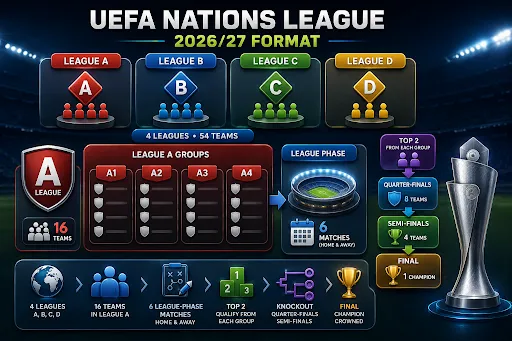
The 2026/27 UEFA Nations League is divided into four leagues: League A, League B, League C and League D. The leagues separate teams into groups and create a system where nations can compete for progression, promotion or avoid relegation.
Leagues A, B and C each contain 16 teams divided into four groups of four. League D contains six teams split across two groups of three. Teams in Leagues A, B and C play six league-phase matches, while League D teams play four.
The main difference comes at the end of the league phase. In League A, the top two teams from each group advance to the quarter-finals. The quarter-finals are played over two legs, with the winners progressing to the Nations League Finals in June 2027.
2026/27 League A Groups
League A features 16 teams, including the current Nations League holders Portugal and the 2026 FIFA World Cup champions Spain.
| Group | Teams |
| A1 | France, Italy, Belgium, Türkiye |
| A2 | Germany, Netherlands, Serbia, Greece |
| A3 | Spain, Croatia, England, Czechia |
| A4 | Portugal, Denmark, Norway, Wales |
Each League A team plays six league-phase matches, three at home and three away, against the other teams in its group. Points accumulated across these matches determine the final group standings.
What Happens After the League Phase?
The League A standings determine which teams continue into the knockout stage:
- 1st and 2nd: Qualify directly for the quarter-finals.
- 3rd: Remain in League A for the next Nations League cycle, subject to the competition’s promotion/relegation structure.
- 4th: Enter the relegation play-off system or face relegation according to the applicable rules.
The quarter-final winners then move into the four-team Nations League Finals, where the semi-finals and final determine the 2026/27 champion.
For anyone researching UEFA Nations League betting, this format is important because the significance of a fixture can change as the group standings develop. A team chasing the top two places may approach a late league-phase match differently from a side with little left to play for, making the competition context relevant when assessing fixtures and Nations League odds.
UEFA Nations League 2026/27 Dates
The 2026/27 UEFA Nations League league phase takes place across three international windows between September and November 2026. The opening matches are scheduled for September 24, with the league phase concluding on November 17.
| Stage | Dates |
| Matchday 1 | September 24–26, 2026 |
| Matchday 2 | September 27–29, 2026 |
| Matchday 3 | October 1–3, 2026 |
| Matchday 4 | October 4–6, 2026 |
| Matchday 5 | November 12–14, 2026 |
| Matchday 6 | November 15–17, 2026 |
| League A quarter-finals | March 25–30, 2027 |
| Nations League Finals | June 9–13, 2027 |
The schedule is relatively compact, particularly during the September international window, when teams play four league-phase matches across two matchdays. The final two matchdays in November then determine the group standings and which League A teams progress to the quarter-finals.
For readers following UEFA Nations League betting, the timing of each matchday can also be important. Squad rotation, short recovery periods, injuries and the importance of the remaining points may affect team selection and subsequently influence Nations League odds as the competition develops.
How To Bet on the UEFA Nations League
UEFA Nations League betting allows you to choose from different markets before or during a match, depending on the bookmaker and your location. Similar principles apply across major football competitions, including UEFA Champions League betting. The basic process is straightforward: choose a match, select a market, review the odds and decide how much you want to stake.
1. Choose a Nations League Match
Start by selecting a fixture from the 2026/27 schedule. You can look at upcoming League A matches or fixtures from Leagues B, C and D. Before choosing a match, check the teams involved, the competition stage and the latest team information.
2. Select a Betting Market
Open the selected fixture and review the available markets. Common options include:
- Match result: Choose the team you expect to win, or select the draw.
- Double chance: Cover two of the three possible match results.
- Both teams to score: Predict whether both sides will score at least once.
- Over/Under goals: Predict whether the total number of goals will be above or below a specified line.
- Correct score: Select the exact final score.
- Draw no bet: Choose a team, with the stake returned if the match finishes level.
The markets available can vary between bookmakers, matches and jurisdictions.
3. Check the Nations League Odds
Once you have selected a market, check the odds attached to each outcome. For example, if a team is listed at 2.50 in decimal odds, a €10 stake would produce a €25 total return if the selection wins, including the original €10 stake.
Remember that odds can change before kick-off as bookmakers react to team news, injuries, line-ups and market activity.
4. Enter Your Stake
After choosing your selection, enter the amount you want to stake. The betting slip will normally display the potential return before you confirm the wager.
For example:
| Selection | Decimal Odds | Stake | Potential Return |
| Team A to win | 2.50 | €10 | €25 |
| Over 2.5 goals | 1.90 | €10 | €19 |
| Both teams to score | 2.00 | €10 | €20 |
These are illustrative examples rather than current market prices.
5. Check the Bet Before Confirming
Before placing a wager, check the selected market, odds, stake and settlement conditions. Pay particular attention to whether the market applies to 90 minutes only or includes extra time and penalties, as this can differ between markets.
6. Confirm and Track the Result
Once you are satisfied that the details are correct, confirm the bet. After the match, the bookmaker settles the wager according to the published market rules.
The key point is that learning how to bet on football is not about assuming that a shorter price is certain to win. It is about understanding the market, knowing what your selection represents and managing your stake before placing a wager.
UEFA Nations League Betting Markets
UEFA Nations League betting markets allow you to predict different aspects of a match or the wider competition. Some markets focus on the final result, while others cover goals, handicaps or longer-term outcomes.
Match Result
The Match Result, or 1X2 market, is the most straightforward option. You predict whether the home team wins, the match ends in a draw or the away team wins. The market is settled according to the final result, with the exact rules depending on the sportsbook and whether the market applies to 90 minutes.
Example:
England vs Spain
- England win: Select 1
- Draw: Select X
- Spain win: Select 2
Draw No Bet
Draw No Bet allows you to select either the home or away team while removing the draw as a losing result. If your selected team wins, the bet wins. If the match ends in a draw, the stake is generally returned. If the selected team loses, the bet loses, subject to the sportsbook’s settlement rules.
Example:
Germany vs Netherlands
- Select Germany – Draw No Bet
- Germany wins: Bet wins
- Draw: Stake returned
- Netherlands wins: Bet loses
Double Chance
Double Chance gives you two possible match results within one selection. You can choose the home team or draw, away team or draw, or either team to win. Because two outcomes are covered, the odds are generally lower than selecting one specific result. Always check the sportsbook’s market definition before placing a wager.
Example:
Italy vs France
- 1X: Italy win or draw
- X2: France win or draw
- 12: Italy or France wins
Over/Under Goals
Over/Under goals markets focus on the total number of goals scored by both teams. You select whether the final combined goal total will be above or below a specified line. Common options include 1.5, 2.5 and 3.5 goals. The market does not require you to predict which team scores the goals.
Example:
Portugal vs Denmark
- Over 2.5: 3 or more total goals
- Under 2.5: 0, 1 or 2 total goals
A 2–1 result would be Over 2.5 goals.
Both Teams To Score
Both Teams To Score, commonly shortened to BTTS, asks whether both teams will score at least one goal during the match. The two standard selections are BTTS Yes and BTTS No. Unlike the Match Result market, BTTS does not require you to predict the winner, only whether both sides will find the net.
Example:
Spain vs Croatia
- BTTS Yes: Spain 2–1 Croatia → Bet wins
- BTTS No: Spain 2–0 Croatia → Bet wins for BTTS No
Correct Score
The Correct Score market requires you to predict the exact final score of a match. You can select results such as 1–0, 2–1, 2–2 or another available scoreline. Because the prediction is more specific than a standard result market, correct-score odds are typically higher, but the selection also has more conditions to satisfy.
Example:
England vs Spain
- Select 2–1 England
- Final score 2–1 → Bet wins
- Final score 1–1 → Bet loses
Handicap Markets
Handicap markets give one team a virtual advantage or disadvantage before the match begins. The handicap is applied when the market is settled, so the adjusted score determines the result. European and Asian handicap markets can work differently, particularly when the adjusted score is level, so the sportsbook’s settlement rules should always be checked.
Example:
France vs Türkiye
- France -1 handicap
- France wins 2–0 → Adjusted result: France 1–0
- France wins 1–0 → Adjusted result: 0–0
Outright Winner
The Outright Winner market concerns the team that will win the entire UEFA Nations League rather than the result of one match. These markets are available before and during the tournament, although prices can change as teams progress. Other futures markets can cover outcomes such as reaching the final, winning a group, qualification, promotion or relegation.
Example:
2026/27 UEFA Nations League
- Select Portugal to win the tournament
- Portugal wins the Nations League → Bet wins
- Another team wins → Bet loses
How To Read UEFA Nations League Odds
UEFA Nations League odds show the price attached to a particular outcome. They can appear as decimal, fractional or American odds depending on the sportsbook and region. Although the formats look different, they communicate the same basic information: how much a successful wager could return relative to the amount staked.
Decimal Odds
Decimal odds show the total return, including the original stake. To calculate the potential return, multiply the amount staked by the decimal price. The remaining amount after subtracting the original stake represents the potential profit. Decimal odds are widely used across European sportsbooks and are generally straightforward to calculate.
Example:
England vs Spain
- England odds: 2.50
- Stake: $10
- Calculation: $10 × 2.50 = $25 total return
- Potential profit: $15
Fractional Odds
Fractional odds show the potential profit in relation to the stake. They are commonly written as fractions such as 5/1, 3/1 or 7/2. The first number represents the potential profit, while the second represents the amount that must be staked. The original stake is then added to calculate the total return.
Example:
Portugal vs Denmark
- Portugal odds: 5/1
- Stake: $10
- Profit: $10 × 5 = $50
- Total return: $60
American Odds
American odds use positive or negative numbers. Positive odds show the potential profit from a $100 stake, while negative odds show how much needs to be staked to make $100 profit. This format is particularly common in the United States and can look unfamiliar if you normally use decimal or fractional odds.
Example:
France vs Italy
- France odds: +200
- Stake: $50
- Potential profit: $100
- Total return: $150
For negative odds, such as -150, a $150 stake would generate $100 profit, giving a $250 total return.
How To Calculate Implied Probability From Nations League Odds
Implied probability can be calculated from decimal odds using:
Implied probability = 1 ÷ decimal odds × 100
For example:
2.50 → 1 ÷ 2.50 × 100 = 40%
The resulting figure represents the probability implied by that price before accounting for bookmaker margin.
If all selections in a market are converted into implied probabilities, the total can exceed 100%. This difference is commonly associated with the bookmaker’s margin.
Current 2026/27 Nations League Outright Odds
Outright odds show the prices attached to teams to win the entire UEFA Nations League rather than a specific match. These prices can change as the competition approaches and progresses, so any published odds should be treated as a dated market snapshot rather than a fixed prediction.
Sporting Life’s September 24, 2026 preview quoted Spain at 7/2, France at 4/1, England at 5/1, Germany at 6/1 and Portugal at 9/1. Oddschecker also quoted Spain at 7/2 in its September 21 update.
| Team | Quoted price | Group |
| Spain | 7/2 | A3 |
| France | 4/1 | A1 |
| England | 5/1 | A3 |
| Germany | 6/1 | A2 |
| Portugal | 9/1 | A4 |
Odds snapshot: September 24, 2026. Prices can change and may differ between sportsbooks and jurisdictions.
For example, a price of 7/2 means a $10 stake would generate $35 in potential profit, plus the original $10 stake, for a $45 total return if the selection wins. The calculation illustrates how the odds work and should not be interpreted as a prediction of the tournament outcome.
The table is included to provide a dated view of the market at the time of publication. Readers should check the latest available prices before using any odds for comparison.
Why Current Team Information Matters in 2026/27
The 2026/27 UEFA Nations League begins on September 24, shortly after the 2026 FIFA World Cup. Current team information is therefore important when researching Nations League odds.
| Team | Group | Key Context |
| Spain | A3 | 2026 World Cup champions |
| Portugal | A4 | Defending Nations League champions |
| France | A1 | Zinedine Zidane begins his tenure |
| Germany | A2 | Jürgen Klopp begins his tenure |
| Netherlands | A2 | Xavi Hernández begins his tenure |
| England | A3 | Face Spain in Matchday 1 |
| Italy | A1 | Face Belgium and France |
| Croatia | A3 | Face Spain and England |
Germany faces the Netherlands on September 24, England meets Spain on September 26, and France plays Türkiye on September 25. These managerial changes, squad updates and recent results provide more relevant context than historical records alone when assessing Nations League odds.
New Managers in the 2026/27 Nations League
Managerial changes are among the most notable storylines of the opening round of the 2026/27 UEFA Nations League. Several major European teams begin the competition with new managers, making their opening fixtures particularly relevant when researching Nations League odds.
| Team | New Manager | Previous Manager | Group | Opening Fixture |
| Germany | Jürgen Klopp | Julian Nagelsmann | A2 | vs Netherlands: September 24 |
| Netherlands | Xavi Hernández | Ronald Koeman | A2 | vs Germany: September 24 |
| France | Zinedine Zidane | Didier Deschamps | A1 | at Türkiye: September 25 |
Germany: Jürgen Klopp
Jürgen Klopp begins his competitive tenure as Germany manager against the Netherlands on September 24. Germany are in League A Group A2 alongside the Netherlands, Serbia and Greece, giving Klopp an immediate test against another leading European side.
Netherlands: Xavi Hernández
The Netherlands also began a new managerial era with Xavi Hernández taking charge. The former Barcelona and Spain midfielder’s first competitive fixture is against Germany on September 24. The result will provide an early indication of how the Netherlands approach their new campaign under Xavi.
France: Zinedine Zidane
France entered the 2026/27 Nations League under Zinedine Zidane following Didier Deschamps’ long tenure as national-team manager. France are in League A Group A1 with Italy, Belgium and Türkiye, and their opening fixture is away against Türkiye on September 25.
These managerial changes are important when assessing Nations League odds, but a new appointment should not automatically be treated as an indicator of a particular match result. Squad selection, tactical changes, player availability, recent performances and the strength of the opposition also need to be considered.
How Nations League Odds Move Before Kick-Off
Nations League odds can change after markets open as new team information and market activity emerge. For this reason, published odds should always include an odds checked date and, where possible, time.
Injuries and Suspensions
A key absence can affect a team’s available price. For example, if a Spain starter is ruled out before facing England, sportsbooks may adjust Spain’s match-result odds.
Confirmed Lineups
Starting XIs provide the latest information before kick-off. If France selects their strongest available lineup against Türkiye while their opponent rotates players, the market may adjust accordingly.
Manager News
Tactical changes, formations and selection decisions can also influence prices. Germany’s lineup and approach under Jürgen Klopp may provide different information from their previous matches under Julian Nagelsmann.
Market Movement
Prices can also change as sportsbooks respond to new information and betting activity. For example, increased market interest in Portugal before facing Denmark could result in changes to Portugal’s available odds.
Odds note: Always check the date, time and sportsbook when publishing Nations League odds, as prices can change before kick-off.
How Group Position Can Affect Nations League Markets
Group position becomes more important as the 2026/27 Nations League progresses. In League A, the top two teams in each group reach the quarter-finals, so the importance of a fixture can change depending on the standings.
Early Matchdays
On Matchday 1, teams have little information about the group. For example, England vs Spain is assessed mainly through current form, squad availability and team strength.
Middle Matchdays
By Matchday 3 or 4, points and goal difference provide more context. A team near the top may aim to protect its position, while another may need points to stay in contention.
Final Matchdays
By Matchday 6, qualification scenarios can make individual results more significant. A team may need a win, only require a draw, or already know its position cannot change.
For Nations League betting, this means Matchday 1 and Matchday 6 markets should be assessed using the current standings, points, goal difference and qualification scenarios.
UEFA Nations League Betting: Match Markets vs Outright Markets
Match markets cover one fixture, while outright markets cover the overall competition. They differ in timeframe, odds movement and settlement.
| Feature | Match Markets | Outright Markets |
| Example | England vs Spain, Match Result | Spain to win the Nations League |
| Timeframe | One fixture | Entire competition |
| Main factors | Form, injuries, lineups, home advantage | Squad strength, group position, format and route to final |
| Odds movement | Before and during the match, depending on market | Throughout the competition |
| Settlement | Based on the selected match outcome | Based on the final tournament outcome |
For example, England vs Spain is settled from that fixture, while an outright market in Spain remains open until Spain’s tournament run is decided.
Understanding the 2026/27 UEFA Nations League Betting Market
The 2026/27 UEFA Nations League offers a range of matches and outright markets across the league phase and knockout rounds. Understanding the format, reading odds correctly and following current team information can help readers interpret Nations League odds more effectively. Results, group position, managerial changes, injuries and confirmed lineups can all change the context around a fixture.
Nations League odds should be treated as time-specific prices rather than fixed figures. Before making any financial decision, check the latest team news, confirm when the odds were recorded, compare the same market across sportsbooks and understand its settlement rules. Always stake responsibly and only use money you can afford to lose.
Responsible Gambling
If you choose to gamble, set a budget and time limit, and never chase losses or wager more than you can afford to lose. Gambling should be treated as entertainment rather than a way to make money. If gambling is causing concern, the National Council on Problem Gambling provides information and confidential support through its National Problem Gambling Helpline, available by call, text and chat.
Disclaimer
The information in this article is provided for informational and educational purposes only. Odds, fixtures, team news and market conditions can change, and published prices may not be available at the time of reading. Gambling involves financial risk and is not guaranteed to result in profit. Check local laws and applicable age requirements before gambling, and only wager what you can afford to lose.