Fractional odds show the potential profit you could make relative to the amount you bet. A price such as 5/2 means you could win 5 units of profit for every 2 units bet, then receive the original amount back if the selection wins. This guide explains how to read fractional odds, calculate profit and total return, convert prices, assess implied probability, and avoid common errors.
Fractional odds are widely associated with UK and Irish betting markets, particularly horse racing, but they can appear across sports betting apps. They are a display format, not a prediction or guarantee. A larger potential return normally reflects a lower implied chance of success.
Fractional Odds: Profit, Returns, Probability
|
What Fractional Odds Actually Show
Fractional odds are written as two numbers separated by a slash, for example 7/2, 11/8, 1/1, or 4/5. The fraction expresses a profit-to-bet relationship.
- The first number is the numerator.
- The second number is the denominator.
- The numerator indicates potential profit.
- The denominator is the reference amount used to calculate that profit.
At 7/2, the relationship is 7 units of profit for every 2 units bet. It does not mean a total return of 7 units. A successful bet returns both the profit and the original amount.
Profit and Total Return Are Different Amounts
Keeping potential profit and total return separate is the easiest way to understand fractional odds.
- Potential profit is the money won above the amount bet.
- Total return is potential profit plus the original amount bet.
For instance, a $10 single bet at 3/1 produces $30 potential profit. The total return is $40 because the original $10 is added back.
| Fractional odds | Meaning | Profit from $10 | Total return from $10 |
| 3/1 | $3 profit for each $1 bet | $30 | $40 |
| 7/2 | $7 profit for each $2 bet | $35 | $45 |
| 1/1 | $1 profit for each $1 bet | $10 | $20 |
| 4/5 | $4 profit for each $5 bet | $8 | $18 |
Reading the Slash as “To”
You can read the slash as “to.” Therefore:
- 5/1 is “five to one.”
- 3/2 is “three to two.”
- 1/4 is “one to four.”
The spoken phrase is useful, but the calculation rule stays the same: divide the first number by the second, then multiply that result by the amount bet to find potential profit.
How to Read Fractional Odds at a Glance
The relationship between the numbers helps you identify whether a selection is priced as an outsider, an even-money proposition, or a favourite. This is a quick way to interpret betting boards without calculating every return immediately.
Odds-Against Prices
When the numerator is larger than the denominator, the price is called odds-against. A successful bet makes more potential profit than the amount bet.
Examples include 2/1, 5/2, 7/2, and 9/1. These outcomes are generally treated as less likely by the market than an even-money selection.
| Price | Profit ratio | Profit from $20 | Total return from $20 |
| 2/1 | 2.00 | $40 | $60 |
| 5/2 | 2.50 | $50 | $70 |
| 7/2 | 3.50 | $70 | $90 |
| 6/1 | 6.00 | $120 | $140 |
A longer price is not automatically good value. It simply offers a greater potential profit because the implied chance is lower.
Evens or Even Money
A price of 1/1 is known as evens or even money. Potential profit equals the amount bet.
A $25 bet at evens generates $25 potential profit if successful, producing a $50 total return. Many betting menus shorten this price to “EVS.”
Evens is a useful reference point. Prices with a higher numerator are odds-against, while prices with a higher denominator are odds-on.
Odds-On Prices
When the denominator is larger than the numerator, the price is called odds-on. The potential profit is lower than the amount bet because the selection is priced as more likely to win.
Examples include 4/5, 1/2, 2/5, and 1/4.
| Price | Profit ratio | Profit from $20 | Total return from $20 |
| 4/5 | 0.80 | $16 | $36 |
| 1/2 | 0.50 | $10 | $30 |
| 2/5 | 0.40 | $8 | $28 |
| 1/4 | 0.25 | $5 | $25 |
Odds-on does not mean a guaranteed result. The price reflects the market’s view, and every betting outcome can be lost.
How to Calculate Fractional Odds Payouts
Use two steps for every standard single bet. First calculate potential profit, then add the original amount bet to find the total return. This works for favourites, outsiders, and unusual fractions.
The Formula for Potential Profit
Potential profit = Amount bet × (Numerator ÷ Denominator)
The Formula for Total Return
Total return = Amount bet + (Amount bet × (Numerator ÷ Denominator)
Or:
Total return = Amount bet × (1 + (Numerator ÷ Denominator))
Worked Payout Example at 11/4
Imagine a $16 bet at 11/4.
- Divide 11 by 4: 11 ÷ 4 = 2.75
- Multiply 2.75 by $16: $16 × 2.75 = $44.
- Add the original $16: $44 + $16 = $60.
The potential profit is $44. The total return is $60.
Worked Payout Example at 2/5
Imagine a $30 bet at 2/5.
- Divide 2 by 5: 2 ÷ 5 = 0.4.
- Multiply 0.4 by $30: $30 × 0.4 = $12.
- Add the original $30: $12 + $30 = $42.
The potential profit is $12. The total return is $42.
Worked Payout Example at 9/2
Imagine a $12 bet at 9/2.
- Divide 9 by 2: : 9 ÷ 2 = 4.5.
- Multiply 4.5 by $12: $12 × 4.5 = $54.
- Add the original $12: $54 + $12 = $66.
The potential profit is $54. The total return is $66.
Fractional Odds Payout Reference Table
This table uses a $25 bet and shows both parts of a potential successful return. It can be used as a quick calculation check.
| Fractional odds | Potential profit | Total return | General market reading |
| 1/5 | $5.00 | $30.00 | Strong favourite |
| 2/5 | $10.00 | $35.00 | Favourite |
| 1/2 | $12.50 | $37.50 | Favourite |
| 4/5 | $20.00 | $45.00 | Slight favourite |
| 1/1 | $25.00 | $50.00 | Evens |
| 5/4 | $31.25 | $56.25 | Slight outsider |
| 3/2 | $37.50 | $62.50 | Outsider |
| 2/1 | $50.00 | $75.00 | Outsider |
| 7/2 | $87.50 | $112.50 | Longer price |
| 6/1 | $150.00 | $175.00 | Long price |
The table illustrates potential returns only. It does not indicate how likely any selection is to win.
Why Fractional Prices Are Not Always Simplified
Some fractional prices may look different even when they represent the same ratio. For example, 6/4 and 3/2 are mathematically identical because both equal 1.5. Racing markets sometimes retain traditional formats such as 6/4, 100/30, or 11/8 rather than reducing every fraction.
6/4 and 3/2 Have the Same Value
For a $20 bet:
$20 × 6/4 = $30
$20 × 3/2 = $30
Both prices produce $30 potential profit and a $50 total return. The appearance differs, but the payout ratio does not.
Keep Precision Until the End
Avoid rounding the fraction too early, especially for prices such as 11/8 or 100/30. Use the original fraction or enough decimal places until you have calculated the final amount.
At 11/8 with a $40 bet:
$40 × (11 ÷ 8) = $55
The result is $55 potential profit and a $95 total return. Early rounding can lead to a small but avoidable calculation error.
What Implied Probability and Vig Mean
Implied probability translates a fractional price into a percentage. It shows the chance the odds suggest before considering the bookmaker’s margin. This can help you compare prices more directly, but it does not guarantee an outcome or prove that a bet offers value.
Implied Probability Formula
Implied probability = (Denominator ÷ (Numerator + Denominator)) × 100
Example: 5/1 as a Percentage
1 ÷ (5 + 1) × 100 = 16.7%
A 5/1 price implies approximately a 16.7% chance before the margin is accounted for.
Example: 4/5 as a Percentage
5 ÷ (4 + 5) × 100 = 55.6%
A 4/5 price implies approximately a 55.6% chance before the margin is accounted for.
| Fractional odds | Implied probability | Market interpretation |
| 1/5 | 83.3% | Strong favourite |
| 1/3 | 75.0% | Clear favourite |
| 1/2 | 66.7% | Favourite |
| 4/5 | 55.6% | Slight favourite |
| 1/1 | 50.0% | Evens |
| 5/4 | 44.4% | Slight outsider |
| 2/1 | 33.3% | Outsider |
| 4/1 | 20.0% | Longer price |
| 9/1 | 10.0% | Major outsider |
What Does Vig Mean in Fractional Odds?
Vig, also called the bookmaker’s margin, overround, or juice, is the built-in difference between the combined implied probabilities in a market and 100%.
In a fair two-outcome market with no margin, the implied probabilities would total exactly 100%. Sportsbooks normally price markets so the total is higher than 100%, which creates their theoretical margin over many similar bets.
Vig Example With Two 10/11 Prices
A common two-way market may show both outcomes at 10/11.
For one 10/11 price:
(11 ÷ (10 + 11)) × 100 = 52.38%
If both sides are 10/11:
52.38% + 52.38% = 104.76%
The overround is therefore:
104.76% − 100% = 4.76%
This does not mean a person loses exactly 4.76% on every bet. It describes the bookmaker’s theoretical margin across that market.
Difference Between Fractional, Decimal Odds & American Odds
Fractional, decimal, and American odds can express the same market price in different ways. The underlying chance and potential return do not change. Only the presentation changes.
| Format | What it shows | Best use | Example for a 3/2 price |
| Fractional | Profit relative to the amount bet | Reading traditional UK and Irish markets | 3/2 means $3 profit for every $2 bet |
| Decimal | Total return per $1 bet, including the original amount | Comparing total returns quickly | 2.50 returns $2.50 in total for every $1 bet |
| American | Profit on $100 for plus prices, or amount needed to win $100 for minus prices | Reading US-facing betting markets | +150 means $150 profit from a $100 bet |
Fractional to Decimal Conversion
Decimal odds include the original amount bet in the total-return multiplier.
Decimal Odds = (Numerator ÷ Denominator) + 1
At 7/2:
7 ÷ 2 + 1 = 4.50
At 4/5:
4 ÷ 5 + 1 = 1.80
Fractional to American Conversion
For odds-against prices:
American Odds = (Numerator ÷ Denominator) × 100
At 7/2, this is +350.
For odds-on prices:
American Odds = −(Denominator ÷ Numerator) × 100
At 4/5, this is -125.
| Fractional | Decimal | American | Implied probability |
| 1/4 | 1.25 | -400 | 80.0% |
| 1/2 | 1.50 | -200 | 66.7% |
| 4/5 | 1.80 | -125 | 55.6% |
| 1/1 | 2.00 | +100 | 50.0% |
| 5/4 | 2.25 | +125 | 44.4% |
| 3/2 | 2.50 | +150 | 40.0% |
| 2/1 | 3.00 | +200 | 33.3% |
| 4/1 | 5.00 | +400 | 20.0% |
Compare Prices in a Single Format
If one bookmaker shows 6/4 and another shows 11/8 for the same selection, convert them before comparing.
- 6/4 becomes 6 ÷ 4 + 1 = 2.50 decimal.
- 11/8 becomes 11 ÷ 8 + 1 = 2.375 decimal
For the same amount bet and identical settlement terms, 6/4 offers the higher potential return. Check that the market, rules, and selections are genuinely identical before comparing.
Calculating Doubles, Trebles, and Accumulators
A multi-selection bet requires every leg in a standard accumulator to win. Fractional odds are easier to combine after converting each price to decimal odds, because decimal returns can be multiplied together.
Double Example Using 2/1 and 1/2
First convert each price:
- 2/1 becomes 3.00 decimal.
- 1/2 becomes 1.50 decimal.
Then multiply them:
3.00 × 1.50 = 4.50
A $10 bet at combined decimal odds of 4.50 returns:
$10 × 4.50 = $45
The total return is $45, including $35 potential profit and the original $10. If either selection loses, a standard double usually loses.
Why Combined Prices Increase Risk
Adding selections increases the potential return only because all outcomes must succeed. A high combined price should not be viewed as a shortcut to a likely payout. Verify the bet type and settlement rules before confirming any multi-selection bet.
How Each-Way Fractional Odds Are Settled
An each-way bet normally contains two equal parts: one bet on the selection to win and one bet on it to place. It is not a single bet. A $10 each-way bet costs $20 in total because it is $10 to win plus $10 to place.
The bookmaker states both the place fraction and the number of available places. Those terms can vary by market, so they must be checked before betting.
Example: $10 Each Way at 8/1, One-Fifth Place Terms
The total amount bet is $20.
The place odds are one-fifth of 8/1:
8/1 ÷ 5 = 8/5
If the selection places but does not win, the place part returns:
$10 × 8/5 = $16 potential profit
The total return from the place part is $26 after adding its original $10. The win half loses.
If the selection wins, both the win and place parts can be paid under the applicable terms. Dead heats and reduced place terms can change settlement, so read the relevant rules.
Practical Tips for Checking Fractional Odds
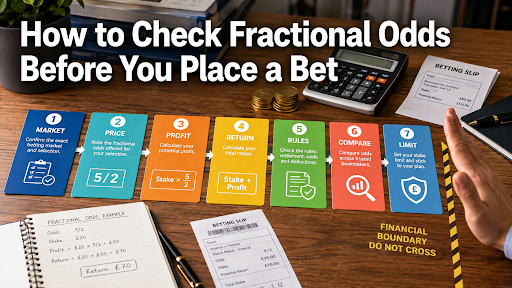
Use Evens as a Quick Reference
Use 1/1 as the dividing line. A larger numerator means odds-against. A larger denominator means odds-on. This helps you identify the general price type before calculating the return.
Check the Projected Return
The bet slip normally displays a projected return. Compare it with your own calculation, particularly for unusual fractions, multi-selection bets, or each-way terms. If the figures differ, review the market rules before proceeding.
Compare Like-for-Like Markets
A price comparison only works when the selection, market definition, bet type, and settlement conditions are the same. For example, two “to win” prices may not be comparable if one includes overtime and the other excludes it.
Treat Each-Way Terms as Part of the Price
An 8/1 each-way offer is incomplete without the place fraction and number of places. One-fifth odds for four places and one-quarter odds for three places can produce different returns even when the win price is the same.
Set a Limit Before Viewing the Return
Large return figures can encourage impulsive decisions. Decide how much you are comfortable losing before placing a bet, and do not increase the amount bet to recover a previous loss.
Errors That Can Distort a Fractional Odds Calculation
Forgetting to Add Back the Original Amount
A $15 bet at 3/1 makes $45 potential profit. The total return is $60, not $45. The original $15 only returns if the bet is successful.
Reversing the Fraction
At 2/5, you make 2 units of potential profit for every 5 units bet. Reading it as 5 for every 2 reverses the price and creates the wrong return.
Assuming Favourites Are Guaranteed
A 1/4 price has a higher implied probability than 4/1, but it can still lose. Odds represent a market price, not certainty.
Ignoring Vig
Implied probabilities in a market can add to more than 100% because of vig. Do not treat a single sportsbook’s implied probability as an exact forecast of the true chance.
Skipping Market Rules
Displayed odds do not tell you how every scenario is settled. Check rules for dead heats, void events, abandoned matches, overtime, each-way place terms, and player or team changes where relevant.
A Clearer Way to Use Fractional Odds
Fractional odds are useful because they show the profit relationship directly. Once you know that the fraction gives potential profit rather than the full return, the calculation is consistent: divide the numerator by the denominator, multiply by the amount bet, and then add the original amount back.
Use odds as information, not a reason to chase a payout. Consider the market rules, risk, and your personal budget before betting. No odds format can remove the possibility of loss.
Responsible Gambling Information
Gambling should be treated as entertainment, not as a way to earn income or manage financial pressure. Never bet money needed for essential expenses, avoid increasing bets to recover losses, and pause if gambling causes stress.
For independent support and practical tools, visit the International Center for Responsible Gaming.