Deposit $500 in Bitcoin before a big weekend of play, and by the time you’re ready to cash out, that $500 could be worth $460 or $540. Same coins, different numbers, purely because BTC moved while you were playing.
That volatility is exactly the problem USDC was built to solve. USDC is a stablecoin: a digital dollar designed to always be worth $1, no matter what the rest of the crypto market is doing. It’s why a growing number of USDC casinos now treat it as a default deposit option rather than an afterthought next to Bitcoin and Ethereum.
Here’s what USDC actually is, how it stacks up against BTC and ETH, and why operators are leaning into it.
USDC in Crypto Casinos
|
What Is USDC?
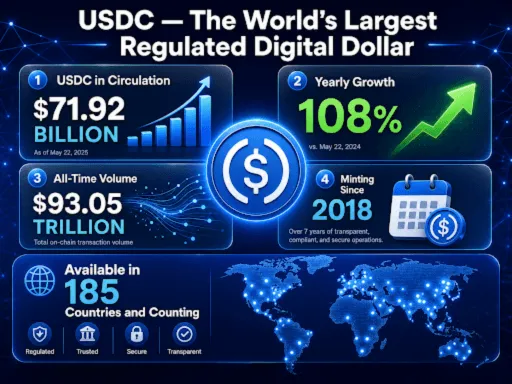
USDC (USD Coin) is a stablecoin issued by Circle, a US-based financial technology company. Launched on Ethereum in September 2018, the core promise hasn’t changed since: every USDC is backed 1:1 by cash and cash-equivalent assets, and it’s always redeemable for one US dollar.
Where the backing actually sits
- Circle Reserve Fund: a government money market fund managed by BlackRock and registered with the SEC, holding short-dated US Treasuries and overnight repurchase agreements
- Cash deposits at major banking institutions
- Verified monthly by Deloitte: Circle’s auditor since 2022: following attestation standards set by the American Institute of Certified Public Accountants, with reports published publicly going back to 2018
Built to scale beyond one chain
USDC has outgrown its original single-chain home. It’s now natively issued on more than 30 blockchains, including Ethereum, Solana, Base, and Polygon, with more being added regularly.
The regulatory backdrop
- The GENIUS Act: the first comprehensive federal framework for payment stablecoins in the US, was signed into law in July 2025, with full rules taking effect by January 2027 at the latest
- Circle has been publicly traded on the NYSE since June 2025, filing the same kind of quarterly disclosures a bank would, a meaningfully different trust proposition than an unregulated, offshore token issuer
When USDC Broke Its Dollar Peg?
Not every stablecoin is built the same way. Circle’s own materials group stablecoins into a few categories: fiat-backed coins like USDC, crypto-backed coins like DAI, and algorithmic stablecoins that hold no real collateral and rely purely on code and incentives to hold their value. TerraUSD (UST), once a major algorithmic stablecoin, collapsed entirely in 2022, a collapse that pushed much of the market toward asset-backed coins like USDC.
Even the USDC hasn’t been perfectly immune to shocks. In March 2023, Circle disclosed that $3.3 billion of USDC’s roughly $40 billion in reserves, about 8%, was stuck inside Silicon Valley Bank when it collapsed. USDC’s price fell as low as $0.87 on secondary markets. It took about three days to fully recover, once US regulators guaranteed SVB depositors would be made whole.
The honest takeaway: no stablecoin, including USDC, carries zero counterparty risk. One rough week in seven years is a strong track record, but “extremely rare” is the accurate description, not “impossible.”
USDC vs. Bitcoin vs. Ethereum: The Real Numbers
On paper, USDC, Bitcoin, and Ethereum are all “crypto”, but they’re built to do different jobs.
| Metric | USDC | Bitcoin (BTC) | Ethereum (ETH) |
| Backing | Cash + short-term US Treasuries, audited monthly | None, scarcity-based | None, utility-based |
| Typical fee | Under a cent on low-cost chains | ~$0.65 average | Under a cent at current gas prices |
| Speed to spendable | Seconds to ~2 minutes | ~40 min per confirmation | ~12 seconds per block |
| Built for | Stable medium of exchange | Store of value | Programmable settlement |
Price Stability
USDC is designed to sit at $1 and stay there. Bitcoin and Ethereum have no such target: their prices move purely on supply and demand, and both have swung by thousands of dollars within a single year.
Fees
Cost depends heavily on which network a transaction actually settles on. Ethereum’s gas fees fluctuate with demand, at today’s relatively quiet levels, a simple transfer costs a fraction of a cent, though fees have spiked past $50 during past congestion. Bitcoin currently averages around $0.65 per transaction, rising when the network gets busy. USDC’s fee depends on which chain it’s moving on: it inherits Ethereum’s cost when sent there, but runs to a fraction of a cent on lower-cost chains like Solana or Base.
Speed
Bitcoin currently averages roughly 40 minutes for a single confirmation, and most platforms, casinos included, wait for 3 to 6 confirmations, or 30 to 60 minutes, before treating a deposit as final. Ethereum produces a new block roughly every 12 seconds. USDC settles at whatever speed its host chain allows: seconds on Solana, a couple of minutes on Ethereum-based networks.
What Each One Is Actually For
Bitcoin is a scarce store of value, capped at 21 million coins. Ethereum is a programmable settlement layer, used to run smart contracts and other blockchain applications. USDC exists purely to be a stable, spendable dollar on-chain.
Why are Casinos Choosing USDC Over BTC and ETH?
For an online casino, USDC solves a handful of very practical problems that BTC and ETH don’t.
Predictable bankroll value
A $500 USDC deposit is worth $500 whether a player cashes out five minutes later or five days later. With BTC or ETH, that same deposit could be worth meaningfully more or less by withdrawal, a worse player experience and messier accounting for the operator.
Cleaner bonus math
Match bonuses, wagering requirements, and cashback are all calculated in real-dollar terms. When the deposit itself doesn’t move in value, those calculations stay accurate from deposit through withdrawal, a volatile deposit currency makes the “real” value of a bonus a moving target.
Cheaper, faster settlement
Because USDC can move on low-fee, high-speed networks like Solana, processing costs for the platform are a fraction of what they’d be settling the same value in BTC or on Ethereum’s mainnet.
Regulatory tailwinds
With the GENIUS Act creating the first real federal framework for payment stablecoins, and Circle operating as an audited, public company, USDC carries a compliance profile that’s easier for a regulated operator to build around than an unregulated token.
A familiar on-ramp
For players newer to crypto, “one USDC equals one dollar” is a far easier mental model than tracking BTC or ETH’s price before every deposit, which lowers the barrier to trying crypto payments at all.
None of this makes BTC and ETH obsolete, plenty of players still prefer them, and casinos continue to support both. But for moving stable, spendable value in and out of a casino account specifically, USDC is doing a job Bitcoin and Ethereum weren’t designed for.
USDC vs. USDT: Why do these two Stablecoin differ?
The main difference between USDC and USDT is who issues them, how they are backed, and their market usage. Both are stablecoins designed to stay around $1, but they have different histories and ecosystems.
| Feature | USDC | USDT (Tether) |
| Full name | USD Coin | Tether (US Dollar Tether) |
| Issuer | Circle Internet Financial | Tether Limited |
| Launch year | 2018 | 2014 |
| Goal | Transparent digital dollar for payments and financial apps | Widely available digital dollar for global crypto trading |
| Backing | Mainly cash, short-term US Treasury assets, and regulated reserves | Cash, Treasury bills, and other reserve assets |
| Transparency | Publishes regular reserve reports and attestations | Publishes reserve reports and attestations |
| Availability | Supported across major blockchains | Available on more blockchains and used more widely |
| Crypto market use | Popular for payments, DeFi, and institutional use | Most widely used stablecoin for trading and transfers |
| Casino use | Used by casinos wanting stable crypto payments | Commonly supported due to high adoption and liquidity |
For a casino user:
- Both help avoid the price swings of Bitcoin and Ethereum.
- A USDC casino focuses on using a more compliance-oriented dollar stablecoin.
- A USDT casino focuses on the convenience and widespread availability of Tether for deposits and withdrawals.
Trade-Offs of Using USDC in Casino
USDC isn’t without downsides, and it’s worth being upfront about them.
No upside from price appreciation
Holding USDC means holding a dollar, it will never be worth more than that, unlike BTC or ETH, which can (and have) appreciated significantly over time. Players using USDC purely to gamble won’t notice this, but it matters for anyone treating a crypto balance as an investment too.
Centralization
Because Circle issues and administers USDC, it retains some control that a fully decentralized asset like Bitcoin doesn’t have. Circle’s own terms state plainly that it can block or freeze USDC at addresses it determines are tied to illegal activity or a violation of its terms, and that it can be compelled to freeze funds under a valid government order. Circle also doesn’t guarantee USDC will hold exactly $1 on third-party platforms, since it can’t control how those platforms price it. USDC balances carry no FDIC- or SIPC-style deposit insurance, either.
Still need an on/off-ramp
Players already holding BTC or ETH who want to switch to USDC still need to convert somewhere, an exchange, a swap feature, or a payment processor, a small extra step compared to depositing crypto they already hold.
How to Deposit and Withdraw in USDC Casino?
Depositing and withdrawing USDC works the same as any other crypto payment method, with one extra detail worth double-checking: the network.
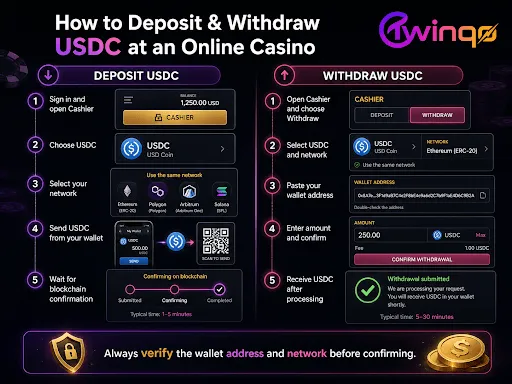
To deposit:
- Log into your Twinqo account and go to the cashier.
- Select USDC as your deposit method.
- Choose the network you’re sending from
- Copy the deposit address (or scan the QR code) and send USDC from your wallet or exchange, making sure the network matches exactly.
- Funds typically appear in your account within 1-2 mins.
To withdraw:
- Go to the cashier and select USDC withdrawal.
- Enter your wallet address and choose the matching network.
- Confirm the amount and submit, most withdrawals are processed within 10 – 15 minutes.
The one mistake that actually matters: sending USDC on the wrong network, say, sending Solana USDC to an Ethereum address, doesn’t just fail, it can send funds somewhere unrecoverable. Always match the network on both ends before confirming a transaction.
In The End
USDC won’t make anyone rich the way holding Bitcoin through a bull run might, that’s not its job. What it does is remove volatility from the deposit and withdrawal process entirely, backed by monthly-audited reserves and an increasingly clear regulatory framework. That’s exactly why it’s become a default option at crypto casinos rather than a niche one.
Gambling should be fun, not a way to make money, and it’s not without risk. Please gamble responsibly and only wager what you can afford to lose. If you or someone you know is struggling with problem gambling, help is available: in the US, contact the National Council on Problem Gambling at 1-800-522-4700 or visit ncpgambling.org.