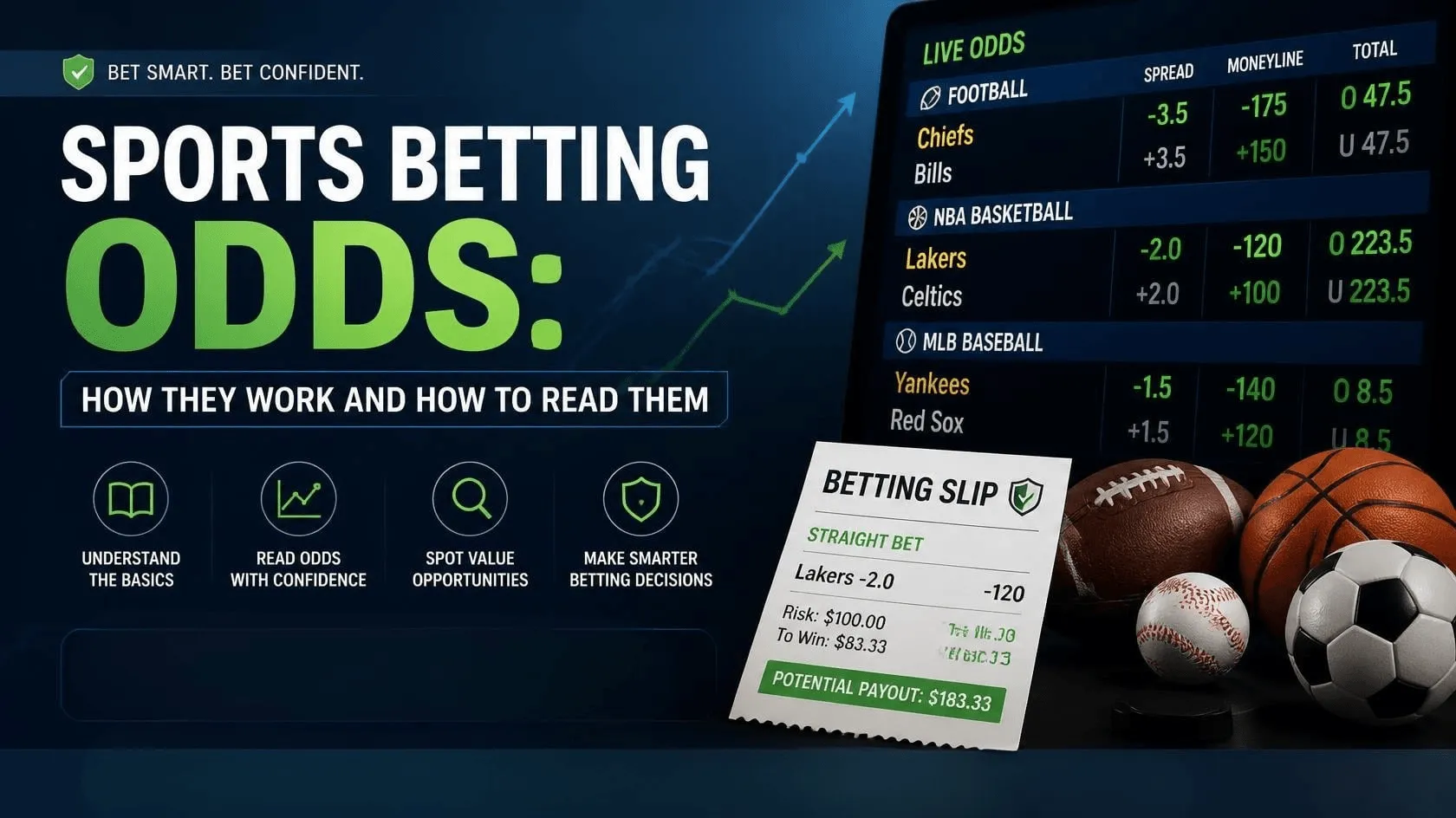
Sports betting odds decide everything about a wager, your potential payout, who is favored, and how confident bookmakers are in an outcome. Yet to a beginner, terms like moneyline, spread, and cover can feel overwhelming.
This guide breaks down exactly how to bet on sports reading odds and how they work. You’ll learn the key terms, explore the different odds formats used across the US, UK, and Europe, and understand payout terms before placing a single bet.
Key Takeaways on Sports Betting Odds
|
What Are Sports Betting Odds and How Do They Work?
Many new bettors ask, “what are betting odds,” because the numbers can look complicated at first. In simple terms, they are sportsbook prices that connect a possible outcome with a possible return. Understanding how betting odds work helps you see why favorites offer smaller profits and underdogs offer larger potential payouts.
Sports gambling odds are not fixed forever. They may change as bookmakers receive new information or update their prices. As you learn how to understand sports betting odds, focus on the market, the odds format, your stake, and the total amount you could receive if the bet wins.
Sports betting odds are numbers that show the potential return from a winning bet and the sportsbook’s implied view of each outcome. To understand what are betting odds, remember that they do not guarantee who will win. They simply show the price offered by the sportsbook.
For example, odds of -150 mean you must risk $150 to make $100 profit. Odds of +150 mean a $100 bet could make $150 profit. The original stake is returned after a winning bet.
Sports gambling odds can change before a game starts. Injuries, team news, weather, and betting activity can affect the price. For example, a team may move from -150 to -180, meaning it has become a stronger favorite and costs more to back.
How to Read Betting Odds
When reading sports odds, first check the market you are viewing. A sportsbook may show a moneyline, point spread, total, player prop, or future. The market tells you what must happen for the bet to win, while the odds show the potential payout for that selection.
Next, identify the odds format selected on the sportsbook. American odds use plus (+) and minus (-) signs. A minus price shows how much a bettor must risk to win $100 profit. A plus price shows how much profit a $100 bet could make. The displayed $100 amount is only a reference point, so bettors can choose a larger or smaller stake.
Decimal odds are read by multiplying the stake by the displayed number. The answer gives the total return, including the original stake. Fractional odds show the potential profit compared with the stake. The first number shows the profit amount, while the second number shows the amount wagered.
Always separate profit from total return. Profit is the money won from the bet, while total return includes both the profit and the original stake. Once you understand the market, odds format, stake, profit, and total return, you can read any sportsbook price more confidently.
Learning how to read betting odds means identifying the bet first and the price second. Check whether you are backing a winner, a spread, or a total, then check the odds format before you enter a stake. Readers learning how to read sports odds should always check whether the displayed figure represents potential profit or the full return.
Different Types of Sports Betting Odds
Sportsbooks use three main formats to display betting odds: American, fractional, and decimal. Although each format looks different, they show the same basic information: which team is favored, which team is the underdog, and how much a winning bet could return.
American odds are mainly used in the United States, fractional odds are common in the UK and Ireland, and decimal odds are widely used across Europe and international betting sites.
The table below shows the same betting prices for the Lions and Sharks in all three formats. The Lions are the favorite, while the Sharks are the underdog.
| Team | American Odds | Fractional Odds | Decimal Odds |
| Lions | -160 | 5/8 | 1.625 |
| Sharks | +135 | 27/20 | 2.35 |
U.S./American Odds
American odds, also called U.S. odds, are the format most commonly displayed by sportsbooks in the United States. They can be used to price many markets, including moneylines, point spreads, totals, prop bets, and futures. American odds use a plus (+) or minus (-) sign before the number.
A minus sign usually shows the favorite in a two-team market. The number tells you how much you must risk to make $100 in profit. For example, the Lions are priced at -160. This means a bettor would risk $160 to win $100 profit. If the Lions win, the sportsbook also returns the original $160 stake, making the total return $260.
You do not need to bet $160. The odds adjust to any stake size. If you bet $40 on the Lions at -160, your potential profit is $25. Your full return is $65, which includes the $40 stake and $25 profit.
A plus sign usually shows the underdog in a two-team market. The number tells you how much profit a $100 bet could make. The Sharks are priced at +135. This means a $100 bet would win $135 profit if the Sharks win.
With a $40 bet on the Sharks at +135, the potential profit is $54. The full return is $94, including the $40 stake.
American odds also help show the sportsbook’s implied view of each team’s chances. The Lions at -160 have an implied probability of about 61.54%, while the Sharks at +135 have an implied probability of about 42.55%. These percentages add up to more than 100% because the sportsbook builds its margin, often called vig or juice, into the odds.
In simple terms, larger negative numbers usually represent stronger favorites. For example, -250 is a shorter price than -160 because you must risk more to make the same $100 profit. Larger positive numbers generally represent bigger underdogs. For example, +250 offers a larger potential profit than +135 because that outcome is considered less likely to happen.
British/Fractional Odds
Fractional odds are traditionally used in the UK and Ireland. They show potential profit as a ratio compared with the stake. The first number represents the possible profit, while the second number represents the amount that must be wagered to earn that profit.
For example, the Lions are priced at 5/8. This means a bettor wins $5 in profit for every $8 wagered. The fraction only shows profit, so it does not include the original stake. This is an important point when learning how to read sports odds in fractional format.
If you bet $40 on the Lions at 5/8, your stake contains five groups of $8. Each group earns $5 profit, so the total profit is $25. Once the original $40 stake is returned, the full payout is $65.
The Sharks are priced at 27/20. This means a bettor wins $27 in profit for every $20 wagered. If you bet $40 on the Sharks, you are betting two groups of $20. Each $20 group could win $27 profit, so the total profit is $54. The full return is $94 after adding back the $40 stake.
Shorter fractional odds, such as 1/2, 5/8, or 4/5, generally indicate favorites. Larger fractional odds, such as 2/1, 5/1, or 10/1, usually indicate underdogs.
European/Decimal Odds
Decimal odds are widely used across Europe and on international sportsbooks. They show the total amount returned from a winning bet. Unlike American and fractional odds, decimal odds already include the original stake.
To calculate a potential payout, multiply the stake by the decimal price. This makes decimal odds one of the simplest formats for readers who want to understand the full return before placing a wager.
The Lions are priced at 1.625. If you bet $40, multiply $40 by 1.625. The result is $65. This is the total return, not just the profit. Since the original stake was $40, the profit is $25.
The Sharks are priced at 2.35. If you bet $40, multiply $40 by 2.35. The result is $94. The $94 total includes the original $40 stake, which means the profit is $54.
When learning how to understand sports betting odds, remember that lower decimal odds usually identify favorites because they produce a smaller return. Higher decimal odds usually identify underdogs because they offer a larger potential payout. Some sportsbooks round decimal odds to two places, so a price such as 1.625 may appear as 1.63, causing a small difference in the final payout.
If you are learning how to read betting odds, decimal prices make comparisons simple because a higher number produces a larger total return for the same stake. This is another practical way how betting odds work, since the price already includes the stake. To make better comparisons across sportsbooks, learn how to understand sports betting odds in the format you prefer.
Understanding How Plus(+) and Minus(-) works in U.S/Moneyline Odds
Every US moneyline number comes attached to a sign, and that sign alone tells you who the bookmakers expect to win. A minus (-) points to the favorite, and the figure next to it shows how much cash you’d need to put down just to earn a $100 profit. Take -180 as an example: you’d risk $180 to walk away with $100 in winnings.
A plus (+) sign flags the underdog instead, and here the number reflects pure profit on a $100 wager. So +220 means a $100 bet turns into $220 profit if it hits. . As that plus number climbs higher, the underdog grows longer, and so does the reward for backing them.
None of this locks you into betting exactly $75 or $180, the odds are just a ratio you can scale up or down. Put $15 on a +220 underdog and you’d still pocket $33 profit , while $15 on a -180 favorite would earn roughly $8.33, following that same proportional math.
Key Sports Betting Terms
Sports betting uses terms that explain bet sizes, possible returns, refunds, and betting results. The Lions vs Sharks example below makes these terms easier to understand.
| Term | Simple Example |
| Bankroll | Alex sets aside $500 for betting |
| Unit | Alex uses $10 as one unit |
| Stake | Alex places a $10 bet |
| Odds | The Sharks are priced at +135 |
| Profit | A winning Sharks bet earns $13.50 profit |
| Payout | Alex receives $23.50 in total |
| Handle | The sportsbook takes $40,000 in bets |
| Push | A Lions +3 bet is refunded after a three-point loss |
| No Action | A cancelled game results in a refunded bet |
| Bad Beat | The Sharks lose after leading late in the game |
Payout
A payout is the full amount returned from a winning bet. It includes the original stake and the profit earned from the wager. For example, Alex places $10 on the Sharks at +135. If the Sharks win, Alex earns $13.50 profit. The sportsbook also returns the original $10 stake, so Alex receives a total payout of $23.50.
Handle
Handle is the total amount wagered on a game, market, event, or sportsbook during a set period. It includes every bet placed, whether the bets win or lose. For example, bettors may place $40,000 in combined wagers on the Lions vs Sharks game. In that case, the sportsbook’s handle for the game is $40,000.
Bankroll
A bankroll is the amount of money a bettor sets aside specifically for sports betting. It should remain separate from money needed for rent, bills, food, savings, or other essential expenses. For example, Alex decides to use $500 only for betting. This $500 is Alex’s bankroll, and any betting wins or losses come from that amount.
Unit
A unit is a standard betting amount used to keep wager sizes consistent. Instead of choosing random stake amounts, bettors can measure each bet in units. For example, Alex has a $500 bankroll and chooses $10 as one unit. A $10 wager is a one-unit bet, while a $20 wager is a two-unit bet.
Bad Beat
A bad beat is an informal term for a bet that loses after appearing likely to win for most of the game. It is not an official sportsbook result, but bettors commonly use the phrase after an unexpected late outcome. For example, the Sharks lead until the final minute, but the Lions score late and win. Alex’s Sharks bet loses in a bad beat.
Push
A push happens when the final result lands exactly on the sportsbook’s whole-number line. The bet is neither a win nor a loss, and the original stake is normally refunded. For example, Alex bets $10 on the Lions at +3. The Lions lost by exactly three points. The bet is graded as a push, and Alex receives the $10 stake back.
No Action
No action means a sportsbook has voided a bet under its market rules. This can happen when a game is cancelled, postponed, or does not meet the settlement requirements. The original stake is normally refunded. For example, Alex bets $10 on the Sharks, but the game is cancelled before it starts. The sportsbook voids the wager and returns Alex’s $10.
Is Sports Betting Legal? A look At the U.S, UK, and Europe
In the United States, sports betting is regulated state by state, not under one federal law. Since the Supreme Court lifted the federal ban in 2018, states have set their own rules, and 39 states plus Washington DC and Puerto Rico now allow it, with 32 permitting online betting. Still, California, Texas, and Mississippi remain closed, with no legal market expected before 2027.
The UK regulates betting nationwide under a single licensing body. Sports betting is widely accepted there, with licensed online and retail sportsbooks operating under strict rules on advertising, age verification, and responsible gambling.
Europe has no single rulebook, as each country sets its own gambling laws. Malta and the UK offer well-established licensing systems, while other nations impose tighter restrictions or run state monopolies. Legal options can vary sharply from one European country to the next.
Sports Betting Law by Region: Is It Legal Where You Live?
Sports betting legality depends heavily on where you’re located. In the US, it varies by state, with most now regulated but a few still closed. The UK allows it nationwide under one licensing system. Europe differs by country, ranging from open markets like Malta to tighter, state-controlled systems elsewhere.
Conclusion
Sports betting odds follow simple, consistent logic once you understand the basics. Whether you’re reading American moneyline odds, British fractional odds, or European decimal odds, each format shows the same two things: probability and payout. Knowing how to spot a favorite from an underdog, calculate a payout, and recognize terms like handle, push, and bad beat puts you in a stronger position before placing any wager. Since legality still varies by state and country, always check local regulations first, and bet with clarity and confidence. If you still ask, what are betting odds, the answers below cover common questions about odds formats, payouts, favorites, underdogs, and sportsbook rules.