So you want to get better at blackjack. Maybe you have been playing for a while and keep losing more than you would like, or maybe you are brand new and just want to skip the beginner mistakes phase entirely. Either way, you are in the right place. This blog walks you through 15 real, practical blackjack strategies that winning players actually use, helping you understand the best blackjack strategy approaches for making better decisions at the table.
Blackjack Strategy Essentials
|
1. Double down on hard 11 whenever the dealer isn’t showing an Ace.
This one feels a little scary the first few times because you’re putting extra money on the table before you know your next card. But a hard 11 gives you excellent odds of landing a strong 20 or 21, making it the single highest value aggressive play in the entire game.
Most ten value cards will push you straight into a winning total, and even a smaller card still leaves you in decent shape. Skipping this double just because it feels risky is one of the most common ways players quietly lose value over a session. The math has been run millions of times through simulation, and it consistently favors doubling here against anything except an Ace. Treat this as an automatic reflex, not a judgment call you make based on how you’re feeling in the moment. Knowing these situations helps players recognize blackjack best plays and avoid costly mistakes.
- Works because you’re statistically likely to draw a 10 value card
- One of the most profitable single decisions in blackjack basic strategy
- Should be automatic, not a gut call
2. Split 8s and Aces every time, no exceptions.
A 16 is famously the worst hand you can hold in blackjack, too weak to comfortably stand on and too risky to hit without a real bust chance. When you’re dealt two 8s, splitting turns that one miserable hand into two separate hands that each get a fresh, more favorable starting point. The same logic applies even more strongly to a pair of Aces, since splitting gives you two realistic shots at blackjack instead of one clunky soft hand that’s hard to play well.
Some tables limit how you can act after splitting Aces, often allowing only one additional card per hand, so check the rules first. Even with that restriction, splitting remains correct almost universally. This is one play where hesitation costs you the most, because the temptation to just play it safe and keep the pair together is strong, but statistically wrong every time.
- Turns a weak 16 into two stronger hands
- Doubles your blackjack chances when splitting Aces
- Correct almost universally, regardless of dealer card
3. Never split 10s or 5s.
This one trips people up because splitting can feel like a sophisticated move, so players assume doing it more often is smarter. It’s not. A pair of 10s already hands you a strong 20, and there’s very little upside to breaking that apart into two separate hands starting from scratch. A 5-5 pair works the same way but in reverse, since it actually plays better left together as a hard 10, setting you up for one of the best doubling opportunities in the game instead of two weak hands starting at 5.
Resisting the urge to split here takes some discipline, especially at a busy table where other players might be splitting everything in sight. Stick with the math instead of the crowd, because these two exceptions are some of the clearest cut blackjack basic strategy rules that exist.
- 20 rarely needs improving through a split
- 5-5 as hard 10 sets up a strong double
- One of the most misunderstood rules in blackjack strategy
4. Stand on hard 17 or higher, every single time.
I know the itch to hit just one more card when you’re sitting on a 17, especially when the dealer looks intimidating. Resist it. Once your hand hits hard 17 or above, the odds of busting on the next card climb sharply, so the bust risk from hitting almost always outweighs any small upside from trying to improve the hand.
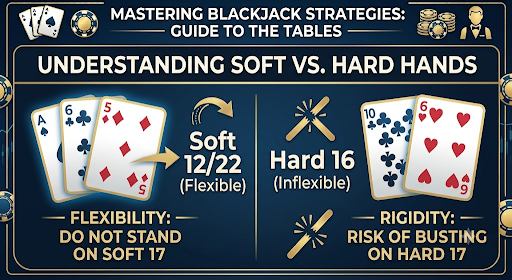
This is one of the most emotionally difficult rules to follow because standing feels passive, like you’re not doing anything, when in reality it’s the mathematically correct move nearly every time. Dealers themselves are required to stand on 17 in most rule sets, which tells you something about how the game is balanced around this number. Trust the total, not the temptation, because every time you hit a hard 17 you’re statistically more likely to hurt your hand than help it.
- Bust probability outweighs any improvement upside
- Mirrors the dealer’s own standard stopping point
- One of the easiest blackjack strategy rules to follow once internalized
5. Hit soft 17, meaning an Ace paired with a 6.
This one confuses people because 17 sounds safe on its own. But a soft 17 is deceptively weak, since the Ace can flex between 1 and 11, giving you room to draw without busting. Hitting here is the mathematically sound move rather than playing it safe like you would with a hard 17.
A lot of casual players stand on soft 17 purely because they see the number 17 and assume it’s strong enough, without realizing the flexibility of the Ace actually makes hitting the better long-term choice. This is a great example of why understanding hand composition matters more than just looking at the total, and it’s exactly the kind of nuance a blackjack strategy chart captures that raw intuition misses entirely.
- Ace flexibility removes most bust risk
- Weaker than a hard 17 despite the same total
- Frequently misplayed by casual players who ignore blackjack basic strategy
6. Double 10 against any dealer upcard from 2 through 9.
A hard 10 is a beautiful hand to double on. You’re likely drawing into a strong 20, and a dealer showing anything from 2 through 9 isn’t in a dominant position either. This play feels aggressive to newer players because doubling means committing more money before seeing your next card, but the math strongly supports it in this range.
The only time you shouldn’t double a hard 10 is against a dealer 10 or Ace, since their own hand is too strong to justify the extra risk. Get comfortable with this distinction early, because it comes up constantly in a normal session and it’s one of the plays that makes blackjack strategy genuinely effective over time. If you’re playing online blackjack real money games, keep a blackjack strategy chart on your second screen until this feels automatic.
- High chance of drawing into a strong 20
- One of the most frequent doubling opportunities in blackjack strategy
- Dealer’s own weak card range makes it mathematically safer
7. Avoid 6:5 blackjack payouts and stick to tables offering 3:2.
This is such a sneaky one because most casual players don’t even notice the difference on the felt. That shift from 3:2 to 6:5 on a natural blackjack quietly cranks up the house edge every single time you land one. Over a long session, that adds up to real money you’re giving away for absolutely no reason. Always glance at the table signage before sitting down, since this single rule difference can matter more than any hand decision you’ll make all night. When you’re playing blackjack for real money, this is the very first thing to check before committing to a table, because a 6:5 payout structure essentially taxes every natural you hit. It’s frustrating how many online blackjack real money platforms bury this detail in fine print, so do your homework upfront and protect your bankroll from avoidable losses.
| Detail | Info |
| Better payout | 3:2 on a natural blackjack |
| Worse payout | 6:5 on a natural blackjack |
| Where to check | Table felt signage before sitting down |
| Impact | Meaningfully raises house edge over time |
8. Skip insurance and even-money offers, basically always.
I get why it’s tempting. The dealer flashes an Ace and suddenly insurance feels like a smart safety net. It’s not. It’s a bet mathematically stacked against you unless you’re counting cards well enough to know the remaining deck is packed with high cards. For the vast majority of players, insurance is just a slow bleed on your bankroll disguised as protection.
The idea that insurance is a smart hedge when in reality it’s a losing proposition over time. Even money is the same thing repackaged as a friendlier offer, but the math doesn’t change. Skip both unless you’re actively tracking the count and know the shoe is rich in ten value cards, which is a skill that comes way later in your blackjack strategy journey.
9. Use surrender tactically on hard 16 versus a dealer 9, 10, or Ace.
Surrender feels like giving up, and nobody loves doing it. But folding for half your bet in these exact spots beats playing out a hand you’re statistically very likely to lose completely. It’s not weakness, it’s just smart math. Not every table offers surrender, so check the rules first, and remember this move is situational rather than a blanket strategy for every rough hand.
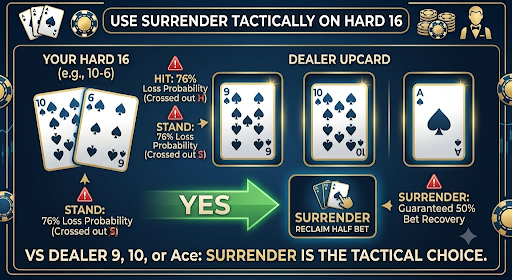
When you’re working with a blackjack strategy chart, surrender options are usually listed separately because they’re table dependent, but when the option is there, taking it on a hard 16 against those three specific dealer upcards saves you money in the long run. This is one of those plays that separates someone who memorized basic moves from someone who’s genuinely applying blackjack optimal strategy, because it requires knowing both the math and the specific table conditions that make it correct.
10. Pick tables with dealer-stands-on-soft-17, double-after-split, and fewer decks.
Not one single rule will turn your night around, but put together they significantly stack the odds back in your favor over the house. In a real casino with a number of blackjack pits, each with its own setup, it pays to spend a few minutes scouting table rules before settling in for a session. This is even more important when selecting an online blackjack real money site, as rules can differ widely from site to site. Understanding these differences is part of finding the best online blackjack strategy for your playing style.
The double deck strategy in Blackjack is especially relevant here as finding a two deck game with good rules can bring the house edge down to about 0.35%. That’s a considerable improvement over the usual six or eight deck shoe. These small differences compound over hundreds of hands, so never underestimate how much table selection contributes to your overall blackjack strategy results.
- Each rule shaves a small amount off the house edge
- Combined effect adds up over a long session
- Table selection is an underrated part of solid blackjack strategy
11. Never chase losses with bet escalation systems like Martingale.
Doubling your bet after every loss sounds logical on paper, win big enough once and you’re back to even, right? Except the odds of any individual hand never change no matter what you bet, and a cold streak can wipe out your entire bankroll faster than you’d think. Flat betting protects you far better than any escalation system ever will, because it keeps your exposure predictable regardless of whether you’re running hot or cold. This is one of those blackjack strategy myths that sounds smart in theory but falls apart in practice, because no betting system actually changes the underlying mathematics of the game. Whether you’re playing casually or chasing serious online blackjack real money winnings, the players who last are the ones who keep bet sizes consistent and let the math play out over time rather than trying to force a recovery through bigger and bigger bets.
- Escalation systems don’t fix the actual house edge
- Cold streaks can drain a bankroll quickly
- Consistency is a core pillar of effective blackjack strategy
12. Learn the Hi-Lo card counting system.
This is the classic entry point into counting, and it’s simpler than people assume. You track plus one for low cards and minus one for high cards as they come out. Over the course of a shoe, this running count gives you a rough sense of whether the remaining cards favor you or the dealer, which can inform bigger bets when the count runs favorable. A blackjack strategy chart won’t cover counting, because it’s a dynamic skill that changes with every card dealt, but it builds directly on the foundation of blackjack basic strategy. You still play every hand according to the chart, you just adjust your bet sizing based on whether the remaining deck is rich in high cards or low cards. This is where blackjack strategy starts becoming blackjack optimal strategy, because you’re no longer just minimizing losses, you’re actively identifying spots where the math favors betting bigger.
| Detail | Info |
| Low cards (+1) | 2, 3, 4, 5, 6 |
| Neutral cards (0) | 7, 8, 9 |
| High cards (-1) | 10, Jack, Queen, King, Ace |
| Goal | Track running count throughout the shoe |
- Simplest widely used counting system in blackjack strategy
- Requires practice to keep pace with dealer speed
- Foundation for more advanced blackjack optimal strategy techniques
13. Calculate the true count in multi-deck games.
A raw running count doesn’t mean much on its own once you’re playing with six or eight decks in the shoe. You need to divide that running count by the number of decks remaining to get an accurate read. Skip this process and essentially you will be calculating for nothing, as a running count of plus six holds a vastly different meaning when you compare a one deck game to a game that uses eight decks. The conversion becomes particularly important when you consider playing using double deck blackjack strategy, as the true count changes a lot when compared to playing with few decks.
However, getting used to doing this math in your head is not an easy task and is what distinguishes people who have learned the Hi-Lo system by heart from those who know how to implement it effectively. Your strategy chart in blackjack remains unchanged in terms of hands; however, your bets become more accurate.
- Essential step for multi-deck accuracy in blackjack strategy
- Without it, running count is nearly meaningless
- Particularly important when applying blackjack double deck strategy
14. Avoid continuous shufflers and prioritize hand-shuffled or traditional shoe games.
These machines keep the game moving at a rapid pace, which sounds fun until you realize how much more money passes through your hands per hour. That speed also completely kills any edge a card counter is trying to build, since the deck composition never settles into a predictable pattern. When you’re playing online blackjack real money games, the equivalent is an auto shuffled digital table that reshuffles every hand, which has the same effect of neutralizing any counting advantage.
This is why blackjack strategy at an advanced level isn’t just about what you do with your cards, it’s about choosing the right game conditions to begin with. A slower hand shuffled table gives you more time to track the count accurately and reduces how much money you expose per hour, both of which matter more than most players realize when they’re trying to build a genuine edge.
- Speed increases total money at risk per hour
- Continuous shuffling erases counting advantages
- Game selection is a core part of advanced blackjack strategy
15. Don’t overcomplicate things before basic strategy is second nature.
This is honestly the biggest mistake to watch out for. Players get excited about card counting or advanced deviations before they’ve even nailed the fundamentals from the core hand decisions section. Inconsistent basic play costs way more money than any missed advanced tactic ever could. Master the core decisions first, then layer in bankroll rules and advanced concepts. These fundamentals create the foundation for the best strategies for blackjack and more consistent decision-making.
Blackjack tournament strategy is another area where players rush ahead too fast, because tournament play requires an entirely different mindset from cash games that only works if your fundamentals are already automatic. If you are not capable of playing the basic strategy of blackjack without even thinking about it, then you shouldn’t even think about tournaments or card counting. The blackjack strategy chart should be considered a backup to you at all times.
- Basic strategy errors are more expensive than they seem
- Blackjack tournament strategy only works on a solid foundation
- Patience with fundamentals pays long-term dividends in blackjack strategy
Final Player Notes Before You Sit Down
Winning this game has nothing to do with being a mathematical wunderkind. It is all about consistency. First learn how to play blackjack, have a blackjack strategy chart handy until playing it comes naturally to you, then start adding your own personal tweaks as soon as you master the basics.
If blackjack ever feels like too much decision making on a stressful night, baccarat for real money is worth exploring as a lower complexity alternative. It has less decisions per hand and a relatively decent house advantage when playing for the banker, making it a welcome departure from the norm without completely giving up the good odds. There are moments in your life when you just want to relax and enjoy yourself, and baccarat offers you a chance to do both.