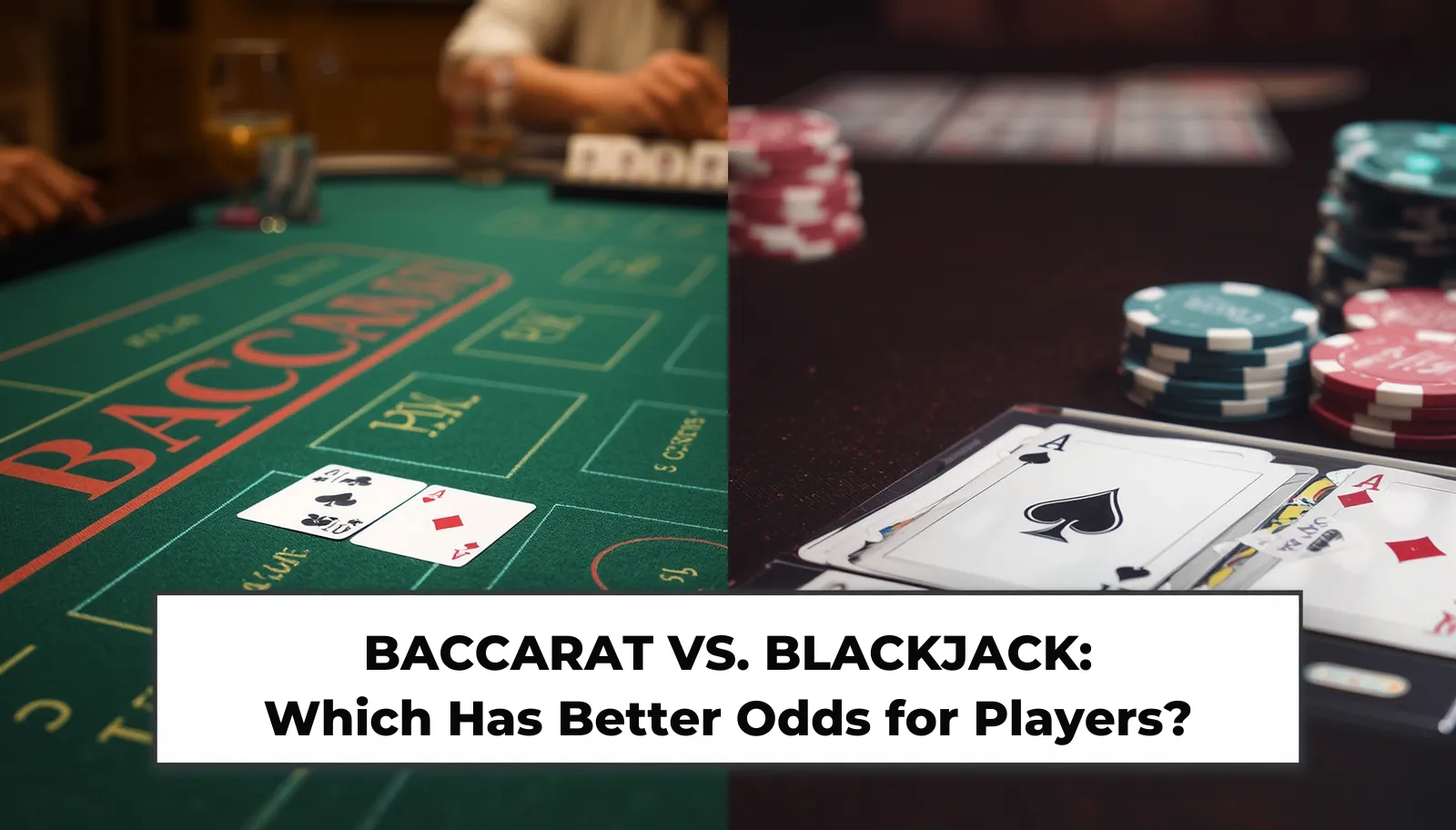
Baccarat and blackjack sit in the same broad category of table games, but they create very different player experiences. One is almost entirely about choosing the right side of a simple bet, while the other rewards strong decision-making and punishes weak choices over time. That difference is exactly why the Baccarat vs. Blackjack question matters so much for players looking beyond style and into actual odds. If the goal is to understand which game gives players the stronger chance of long-term value, the answer depends on whether you want simplicity or whether you are willing to learn strategy and apply it consistently. This guide breaks down Baccarat vs. Blackjack in practical terms, covering house edge, game flow, common mistakes, and the kind of player each game suits best.
Baccarat vs. Blackjack – Clearer Choices
|
What Is the Difference Between Baccarat and Blackjack?
Baccarat and blackjack may both be card games, but they ask almost opposite things from the player. In baccarat, the main choice is where to place the bet: banker, player, or tie. After that, the game follows fixed drawing rules and the player has no strategic decisions to make. In blackjack, every hand creates a sequence of decisions, including whether to hit, stand, double, or split. That means blackjack is a decision-driven game, while baccarat is a bet-selection game.
This matters because odds in casino games are shaped not just by the rules, but also by the amount of control a player has over expected outcomes. When learning how online casinos actually work, it becomes obvious that every game is built around a mathematical edge, but that edge behaves differently depending on whether the player can influence the result with better choices. In baccarat, the edge is mostly fixed around the bet type. In blackjack, the edge changes based on the quality of the player’s decisions and the exact rules of the table.
Baccarat vs Blackjack Odds: House Edge Compared
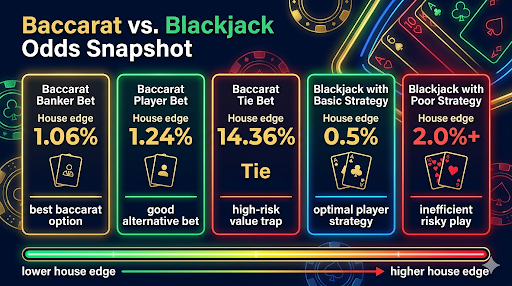
The clearest way to compare Baccarat vs. Blackjack is by looking at house edge, which is the casino’s long-term mathematical advantage over players. In baccarat, the banker bet usually carries the lowest house edge, the player bet is slightly worse, and the tie bet is dramatically worse. In blackjack, the house edge can be very low, but only under good rules and only if the player uses basic strategy correctly.
| Game | Bet / Style | House Edge | Player Impact |
| Baccarat | Banker | ~1.06% | Stable low-edge choice |
| Player | ~1.24% | Slightly higher risk | |
| Tie | 14%+ | High payout, poor value | |
| Blackjack | Basic strategy | ~0.5% or lower | Strongest overall odds |
| Weak strategy | 2%+ | Mistakes increase losses |
The practical takeaway in Baccarat vs. Blackjack is simple. Blackjack can offer better odds for players, but baccarat gives more stable odds with less room for self-sabotage. Players who want the strongest theoretical edge often land on blackjack. Players who want fewer decision errors often prefer baccarat.
House Edge by Bet Type and Playing Style
Not every wager in baccarat or blackjack offers the same long-term value. Some options are designed around lower mathematical advantage for the house, while others carry significantly higher risk despite attractive payouts. This snapshot simplifies the difference between the most common bet types and playing styles.
Why Can Blackjack Beat Baccarat on Odds?
Blackjack has one major advantage that baccarat does not: skilled decisions can actively reduce the house edge. That is the core reason Baccarat vs. Blackjack usually tilts toward blackjack when people talk about raw odds. If you know when to hit, when to stand, and when to double based on the dealer’s upcard, the game becomes one of the lowest-edge options in the casino.
That said, many players never access those better odds in practice. They rely on instinct, superstition, or fragments of strategy remembered incorrectly. That is where a lot of value is lost. Many of the most common errors are still repeated because players misunderstand how probability works in blackjack, which is exactly why so many blackjack strategy myths continue to mislead players. A strong theoretical edge means very little if the player cannot apply it consistently hand after hand.
Baccarat, by contrast, does not give players much room to improve their odds, but it also gives them very little room to ruin them. Bet on the banker repeatedly, avoid the tie bet, and you are already close to optimal play. That simplicity is why many players see baccarat as the safer practical option even if blackjack wins on paper.
Why Can Baccarat Feel Safer in Real Play?
There is a strong practical case for baccarat in the Baccarat vs. Blackjack debate, especially for players who value discipline and simplicity over decision-heavy sessions. Because baccarat has so few choices, it reduces the impact of emotional errors. There is no pressure to make a rapid hit-or-stand call, no temptation to invent patterns, and no false feeling that you can outsmart the shoe through impulsive decisions.
That structure matters more than many players realise. A game with a slightly higher house edge but fewer player mistakes can outperform a lower-edge game in real sessions if the player struggles with discipline. Baccarat is also easier to follow in live dealer settings, where pace, presentation, and confidence matter to newer players. If you are exploring how live casino games work, baccarat is often one of the easiest live table formats to understand quickly because the dealer handles almost everything and the outcome structure is visually simple.
What Table Rules Change the Odds?
Not every blackjack or baccarat table gives the same value. This is one of the most important parts of the Baccarat vs. Blackjack comparison, because good and bad rules can change the edge more than many players expect.
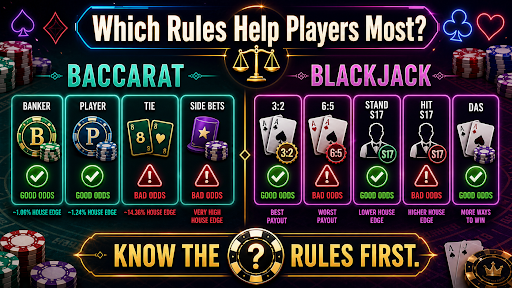
In blackjack, some rules help the player and some help the casino. A table that pays 3:2 on a natural blackjack is far better than one that pays 6:5. Dealer stands on soft 17 are better for players than dealer hits soft 17. The ability to double after splitting also improves the player’s position. These details are not cosmetic, they materially change the odds.
In baccarat, the biggest difference is not usually in the core rules but in what bets are promoted around the table. The banker bet remains the strongest standard option, but many tables push side bets or novelty wagers that look exciting and pay well when they hit. Those extras usually come with a much steeper house edge. The same broad principle that applies to RTP and volatility in casino games also matters here: the most exciting-looking option is not always the most efficient one.
| Table Feature | Better for Players? | Why It Matters |
| Blackjack pays 3:2 | Yes | Keeps blackjack edge much lower |
| Blackjack pays 6:5 | No | Increases the casino edge noticeably |
| Dealer stands on soft 17 | Yes | Slightly improves player expectation |
| Baccarat banker bet | Yes | Usually the best standard baccarat bet |
| Baccarat tie bet or side bet | No | Higher payout, much worse long-term odds |
The Table Conditions That Change Baccarat vs. Blackjack Odds
The quality of a baccarat or blackjack table is often determined by its rules rather than the game itself. Features like payout ratios, dealer actions, and side bet availability all influence how favorable the odds become for players in practice.
| Player Note: A simple game played correctly often beats a better game played badly. That is one of the main reasons baccarat keeps attracting players who care about odds but do not want strategy complexity. |
Blackjack or Baccarat: Which Game Suits You?
Baccarat vs. Blackjack is not only about mathematics. It is also about fit. The better game for one player can be the worse game for another if the style does not match how they naturally play.
Baccarat suits players who want a calm, low-decision experience and who are comfortable repeating one disciplined bet without chasing action elsewhere. It also suits players who play live dealer formats and prefer a more elegant, less tactical atmosphere.
Blackjack suits players who enjoy learning systems, making frequent decisions, and taking active responsibility for the quality of their play. It can be more engaging, more flexible, and more rewarding for disciplined players who like understanding the game deeply. If that is not your style, baccarat may actually deliver better real-world results even if blackjack has the stronger theoretical numbers.
Better Odds Only Matter If You Can Use Them
Blackjack has better odds for players in the Baccarat vs. Blackjack comparison, but only when the rules are good and the player is consistent with basic strategy. That is the technical answer, and it matters. The practical answer is more personal. If strategy discipline is not realistic for you, baccarat can be the smarter choice because it protects you from many of the errors that quietly raise blackjack’s house edge.
The best game is not the one with the lowest published number alone. It is the one you can play correctly, calmly, and within your limits. Play responsibly, avoid low-value side bets, and treat house edge as a guide to better decision-making, not a promise of short-term results.
Experience baccarat and blackjack side by side on Twinqo and see which table game suits your play style best.