Artificial intelligence (AI) has become a core part of many digital industries, from streaming platforms and online shopping to customer support and cybersecurity. Online casinos are no exception. As gambling platforms grow larger and more competitive, operators rely on AI systems to manage data, improve safety, and deliver smoother user experiences.
In online casinos, AI is used to analyze player behavior, detect fraud, personalize content, and automate support systems. These technologies help casinos operate efficiently while meeting regulatory and security requirements.
It’s important to clarify that AI does not control or manipulate game outcomes. Casino games are powered by Random Number Generators (RNGs), while AI works behind the scenes, supporting operations, monitoring risk, and enhancing how players interact with the platform.
What Is Artificial Intelligence in Online Casino Gambling?
Artificial intelligence refers to computer systems designed to perform tasks that normally require human intelligence. In online casino gambling, AI is mainly powered by machine learning, a subset of AI that allows systems to learn from data, identify patterns, and improve performance over time.
How AI Works in Online Casinos?
Online casinos generate massive amounts of data every day. AI systems analyze this data in real time, including:
- Player login behavior
- Betting patterns and session duration
- Device, location, and transaction data
- Game preferences and activity frequency
By processing this information, AI helps casinos understand how their platforms are being used and where potential risks or improvements exist.
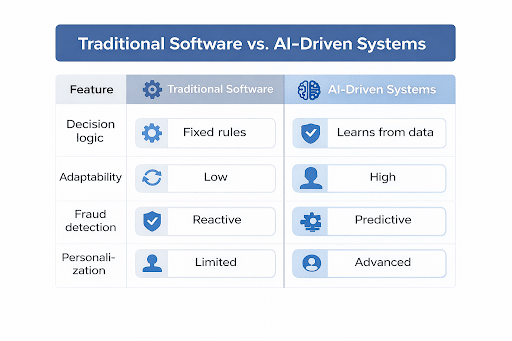
AI vs Traditional Rule-Based Systems
Before AI adoption, casinos relied on static, rule-based software. These systems followed fixed instructions such as:
- Flag any withdrawal above a set amount
- Block accounts after a predefined number of failed logins
While effective to a degree, rule-based systems lack flexibility. AI-driven systems improve on this by adapting dynamically.
Why Is AI More Effective?
AI systems continuously refine themselves by learning from new data. For example:
- If a fraud pattern changes, AI can detect it faster
- If player preferences shift, AI adjusts recommendations automatically
- If suspicious behavior appears subtle, AI can flag it before damage occurs
In short, AI in online casinos acts as an intelligent support system, making platforms safer, more efficient, and more responsive without interfering with fair gameplay or randomness.
How AI Is Used in Online Casino Platforms?
Artificial intelligence plays a practical, behind-the-scenes role in how modern online casino platforms operate. Rather than influencing gameplay, AI focuses on data analysis, content organization, and platform efficiency. Two of the most important areas are player behavior analysis and personalized game discovery.
Player Data Analysis and Behavioral Insights
Online casinos host thousands (or millions) of player sessions daily. AI systems process this activity at scale to identify patterns and trends.
AI reviews data points such as:
- Gameplay frequency (how often players log in)
- Game types played (slots, live games, tables, etc.)
- Session duration and time-of-day activity
- Device usage and platform navigation behavior
Using this information, AI helps casinos:
- Understand overall player trends instead of individual outcomes
- Identify which game categories perform best
- Detect peak usage hours for server and performance planning
- Optimize lobby layout and loading speeds
For example, if data shows that short-session players prefer fast-loading slot games, platforms may prioritize those titles on mobile interfaces. This type of insight allows casinos to improve usability without interfering with gameplay mechanics.
AI-driven analysis is also useful for long-term planning, such as:
- Deciding which game providers to expand
- Improving mobile vs desktop performance
- Adjusting platform design based on user flow data
Game Discovery and Content Personalization
As online casinos grow, game libraries can include thousands of titles. AI helps players navigate this complexity efficiently.
AI-powered personalization includes:
- Suggesting games based on past play history
- Highlighting similar titles using genre, volatility, or feature patterns
- Reorganizing casino lobbies dynamically for each user
- Reducing clutter by surfacing relevant content first
Instead of showing the same lobby layout to everyone, AI adapts the experience. For example:
- A player who prefers live dealer games may see those sections prioritized
- Slot-focused users may receive recommendations based on mechanics they already enjoy
- New players may be guided toward beginner-friendly games
This improves:
- User experience and engagement
- Time spent navigating menus
- Overall platform efficiency for large game libraries
Importantly, AI suggestions do not affect odds or outcomes, they only improve how content is presented.
AI and Online Casino Security Systems
AI also plays a critical role in online casino security systems. In this area, the focus is purely technical: protecting accounts, preventing abuse, and monitoring financial activity.
Fraud Prevention and Account Protection
AI systems continuously monitor player behavior to detect patterns that may indicate risk or misuse.
Common areas AI monitors include:
- Unusual login behavior (sudden location or device changes)
- Repeated failed login attempts
- Simultaneous access from multiple devices
- Abnormally fast or automated gameplay patterns
AI is also effective at identifying:
- Duplicate accounts created to exploit bonuses
- Automated or bot-driven activity
- Coordinated behavior across multiple accounts
Unlike manual reviews, AI can:
- Detect subtle anomalies in real time
- Compare activity against large datasets
- Adapt as fraud techniques evolve
This allows casinos to respond faster while reducing false positives that could affect legitimate players.
Transaction Monitoring
Financial security is another major area where AI is applied.
AI systems review:
- Deposit and withdrawal frequency
- Transaction size patterns
- Payment method consistency
- Sudden changes in financial behavior
For example, AI may flag:
- Rapid deposits followed by immediate withdrawals
- Unusual spikes in transaction values
- Repeated attempts using different payment methods
Once flagged, these cases can be:
- Reviewed internally by risk teams
- Temporarily paused for verification
- Cleared quickly if no issue is found
By automating initial checks, AI supports faster internal verification processes while maintaining compliance and financial integrity.
Overall, AI strengthens casino security by acting as a constant monitoring layer, working quietly in the background to protect both platforms and players.
AI in Live Casino Gambling Environments
Live casino gambling combines real-time gameplay, human dealers, and high-volume streaming technology. In this environment, AI is used strictly for operational support, monitoring, and performance optimization, not for influencing game results or player decisions.
Live Game Monitoring
Live dealer tables generate continuous streams of data from bets, player actions, and system events. AI assists platforms by monitoring this activity in real time.
AI-supported monitoring includes:
- Tracking betting patterns across live tables
- Identifying irregular or coordinated behavior
- Detecting unusually fast or repetitive betting sequences
- Monitoring table activity during peak traffic hours
This information helps platform teams:
- Maintain fair and orderly gameplay environments
- Detect technical issues early
- Support compliance and internal risk checks
- Assist moderators in reviewing flagged activity efficiently
AI does not interfere with live game outcomes. All live casino results are determined by physical equipment such as cards, wheels, or dice, operated by human dealers. AI simply acts as an analytical layer, highlighting anomalies that may require human review.
Additionally, AI tools support live dealer operations by:
- Monitoring table occupancy and player flow
- Helping platforms balance traffic across tables
- Reducing downtime by identifying performance bottlenecks
This allows live casino studios to operate smoothly even during high-demand periods.
Video and Stream Quality Optimization
Live casinos rely heavily on video streaming. Any lag, buffering, or quality drop can negatively affect the player experience. AI helps manage these technical challenges dynamically.
AI-driven video optimization includes:
- Monitoring stream stability in real time
- Automatically adjusting resolution based on bandwidth
- Optimizing latency for smoother gameplay
- Adapting streams to different devices and screen sizes
For example:
- A mobile user on a slower connection may receive a lower resolution stream with minimal delay
- Desktop users with strong connections may receive higher-quality video
- Sudden network drops can trigger instant quality adjustments instead of stream failure
By continuously analyzing connection quality, AI ensures that:
- Streams remain stable across regions
- Players experience fewer interruptions
- Live casino sessions feel consistent and reliable
This behind-the-scenes optimization improves performance without requiring manual intervention from users or staff.
AI and Customer Support in Online Casinos
Customer support is another area where AI plays a practical role in online casino platforms. Rather than replacing human agents, AI helps manage high volumes of routine inquiries efficiently.
AI-Powered Chat Systems
Many online casinos use AI-powered chat systems to handle basic support requests. These systems are designed to respond instantly to common questions, such as:
- Account registration and login issues
- Bonus terms and wagering requirements
- Deposit and withdrawal status
- Game loading or compatibility problems
AI chat systems improve:
- Response times for simple queries
- Availability during peak traffic hours
- Consistency in support information
Because these systems are trained on predefined knowledge bases, they provide accurate answers without delay.
Human Support Escalation
When an issue becomes complex or sensitive, AI systems automatically escalate the request to a human support agent.
Typical escalation scenarios include:
- Account verification concerns
- Payment disputes or transaction delays
- Responsible gambling requests
- Technical issues requiring manual review
AI assists human agents by:
- Collecting relevant information before handoff
- Categorizing issues for faster resolution
- Reducing repetitive questioning
This hybrid approach ensures players receive quick answers for simple issues while still having access to human support when needed. Overall, AI improves efficiency without removing the human element from customer service.
The Role of AI in Platform Optimization
Online casino platforms must remain stable and responsive even during periods of high traffic, such as promotions, tournaments, or peak evening hours. AI plays an important role in maintaining platform performance by managing system resources dynamically and reducing operational stress.
Load Balancing During Peak Traffic
AI helps distribute user activity across servers in real time. By analyzing traffic flow and user demand, AI systems can:
- Redirect users to less congested servers
- Balance live and instant game traffic efficiently
- Prevent overload on individual system components
This ensures that gameplay, payments, and account access remain smooth even when thousands of users are active simultaneously.
Reducing Downtime
AI systems monitor platform performance continuously and can detect early warning signs of technical issues.
These systems:
- Identify unusual spikes in system load
- Detect slow response times or server instability
- Trigger automated adjustments before failures occur
By responding proactively, AI reduces the risk of sudden outages and minimizes service interruptions. This approach is especially important for live casino environments, where uninterrupted access is critical.
Improving Overall Platform Stability
Beyond traffic management, AI contributes to long-term platform stability by analyzing historical performance data.
AI supports:
- Predictive maintenance by identifying recurring technical issues
- Capacity planning for future traffic growth
- Optimization of database queries and backend processes
Over time, this allows platforms to scale efficiently without sacrificing reliability. Instead of reacting to problems after they occur, AI enables preventive system management that improves overall user experience.
Final Thoughts
Artificial intelligence plays a supportive role in modern online casino gambling, operating largely behind the scenes. Its primary function is not to influence gameplay, but to assist platforms in managing scale, security, and usability.
AI helps casinos handle large volumes of data, protect user accounts, and deliver smoother experiences across devices. Core gambling mechanics, such as game outcomes and randomness, remain unchanged and are governed by established systems like RNGs and physical live dealer equipment.
In essence, AI’s role in online casinos is functional rather than outcome-driven. It enables platforms to operate more efficiently while maintaining fairness, stability, and player trust.