
Boston Celtics

Detroit Pistons
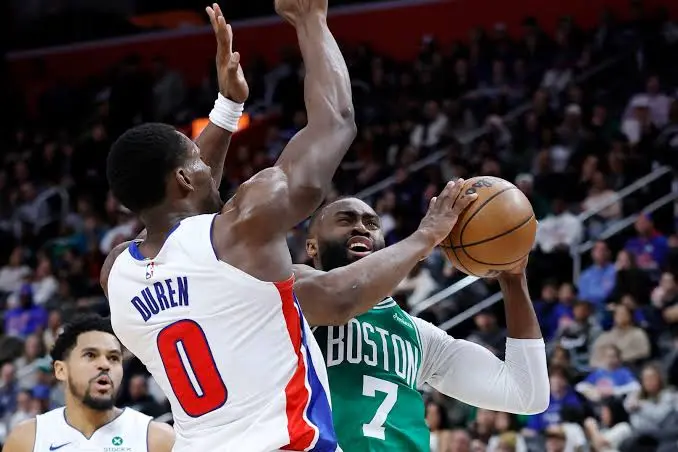
Detroit welcome a reshaped Boston team for an opener built around wing creation, defensive pressure and rebounding. The Pistons finished last season 60-22 and won three of four regular-season meetings with Boston. The Celtics went 56-26 and have since traded Jaylen Brown to Philadelphia in a deal that brought Paul George to Boston. They also added experienced depth through Mike Conley and Mitchell Robinson. Cade Cunningham leads the home attack, while Jayson Tatum and George begin their new partnership. NBA Betting for this matchup centres on whether Boston’s perimeter scoring can overcome Detroit’s home advantage and returning core. Detroit are the narrow pick to win 112-108, with Boston’s perimeter shooting the main threat to that forecast.
Our Prediction
Celtics Vs. Pistons Opening Game Outlook
|
Celtics Vs. Pistons Prediction: The Opening-Day Winner Pick
Detroit are the narrow preference, with a projected 112-108 home win. Their 60-win foundation, returning core and recent matchup advantage support the selection. Boston’s new Tatum-George partnership gives them a credible scoring response. A Boston victory by a few points is the alternative if perimeter accuracy overcomes Detroit’s inside scoring and rebounding.
Recent Performances Behind the Selection
Detroit have one preseason result; Boston have not yet played an exhibition as of 6 October. Their previous regular-season records, 60-22 and 56-26, provide a broader baseline than one preseason comeback or a short playoff sequence.
The Phoenix game offered an early look at Detroit’s new combinations, though preseason minutes differ from regular-season rotations. Boston’s spring losses also involved a previous roster. Detroit’s returning core and home court provide the strongest reasons for the narrow home preference.
Previous Matchups Behind the Selection
Detroit’s three wins in four meetings last season support a modest advantage. Boston’s November shooting performance identifies the clearest counterargument. Detroit must defend the arc without allowing Tatum and George easy drives, while Boston need to prevent Cunningham from repeatedly finding finishing opportunities for the frontcourt.
Predicted Score and Winning Margin
The selected score is Detroit 112, Boston 108. A four-point Detroit win reflects the expectation of another close meeting.
NBA odds for the winner, handicap and total describe separate outcomes. Detroit winning by four would not cover every negative spread. The projected combined score of 220 also does not establish value independently of an offered total and price.
What Are Boston’s Form and Team News Before Detroit?
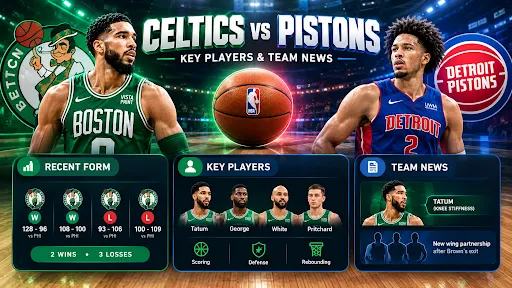
Boston’s main change is the Tatum-George wing partnership after Brown’s move to Philadelphia. White, Pritchard and Queta provide continuity, with Conley and Mitchell Robinson adding experienced options. Boston’s playoff exit came before these roster changes. Opening day tests how quickly the new players share creation and how well the frontcourt protects possessions and rebounds.
Boston’s Recent Results Ahead of the Pistons Game
Boston have not started their 2026 preseason schedule as of 6 October. Their completed games below come from the Philadelphia playoff series, not from a new regular-season campaign.
| Local date | Game | Competition | Result |
| 2 May 2026 | Boston 100-109 Philadelphia | Playoffs, Game 7 | Loss |
| 30 Apr 2026 | Philadelphia 106-93 Boston | Playoffs, Game 6 | Loss |
| 28 Apr 2026 | Boston 97-113 Philadelphia | Playoffs, Game 5 | Loss |
| 26 Apr 2026 | Philadelphia 96-128 Boston | Playoffs, Game 4 | Win |
| 24 Apr 2026 | Philadelphia 100-108 Boston | Playoffs, Game 3 | Win |
Boston won twice before dropping the final three games of the series. Their 128-point Game 4 performance was followed by games in which they scored 97, 93 and 100. Tatum missed Game 7 with knee stiffness. Boston now have a different wing combination following Brown’s departure.
Boston’s Guards, Wings and Bigs for the Pistons Game
White, Pritchard, Tatum and Queta remain central options alongside George, Conley and Robinson. Boston’s main positional groups combine creation, perimeter shooting and different center profiles.
- Guards: Derrick White, Payton Pritchard, Mike Conley and Ron Harper Jr.
- Wings and forwards: Jayson Tatum, Paul George, Sam Hauser, Baylor Scheierman, Hugo González and Jordan Walsh.
- Centers and frontcourt options: Neemias Queta, Mitchell Robinson, Luka Garza, Amari Williams and Chris Cenac Jr.
White can organise possessions and defend guards, while Pritchard adds shooting and secondary creation. Conley offers another ball-handler. George and Tatum can initiate from the wing, with Hauser and Scheierman providing spacing. Queta and Robinson bring screening, finishing and rebounding. George’s arrival changes how Boston share scoring responsibilities alongside Tatum.
Boston’s Projected Starting Five
Boston’s projected starters are Derrick White, Baylor Scheierman, Paul George, Jayson Tatum and Neemias Queta.
White handles the guard responsibilities, George and Tatum share creation, and Queta occupies the middle. Pritchard, Hauser and Robinson provide alternatives that change the balance of ball-handling, spacing and size.
What Are Detroit’s Form and Team News Before Boston?
Detroit retained Cunningham, Thompson and Duren after their 60-win campaign. Collins, Joe and Prince add different frontcourt and shooting options, while Stewart, Harris and LeVert have departed. The goal is to improve spacing around Cunningham while maintaining the defensive pressure that made Detroit effective. Their preseason win provides an encouraging start, although the regular season presents a different test.
Detroit’s Recent Results Ahead of the Celtics Game
Detroit beat Phoenix 109-107 in their preseason opener on 5 October. The table distinguishes that exhibition from the final games of their Cleveland playoff series.
| Local date | Game | Competition | Result |
| 5 Oct 2026 | Detroit 109-107 Phoenix | Preseason | Win |
| 17 May 2026 | Detroit 94-125 Cleveland | Playoffs, Game 7 | Loss |
| 15 May 2026 | Cleveland 94-115 Detroit | Playoffs, Game 6 | Win |
| 13 May 2026 | Detroit 113-117 Cleveland | Playoffs, Game 5 | Loss, overtime |
| 11 May 2026 | Cleveland 112-103 Detroit | Playoffs, Game 4 | Loss |
Detroit recovered from a 68-50 halftime deficit against Phoenix through a 34-16 third quarter. The comeback showed Detroit’s resilience, although one preseason game does not establish how they will start against Boston. Their playoff finish also varied sharply: a 21-point road win forced Game 7, followed by a heavy home loss. The preseason win and playoff results came with different opponents and rotations, so they should be assessed separately.
Detroit’s Guards, Wings and Bigs for the Celtics Game
Cunningham leads the attack, Thompson defends opposing wings and Duren provides finishing and rebounding inside. Detroit’s additions provide new options for perimeter shooting and frontcourt combinations.
- Guards: Cade Cunningham, Daniss Jenkins, Isaiah Joe, Kevin Huerter, Chaz Lanier, Brice Williams, Javonte Green, Elijah Harkless and Ebuka Okorie.
- Wings and forwards: Ausar Thompson, Duncan Robinson, Ron Holland II, Taurean Prince, John Collins and Isaac Jones.
- Centers and frontcourt options: Jalen Duren, Paul Reed, Tolu Smith and Ugonna Onyenso.
Cunningham can score or find an open teammate after drawing extra defenders. Thompson gives Detroit a demanding defensive matchup for Boston’s wings. Duren offers finishing and rebounding, while Collins provides another scoring route. Joe, Huerter and Duncan Robinson widen the shooting options. Duren’s absence against Phoenix was for rest, not confirmation of an opening-day absence.
Detroit’s Projected Starting Five
Detroit’s projected starters are Cade Cunningham, Duncan Robinson, Ausar Thompson, John Collins and Jalen Duren.
Cunningham runs the attack, Robinson supplies movement shooting and Thompson takes the wing-defence role. Collins and Duren provide size around the basket. Joe, Huerter, Prince and Holland give the coaching staff other spacing and defensive combinations.
Celtics–Pistons History Across Recent Seasons
Detroit won three of the four regular-season meetings in 2025/26, including the 19 January 2026 game. Every meeting was decided by seven points or fewer. Brown and Harris contributed heavily but are no longer with their respective teams. The close scores provide matchup history without establishing that the new rotations will repeat those performances.
Scores From the Five Latest Meetings
Detroit won four of the five meetings listed below. The latest four were settled by seven points or fewer; the older February 2025 game ended with a larger margin.
| Date | Venue | Score | Winner |
| 19 Jan 2026 | Detroit | Detroit 104-103 Boston | Detroit |
| 15 Dec 2025 | Boston | Boston 105-112 Detroit | Detroit |
| 26 Nov 2025 | Boston | Boston 117-114 Detroit | Boston |
| 26 Oct 2025 | Detroit | Detroit 119-113 Boston | Detroit |
| 26 Feb 2025 | Detroit | Detroit 117-97 Boston | Detroit |
19 January 2026: Detroit Hold On by One Point
Detroit won 104-103. Harris scored 25, and Brown missed a potential winner at the end. Both players have since changed teams. The narrow finish is a useful matchup reference, but their individual roles do not carry unchanged into the opener.
15 December 2025: Detroit Execute Late
Detroit won 112-105 in Boston. Late execution and turnovers helped separate the sides. Seven points was the largest margin of their four meetings that season, still supporting a competitive forecast rather than an assumption of a wide home victory.
26 November 2025: Boston End Detroit’s Winning Run
Boston won 117-114 and ended Detroit’s 13-game winning streak. The Celtics made 20 of 43 three-point attempts. That performance shows the threat of Boston’s perimeter accuracy, but it does not establish the same output from the revised roster.
26 October 2025: Cunningham and Duren Deliver
Detroit won 119-113 at home. Cunningham scored 25 and Duren 24, while Brown scored 41 for Boston. The Detroit guard-center connection remains relevant; Brown’s scoring belongs to the previous Boston team.
26 February 2025: Detroit Win by Twenty
Detroit won 117-97. Cunningham contributed 21 points and 11 assists, while Beasley scored 26. This older result involved a different rotation and should not outweigh the four closer games that followed.
Betting Tips for the Celtics–Pistons Season Opener
Detroit’s narrow home-win forecast creates several distinct betting routes. The 15 markets below cover the result, scoring, individual contributions and longer-term outcomes; they are alternatives, not a recommendation to combine every selection.
Those choosing to bet on basketball should distinguish the actual market line from the projected 112-108 score. Numerical examples below illustrate settlement and are not presented as live prices.
Moneyline: The Straight-Up Winner
Moneyline selects the team that wins, without adding or subtracting points. Standard full-game basketball moneylines generally include overtime, making the final winner decisive rather than the score after 48 minutes. Detroit are the narrow preference because they host the opener, retained Cunningham and Duren, and won three of four meetings last season. Boston’s Tatum-George partnership gives the visitors a credible response. A one-point Detroit victory satisfies the same condition as a comfortable win. Neither possession dominance nor leading at halftime is enough if Boston finish ahead.
Selection angle: Detroit moneyline best reflects the home-win forecast without requiring a particular winning margin.
Point Spread: The Winning Margin
A point spread adjusts the final score to create a handicap. Detroit minus 2.5 would require a win by at least three; Boston plus 2.5 would succeed with an outright win or a defeat by one or two. These numbers illustrate the rule rather than quote an available line. When the winning margin exactly matches a whole-number spread, the bet can push, meaning the stake is returned under standard rules. Detroit’s four-point projected advantage favours a modest home handicap, not every negative spread. Boston’s perimeter shooting makes a wider Detroit margin harder to justify.
Selection angle: Prefer a handicap consistent with a close contest rather than treating Detroit winning as sufficient for any spread.
Game Total: Combined Points
A game total asks whether both teams’ combined score finishes above or below the posted line. A 225.5 example requires 226 or more for the over and 225 or fewer for the under. Standard full-game totals generally include overtime; a whole-number line can produce a push. The projected 112-108 result adds to 220, but a forecast is not a market price. Boston’s three-point shooting, Detroit’s transition opportunities and offensive rebounds can shift the total without changing the winner. A narrow game does not automatically mean low scoring.
Selection angle: The 220-point forecast supports an under lean only against a sufficiently higher offered total.
Quarter and Half Markets
Quarter and half markets settle on their stated period rather than the final game. They can cover a period winner, spread or total. Boston winning the first quarter would not establish a successful full-game selection, and a Detroit comeback would not rescue a lost first-half bet. Detroit’s Phoenix preseason win followed a large halftime deficit, illustrating the difference between those outcomes. One exhibition cannot establish a dependable slow-start pattern. Rotation changes, substitutions and the initial defensive assignments matter especially over shorter periods, with less time for shooting fluctuations to even out.
Selection angle: A quarter or half selection should reflect the expected opening rotations, not simply the preference for Detroit to win the game.
Live Betting During the Game
Live betting offers updated markets during the Celtics Vs. Pistons game. Prices and lines respond to scoring runs, remaining time, player availability and other developments. A quick Boston lead may alter Detroit’s moneyline without proving the original matchup analysis wrong. Cunningham’s foul trouble, Duren’s minutes or an adjustment to Boston’s wing defence can be more informative than the score alone. Delays and market suspensions mean a displayed price may change before acceptance. A missed shooting sequence also does not establish that the next attempt will fall or that a comeback must follow.
Selection angle: Focus on a genuine rotation or tactical change, not an impulse to recover an earlier losing selection.
Race to a Points Milestone
A race-to-points market selects which team reaches a specified score first within the stated period. For a race to 20 in the opening quarter, only that quarter’s scoring sequence matters. The first team to the target can still lose the period or the game. Boston’s outside shooting can accelerate its score quickly, while Detroit can build through Cunningham’s drives and Duren’s finishing. The target, period and no-team-reaches-it rules determine settlement. Full-game averages do not establish which side will reach a short-term threshold first, particularly when early substitutions change the personnel.
Selection angle: Use the opening lineup and scoring routes rather than translating the Detroit final-score forecast into a race selection.
Individual Player Stat Totals
Player totals measure one named statistic against a line, including points, assists, rebounds, steals or blocks. Cunningham’s points depend on his scoring; his assists depend partly on teammates finishing. Duren’s rebounding depends on minutes, missed attempts and the frontcourt matchup. Tatum can exceed a points line during a Boston loss, so player settlement is separate from moneyline settlement. Whole-number thresholds can push, while half-point thresholds cannot tie. Overtime, participation and injury treatment follow the specific market terms. Familiarity with a player’s name is not evidence that any offered threshold is worthwhile.
Selection angle: Match Cunningham, Tatum or Duren to a clearly defined statistic and role rather than the predicted winning team.
Player Combination Markets
Combination markets add two or more statistics for one player. Points plus rebounds plus assists, often called PRA, totals all three categories rather than requiring a separate minimum in each. Tatum’s varied involvement and Cunningham’s scoring-playmaking role make them relevant examples. A combination gives several routes to the threshold, but it does not automatically reduce volatility or make the bet safer. Reduced minutes can affect every category simultaneously. The combined threshold and available odds determine how demanding the selection is. A player can exceed an individual assists line while falling short of a combined-statistics total.
Selection angle: Cunningham’s scoring and playmaking make him relevant to combination markets, but the combined threshold must suit his expected minutes and role.
Team Statistical Propositions
Team props isolate one side’s output, such as total points or three-pointers made. Boston can exceed a three-point line and still lose, while Detroit can win without exceeding its points total. Boston’s 20 made threes in their November 2025 meeting provide an opponent-specific example, not a repeat guarantee after roster changes. Detroit’s perimeter additions offer new spacing options around Cunningham. A team-points line should be compared with the forecast for that team, not the combined game total. Market definitions also determine overtime treatment and how the statistic is officially credited.
Selection angle: Boston perimeter output and Detroit team scoring express different matchup views; choose the one supported by the actual line.
Parlays Across Multiple Selections
A parlay combines multiple selections into one ticket. Every non-voided leg generally needs to win for the full ticket to pay, subject to the treatment of pushes and cancellations. A single losing leg usually defeats the parlay. Combining Detroit’s result with another game therefore adds another necessary outcome rather than protecting the first. The potential return is larger because fewer combinations satisfy all conditions. Confidence in Detroit does not strengthen unrelated selections elsewhere on the ticket. More selections also create more ways for an otherwise reasonable forecast to fail on one component.
Selection angle: Treat a parlay as a more demanding combined prediction, not a larger version of a standalone Detroit bet.
Same-Game Parlays
A same-game parlay combines selections from this Celtics vs. Pistons matchup. Detroit moneyline, Cunningham assists and a game-total under would each impose a separate requirement. A Detroit win alone is insufficient. Those legs can be correlated: a slower game may help an under while reducing assist opportunities, and additional possessions can affect several statistics together. The combined price reflects those relationships rather than necessarily multiplying standalone odds. A whole-game result and player contribution can also diverge when another teammate leads the scoring. Participation, voiding and push rules determine the final settlement.
Selection angle: Pair selections that fit the same expected game pattern, while recognising that every required outcome must succeed.
Teasers With Adjusted Lines
A teaser combines eligible spread or total selections after moving the lines in the bettor’s favour. A fixed adjustment might turn a Detroit negative spread into a smaller handicap or increase the allowance for Boston. The adjustment size and permitted markets depend on the available product. In exchange, the return is lower than for an equivalent unadjusted combination. Each leg must satisfy the teaser’s conditions, with push rules handled separately. A more forgiving individual line does not eliminate the need for the other legs to succeed, and basketball teaser availability is not universal.
Selection angle: Evaluate the adjusted line and reduced return together instead of describing the extra points as free protection.
Alternative Spreads and Totals
Alternative lines offer different handicaps or totals for the same game at adjusted prices. A Detroit plus 3.5 spread would cover a win or a defeat by up to three, while a larger negative spread would demand a wider victory. These examples are illustrative, not posted selections. Moving away from the main line changes both the permitted outcomes and return. The 112-108 projection supports a close-game assessment but cannot establish value at every alternative. Alternative markets are normally individual choices, unlike a teaser that combines adjusted lines under a specific product’s rules.
Selection angle: Select the margin or total that reflects the expected match pattern, then assess its price separately.
First Basket Scorer
First-basket markets select the player credited with the opening qualifying score. Some products count free throws, while first-field-goal markets require a made shot from the floor. Starter and non-participation rules also differ. Cunningham, Tatum and Duren illustrate different possible scoring routes, but overall points averages do not establish who receives the first shot. The opening possession, initial play and first defensive matchup matter more. A player can lead the game in scoring while losing this selection immediately. The longer offered price reflects a narrow outcome, not evidence of value.
Selection angle: Cunningham, Tatum and Duren offer different opening-shot routes. The selection depends on the first possession and the market’s treatment of free throws.
Season Futures Beyond Opening Day
Futures settle on a later season outcome, such as the championship winner, division winner or Most Valuable Player. They are not bets on the result of Celtics vs. Pistons. Detroit’s 60-win season and Cunningham’s leading role create relevant season-long questions, while Boston’s new Tatum-George partnership adds uncertainty to its outlook. One opening-day result cannot settle an entire campaign. Injuries, trades, schedule strength and playoff performance can change the picture over months. A stake may remain committed until the market resolves, and early cash-out availability is not guaranteed.
Selection angle: Separate any Detroit or Boston season-long preference from the narrow opening-game forecast and the time commitment it requires.
Keep the Celtics–Pistons Opener in Perspective
A late Boston three or a Detroit scoring run should not change the amount set aside for the game. Keep everyday spending separate and avoid adding markets simply because the opener feels exciting.
Gambling Therapy offers free online advice and emotional support internationally.
Gamblers Anonymous lists international peer-support meetings for people seeking help with their gambling.
Online access, languages and meeting schedules vary. Step away when betting starts affecting bills, sleep or relationships.
Disclaimer
Celtics–Pistons selections for 20 October 2026 express opinions, not guaranteed results or returns. Betting is restricted to adults aged 18+, or the higher minimum age required locally, and only where permitted. Never use borrowed money or essential funds. A projected score does not remove risk, and no combination of selections can make a basketball bet certain.
Before Celtics–Pistons Tips Off
The main matchup questions are how Cunningham creates chances for Detroit and how Tatum and George share Boston’s possessions. Those roles can alter scorer, assists and combination markets independently of the predicted winner.