Most players jump into online slots because they’re fast, fun, and visually exciting, but behind every spin lies a mathematical structure that determines how the game behaves over time. Two of the most important concepts that shape your slot experience are RTP (Return to Player) and volatility. Together, they define everything from how often you can expect to win to the size of the payouts you’re likely to see.
Understanding these terms isn’t just for seasoned gamblers or math enthusiasts. Whether you enjoy casual low-stakes sessions or you’re the type who chases big jackpot-style hits, knowing how RTP and volatility work can help you manage your bankroll smarter, choose better-suited games, and set realistic expectations before you start spinning. In this guide, we break down these core mechanics in clear, practical terms, so you can make informed choices and get the most value out of your gameplay.
| Understanding RTP and Volatility in Online Slots
RTP (Return to Player) and volatility are two key metrics that define how online slots behave. RTP indicates the long-term payout percentage, while volatility measures the frequency and size of wins. Together, they shape gameplay experiences, ranging from steady, low-risk sessions to high-risk, high-reward spins, helping players choose slots that match their play style, bankroll, and winning expectations. |
What Is RTP?
RTP, or Return to Player, is a key metric that tells punters how much a slot is designed to pay back over the long run. Expressed as a percentage, RTP represents the theoretical amount returned to players across millions of spins.
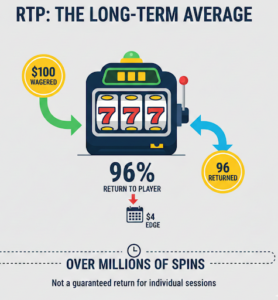
For individual players, RTP should never be seen as a guaranteed return. One punter might hit a bonus early and cash out well above expectation, while another may experience a dry ses sion and land below the theoretical average. RTP reflects long-term performance, not the outcome of a single night or a few hundred spins.
Most online slots fall between 94% and 97% RTP, with some classic or highly branded titles offering slightly lower percentages and certain strategy-friendly games pushing closer to 98%.
How RTP Affects Your Gameplay?
While RTP is a long-term mathematical metric, it still plays a meaningful role in shaping your overall slot experience. For punters, a higher RTP simply means a lower house edge, which improves your chances of stretching your bankroll during longer sessions.
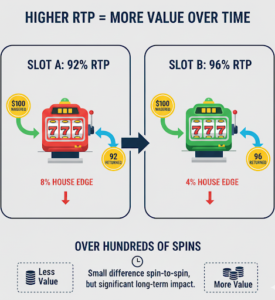
However, RTP doesn’t control how often wins appear or how large they are. You can play a high-RTP slot and still hit a cold run because the percentage is calculated over millions of spins, not your individual play session. RTP influences your expected overall return, not your short-term luck.
Where RTP matters most is in bankroll endurance. Punters who prefer longer sessions with smaller risk often gravitate toward higher-RTP titles because they tend to give back more in the long haul. Conversely, lower-RTP games may feel more expensive to play, especially when volatility is high.
What Is Slot Volatility?
Slot volatility, also called variance, is another critical factor that punters need to understand. While RTP tells you the average return over time, volatility describes how a slot behaves in the short term, essentially, the pattern of wins and losses you can expect during a session. It answers questions like: How often will I win? and How big are those wins likely to be?
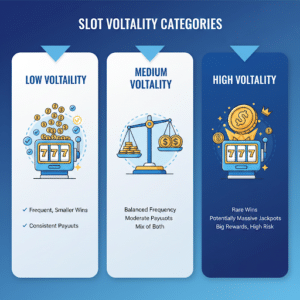
Slots generally fall into three categories:
- Low volatility: Frequent, smaller wins. Perfect for punters who enjoy steady gameplay and want to extend their bankroll. These slots rarely deliver huge payouts but keep sessions exciting with regular rewards.
- Medium volatility: Balanced frequency and payout size. Offers a mix of small wins with occasional bigger hits. Ideal for punters seeking a combination of thrill and consistency.
- High volatility: Rare but potentially massive wins. These slots appeal to risk-takers willing to endure long dry spells in exchange for the chance of hitting life-changing payouts.
RTP & Volatility: How They Work Together
While RTP and volatility describe different aspects of a slot, their true impact emerges when considered together. Think of RTP as the long-term promise of a game, while volatility is the short-term behavior. A slot’s RTP tells you how much value you can expect to get back over millions of spins, but volatility determines how that value is delivered during your session.
For instance:
- A high-RTP, low-volatility slot provides steady, frequent wins. You may never hit a life-changing jackpot, but your bankroll is likely to last longer and grow gradually. This combination is perfect for players who prefer consistent, low-risk sessions.
- A high-RTP, high-volatility slot is mathematically generous in the long run, but wins are rare and unpredictable. You might go several spins without a payout, then hit a large win that compensates for the dry streak. Players chasing big thrills often gravitate toward these games.
- A lower-RTP, high-volatility slot is riskier overall. You may experience long periods with no significant wins, and the expected long-term return is smaller. However, the occasional massive payout can still deliver exciting moments for high-risk players.
Understanding this relationship helps you set realistic expectations. Two slots with the same RTP can feel completely different because of volatility. One might provide a smooth, relaxing session with small wins, while the other keeps you on edge, offering infrequent but high-value payouts.
| Practical Tip: Before starting a session, consider both factors:
By combining RTP and volatility insights, you can choose slots that match your play style, bankroll, and risk tolerance, giving you a more enjoyable and strategic experience. |
Examples of How RTP & Volatility Appear in Real Slots
1. Buffalo’s Sun 3 (Low Volatility, High RTP ~96%)
| Gameplay | Frequent small wins keep your bankroll moving steadily. |
| Session Experience | You won’t hit massive payouts often, but sessions are long and consistently rewarding. |
| Best For | Players who enjoy low-risk, relaxed gameplay. |
2. Thunder Myth (High Volatility, High RTP ~96%)
| Gameplay | Wins are rare at first, but bonus features and multipliers can deliver huge payouts. |
| Session Experience | You may experience long dry spells, but the big wins can be life-changing when they hit. |
| Best For | Risk-takers chasing rare, high-value rewards. |
3. Amazons Riches (Medium Volatility, RTP ~95.5%)
| Gameplay | Offers a balance of smaller wins and occasional larger hits through its bonus rounds. |
| Session Experience | Provides a mix of excitement and steadiness, keeping sessions engaging without extreme swings. |
| Best For | Players seeking a blend of thrill and consistent returns. |
Conclusion
Ultimately, every spin is a mix of chance and design. RTP and volatility don’t guarantee wins, but they give you a framework for understanding the odds and patterns behind the fun. By considering both factors when choosing slots, you can play smarter, stay in control of your bankroll, and maximize your enjoyment every time you sit down to spin the reels.
FAQs: Understanding RTP and Volatility in Online Slots
Can RTP and volatility change between different versions of the same slot?
Yes. Some slots are released in multiple versions where RTP and volatility can differ. Mobile-optimized or special editions may have adjusted payout structures, so players should always check the specific version’s details.
Does volatility affect bonus rounds and free spins?
Yes. High-volatility slots trigger bonuses and free spins less often but can deliver larger payouts, while low-volatility slots provide smaller bonus wins more frequently.
How can beginners use RTP and volatility to choose the right slot?
Beginners should start with high-RTP, low-volatility slots to enjoy longer play sessions and more frequent small wins while learning game mechanics.
Are RTP and volatility the same across online and land-based casinos?
Not always. Online slots usually have fixed, published RTP values, while land-based machines can vary slightly. Online games generally offer more transparency.
Can a slot feel different even if two games have the same RTP?
Yes. RTP reflects long-term returns, while volatility, bonus design, and reel mechanics affect short-term gameplay, making slots with the same RTP feel very different.