
There’s a reason the Aviator crash game has pulled so many players away from spinning reels and toward a single, blinking multiplier. It’s not luck-based nostalgia or flashy graphics. It’s the tension of watching a number climb, knowing it could keep going or vanish in a blink, and having to decide, in real time, when enough is enough. No spinning wheel, no waiting for symbols to line up. Just you, a rising number, and one button. This guide walks through exactly what are crash casino games like Aviator are, its works, its rules, its fairness system, and how to play it with a clear head instead of guesswork.
Aviator Crash Game: The Basics Explained
|
About Aviator Crash Game
No list of crash games is complete without the title that started it all. Aviator crash game is where the entire genre traces its roots, and most of the planes, rockets, and dragons covered so far exist because of the blueprint it set. Aviator was developed by Spribe, a studio founded in 2018, and the game itself launched in January 2019. The concept is about as pure as the genre gets: a red plane takes off, a multiplier climbs from 1.00x, and you cash out before the plane flies off screen. Wait too long, and the stake is gone.
| Detail | Info |
| Developer | Spribe |
| Founded | 2018 |
| Released | January 2019 |
| Genre | Crash game |
| Core mechanic | Multiplier climbs from 1.00x, cash out before the plane flies away |
Core Stats
Aviator’s published numbers are fairly consistent across operators, though a few figures shift depending on where you’re playing.
| Stat | Typical Figure |
| RTP | ~97% (can vary 94-97% by operator) |
| Max win | Up to $10,000 per bet, or higher theoretical caps depending on casino |
| Bet range | $0.10 to $100 |
| Round length | 5 to 30 seconds |
Key Features of Aviator Crash Game
Aviator’s staying power comes down to a handful of features that, at the time, were genuinely new to the crash format.
- Dual betting: Lets you place one or two bets in the same round, so you can cash one out early for a safer win while letting the second ride for a bigger multiplier.
- Auto Cash Out / Auto Bet: Set a target multiplier in advance and let the system handle the timing, or automate repeat bets across multiple rounds without manual input each time.
- Live social feed: A running feed of other players’ bets and cash-outs, plus an in-game chat, gives Aviator a social layer that plainer crash titles don’t really replicate.
- Provably Fair system: This is arguably Aviator’s most distinctive feature. It uses SHA-512 hashing combined with a server seed and client seeds from the first three players to bet in each round. The crash point literally doesn’t exist until those players place their bets, meaning neither Spribe nor any single player can know or influence the outcome in advance. Every round can be independently verified afterward.
- Promotions: Spribe built in tools like Free Spins and a “Rain Promo,” where free spins randomly drop into the chat for other players to claim, reinforcing the communal feel that runs through the whole game.
Aviator Crash Game Rules
The aviator crash game rules are simple on paper, but knowing them could avoid confusion once a round is actually moving.
| Aviator Crash Game Rules | What It Means |
| Betting window | Open only before the round starts, closes once the plane takes off |
| Cash-out timing | Can happen any time during the climb, up until the crash |
| Missed cash-out | Full stake lost, regardless of how close you were to cashing out |
| Betting limits | Vary by platform and currency, usually a wide range from micro-stakes upward |
| Round flow | Continuous, a new round typically opens within seconds of the last one ending |
Because there’s no pause between decisions and outcomes, staying attentive during the multiplier phase matters. The cash-out window can close in a fraction of a second once a crash hits, so this isn’t a game you want to play half-distracted.
Understanding Aviator Crash Game Multipliers and Payouts
The multiplier is the entire scoring system in Aviator crash game, so it’s worth understanding exactly how it turns into real winnings.
How payouts are calculated:
- Bet 10 units, cash out at 2.00x → payout is 20 units
- Bet 10 units, cash out at 5.00x → payout is 50 units
- Same stake, same round type, wildly different outcome depending purely on timing
| Multiplier Range | Frequency | Risk Level |
| Under 2x | Very common | Low risk, low reward |
| 2x to 5x | Moderate frequency | Balanced risk/reward |
| 5x to 10x | Less frequent | Higher risk, solid reward |
| 10x+ | Rare | High risk, high reward |
Low multipliers happen far more often, simply because the plane can crash at any point, including seconds into a round. Higher multipliers show up less frequently but pay out significantly more when they hit.
This creates a natural trade-off:
- Players chasing smaller, steady wins tend to cash out early and consistently
- Players chasing bigger multipliers accept a much higher chance of losing the round entirely, in exchange for a larger potential payout
Neither approach is objectively better. It comes down to personal risk tolerance and how you’re managing your bankroll for that session. If you’re weighing Aviator specifically against a completely different format, this comparison of crash games vs slots and which has better odds for crypto players is worth a look before deciding where to focus your sessions.
Is Aviator Crash Game Fair? Understanding Its Technology
This is one of the most common questions new players ask, and it’s a fair one given how central randomness is to the whole format.
How fairness works:
- Aviator crash game runs on a provably fair system, a cryptographic method that lets the outcome of each round be independently verified after it happens
- The crash point is generated using a combination of server-side and client-side data, set before the round even starts
- This data can later be checked by the player to confirm the result wasn’t altered once bets were placed
Because the crash point is generated randomly and independently every round, previous results have zero influence on future ones. This means:
- Aviator crash casino games results cannot be reliably predicted
- Patterns in the round history bar are not signals, they’re coincidence
- No software can forecast where a specific round will crash
Aviator Crash Game Cash-Out Options
Aviator cash out strategy typically gives players more than one way to manage the cash-out decision, which adds some flexibility to how a round can actually be played.
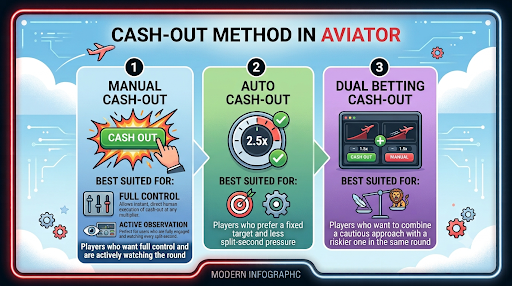
Manual Cash-Out
This is the most direct method. You watch the multiplier climb and click cash out the moment you decide to stop. It gives full control over timing, but it also demands attention, since the difference between cashing out a fraction of a second earlier or later can noticeably change the payout.
Auto Cash-Out Feature
Instead of watching the screen and reacting in real time, you can set a target multiplier in advance. Once the multiplier hits that number, the system crashes automatically, no manual click required. This suits players who want consistency in their approach, or who’d rather not make split-second decisions during a fast-moving round.
Using Multiple Bets in One Round
Some versions of Aviator crash game let you place two separate bets within the same round, each with its own cash-out settings. A common approach:
- Cash out Bet 1 early for a smaller, guaranteed win
- Let Bet 2 ride for a potentially higher multiplier
How to Play Aviator Crash Game: Step-by-Step Guide?
Getting started with Aviator isn’t complicated, but each step matters more than it looks at first glance, since a rushed decision at any point can throw off the whole round. Trying an Aviator crash game demo is the best way to start learning the game.
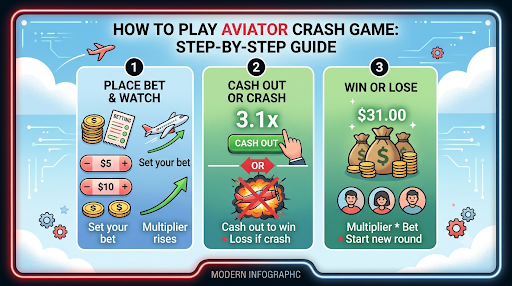
Step 1: Choose your stake
Before the round begins, you’ll see an open betting window, usually lasting just a few seconds. This is where you set how much you want to wager. The key here is to think about your stake in terms of your overall session budget, not just this one round. A common approach is deciding on a fixed unit size before you start playing, then sticking to it rather than adjusting it emotionally round to round.
Step 2: Join the round
Once the betting window closes, you’re automatically locked into that round if you placed a bet. There’s no opting out at this point. The plane takes off, and the multiplier begins climbing from 1.00x. This is where the game shifts from a decision phase into a watching-and-reacting phase.
Step 3: Monitor the multiplier
As the multiplier climbs, your job is to track its pace and decide, in real time, whether to hold or cash out. Early in the round, the climb tends to feel slow. As time passes, it often accelerates, which is exactly why hesitation becomes costly the longer a round runs. This step is really the heart of the entire game. It’s not about predicting anything, since the crash point is already set. It’s about deciding how much risk you’re comfortable carrying moment to moment.
Step 4: Cash out
You can cash out manually by clicking the button the instant you decide you’re satisfied with the current multiplier, or you can rely on an auto cash-out setting if you configured one before the round started. Either way, this action is what converts a rising number into an actual payout. Miss this window, and the stake is gone the second the plane crashes.
Step 5: Review the round
Once the round ends, take a second to look at what happened. Did you cash out at a point that matched your plan, or did you deviate from it? Reviewing isn’t about dwelling on the outcome, it’s about noticing whether your decision-making stayed consistent. This step is often skipped by newer players, but it’s what separates a session built on structure from one built on impulse.
Repeating this same five-step rhythm round after round, rather than reinventing your approach every time based on how the last round went, tends to produce a far steadier and more enjoyable experience over a full session.
Aviator Crash Game Strategies and Tips for Beginners
While Aviator’s outcome is entirely random, how you manage your stakes and decisions still shapes the overall experience, and often the difference between an enjoyable session and a frustrating one comes down to habits rather than luck.
Set a Realistic Cash-Out Target
Setting a realistic cash-out target before a round starts, rather than deciding in the heat of the moment, tends to lead to far more consistent decision-making. If you know you’re aiming to cash out around 1.5x to 2x, for example, you’re less likely to freeze up or second-guess yourself once the multiplier starts climbing.
Manage Your Session Limits
Managing session limits matters just as much as in-round decisions. Setting a maximum amount you’re willing to spend, or a time limit for how long you’ll play, keeps the game feeling like entertainment rather than something that spirals into stress. This is especially important with a fast-paced format like Aviator crash game, where rounds move quickly enough that it’s easy to lose track of time or spending.
Avoid Chasing Losses
Avoiding the temptation to chase losses is one of the most important habits to build. After a losing round, there’s a natural pull to increase your next stake to “win it back.” This instinct is understandable, but it tends to accelerate losses rather than recover them, since each round remains completely independent of the last.
Stick to Smaller, Consistent Decisions
Using smaller, consistent decisions rather than dramatically shifting your approach every round also creates a steadier experience overall. Jumping between conservative and aggressive strategies round to round, based purely on how you’re feeling in the moment, usually leads to inconsistent results and a harder time tracking what’s actually working.
Understand That Rounds Have No Memory
Perhaps most importantly, understanding that previous rounds do not predict future results removes a huge source of unnecessary tension. It’s tempting to look at a string of low multipliers in the history bar and assume a big one is “due,” but the Aviator crash game has no memory. Every round starts fresh, with its own independently generated outcome.
Common Mistakes to Avoid While Playing Aviator Crash Game
A handful of habits show up again and again among newer players, and recognizing them early can save both money and frustration.
Waiting Too Long for Bigger Multipliers
Waiting too long in pursuit of bigger multipliers is probably the most common mistake of all. It happens gradually. A player cashes out successfully a few times, gets comfortable, and starts pushing their target multiplier higher and higher, often past the point where a reasonable, planned cash-out was already available. The pull toward “just a little longer” is exactly what makes crash games risky if left unchecked.
Increasing Stakes After a Loss
Increasing stakes after a loss, in an attempt to recover quickly, is another frequent misstep. It feels logical at the moment, but because each round is independent and carries no memory of past results, a bigger stake after a loss doesn’t improve your odds. It just increases what’s at risk if the next round goes the same way.
Trusting Prediction Software or Signals
Trusting prediction software or pattern-based signals is a mistake that’s easy to fall into, especially since these tools are marketed convincingly. But no external tool has access to the random generation process behind a round, which means they cannot forecast outcomes any better than pure guesswork, regardless of how confident their claims sound.
Ignoring Bankroll Management
Ignoring basic bankroll management is arguably the most damaging habit on this list, simply because it removes the entire structure that keeps the game enjoyable. Playing without a predetermined spending limit, or without any plan for how long a session should last, turns what’s meant to be quick, engaging entertainment into something that can spiral out of a player’s control far faster than they expect.
Playing Aviator Crash Game With Confidence
Aviator rewards players who understand its mechanics rather than those relying on guesswork or prediction tools that simply don’t work. Once the Aviator crash game rules, the multiplier system, and the cash-out options are clear, the game becomes far easier to approach with a steady, considered strategy instead of impulse. Trying the Aviator crash game demo mode first, setting session limits before you start, all make for a smoother, safer experience.
Ready to try it live? Head over to Twinqo for Aviator action with instant withdrawals and no lengthy sign-up. Play now!