
Walk up to any roulette table and the wheel looks almost hypnotic, numbers spinning past in a blur of red and black until the ball finally settles into a single pocket. But before you place a single chip, it helps to know exactly what you are looking at. How many numbers are on a roulette wheel, how are they arranged, and does that arrangement actually matter to your odds? These are questions every new player asks sooner or later, and the answers change depending on which version of the game you sit down to play.
This guide breaks down roulette wheel numbers across every major variant, explains why the count differs between them, and clears up the order and color pattern that often looks random but really is not.
The Numbers That Matter in Roulette
|
The Short Answer: 37 or 38 Numbers Depending on the Wheel
If someone asks how many numbers are on a roulette wheel, the honest answer is “it depends on which one.” Roulette comes in a handful of variants, and the pocket count is the single biggest difference between them.
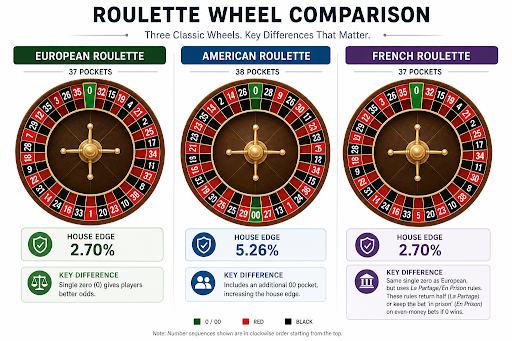
A single-zero wheel, used in both European and French roulette, has 37 numbered pockets. That covers 1 through 36 plus one green 0. A double-zero wheel, the standard in American roulette, adds a second green pocket marked 00, bringing the total to 38. There is also a rarer triple-zero version with 0, 00, and 000, which brings the count up to 39 pockets. So while “how many numbers on a roulette wheel” sounds like it should have one universal answer, the real number depends entirely on the table you choose.
| Wheel Type | Total Numbers | Zero Pockets | Approximate House Edge |
| European | 37 | Single 0 | 2.70% |
| French | 37 | Single 0 | 1.35% (on qualifying even-money bets) |
| American | 38 | 0 and 00 | 5.26% |
| Triple Zero | 39 | 0, 00, and 000 | 7.69% |
European Roulette Wheel Numbers
European roulette is built around the single-zero wheel, meaning it has 37 total numbers: 1 through 36 plus a single 0. This is the version most commonly recommended to new players, largely because that single zero pocket keeps the house edge relatively low, sitting around 2.7 percent on most bets.
The 36 non-zero numbers are split evenly, 18 red and 18 black, with the 0 pocket colored green so it stands apart from both. Roulette wheel numbers on the European layout are not arranged in numerical order around the rim. Instead they follow a specific sequence designed to spread red, black, high, and low values as evenly as possible across the wheel.
American Roulette Wheel Numbers
American roulette uses the same base structure, numbers 1 through 36, but adds a second zero pocket labeled 00. That brings the total to 38 numbers on the wheel. The extra green pocket does not pay out on any of the standard even-money bets, which pushes the house edge up to roughly 5.26 percent, almost double what you would find on a single-zero wheel.
This is the main reason experienced players tend to steer toward European or French tables whenever both are available. The gameplay looks nearly identical from a distance, but that one additional pocket meaningfully changes the math in the casino’s favor.
French Roulette Wheel Numbers
French roulette shares the exact same 37-number wheel as the European version, 1 through 36 plus a single 0, so the pocket count and house edge starting point are identical. What sets French roulette apart is not the wheel itself but a pair of rules, La Partage and En Prison, that can return half or all of an even-money bet if the ball lands on zero. Those rules lower the effective house edge on qualifying bets even further, sometimes down to around 1.35 percent, without changing how many numbers are actually on the wheel.
Triple Zero Roulette and Other Variants
While European, American, and French wheels cover the vast majority of tables you will encounter, a few other variants exist. Triple-zero roulette adds a third green pocket, 000, bringing the wheel to 39 total numbers. This format significantly increases the house edge, often above 7.5 percent, making it one of the least favorable roulette variants for players despite looking nearly identical to a standard wheel at a glance.
Some casinos also offer promotional or themed wheels with additional special pockets, though these are less standardized and tend to be marketed as novelty formats rather than core game types. In every case, more pockets beyond the standard 37 translate to a higher house edge, so checking the wheel type before you bet is always worth the extra few seconds.
Why Does the Extra Zero Change Everything?
It might seem like one extra pocket out of 37 or 38 should not matter much, but that single green space carries real weight. Every zero pocket on the wheel is a number that even-money bets like red/black, odd/even, or high/low simply do not cover. The more zero pockets a wheel has, the more often the ball lands somewhere your bet cannot win, and that gap is exactly where the house edge comes from.
This is why a triple-zero wheel, with 39 total numbers, carries a house edge north of 7 percent, making it one of the worst versions of the game available in terms of player value. Knowing how many numbers on a roulette wheel exits before you sit down is really a shortcut for knowing how favorable or unfavorable that particular table is going to be over time.
The Order of Numbers on a Roulette Wheel Is Not Random
One of the more surprising things new players learn is that roulette wheel numbers are not placed around the rim in any obvious numerical order. On a European wheel, the clockwise sequence starting from zero runs 0, 32, 15, 19, 4, 21, 2, 25, 17, 34, 6, 27, 13, 36, 11, 30, 8, 23, 10, 5, 24, 16, 33, 1, 20, 14, 31, 9, 22, 18, 29, 7, 28, 12, 35, 3, 26.
That looks chaotic at first glance, but there is a clear design logic behind it. The layout alternates red and black pockets around almost the entire wheel, and it balances low numbers (1 to 18) against high numbers (19 to 36) so that neither range clusters together in one section. It also spreads odd and even numbers fairly evenly, so no single area of the wheel favors one betting category over another.
The American wheel follows a completely different sequence because of the added 00 pocket. Starting from 0 and moving clockwise, the order runs 0, 28, 9, 26, 30, 11, 7, 20, 32, 17, 5, 22, 34, 15, 3, 24, 36, 13, 1, 00, 27, 10, 25, 29, 12, 8, 19, 31, 18, 6, 21, 33, 16, 4, 23, 35, 14, 2. Notice that the two zero pockets sit almost directly opposite each other on the wheel, another deliberate design choice meant to keep the layout as balanced as possible despite having two non-covered spaces instead of one.
Colors and Number Distribution of Roulette
Across both major wheel types, the 36 standard numbers split into 18 red and 18 black pockets, with the zero (or zeros) colored green to keep them visually and functionally separate from the colored betting categories.
| Color | Numbers |
| Red | 1, 3, 5, 7, 9, 12, 14, 16, 18, 19, 21, 23, 25, 27, 30, 32, 34, 36 |
| Black | 2, 4, 6, 8, 10, 11, 13, 15, 17, 20, 22, 24, 26, 28, 29, 31, 33, 35 |
| Green | 0 (European and French), 00 (American only) |
Beyond color, the wheel also balances odd and even numbers and keeps low (1-18) and high (19-36) numbers reasonably spread out, rather than grouped together in a single arc. This balance is what makes outside bets like red/black or odd/even function the way players expect, without one section of the wheel skewing results toward a particular category over a long session.
Roulette Table Layout vs Wheel Layout
It is worth separating two things that often get confused, the wheel itself and the betting table. The wheel is where the physical numbered pockets and the spinning mechanism live, while the table layout is the flat betting surface where players place their chips. Roulette table numbers match whatever wheel is in play, so a European table shows 37 numbers including a single 0, while an American table adds the extra 00 space to match its wheel.
Unlike the wheel, the table layout does follow a straightforward ascending numerical order, arranged in three columns of twelve numbers each, with the zero (or zeros) positioned at one end. This is intentional, since players need to locate specific numbers quickly when placing bets, and a scattered sequence like the one used on the wheel itself would make that far harder to do at speed.
How Roulette Wheel Numbers Affect Betting Odds?
Understanding this relationship is useful beyond just picking a table. It also explains why inside bets, which cover fewer numbers and pay out at higher odds, and outside bets, which cover larger groups of numbers at lower odds, both carry roughly the same underlying house edge on any single wheel. The number of pockets sets the baseline, and every bet type on that wheel inherits it.
| Bet Type | Numbers Covered | Payout | Win Probability (European Wheel) |
| Straight Up | 1 | 35 to 1 | 1 in 37 |
| Split | 2 | 17 to 1 | 2 in 37 |
| Street | 3 | 11 to 1 | 3 in 37 |
| Corner | 4 | 8 to 1 | 4 in 37 |
| Red/Black or Odd/Even | 18 | 1 to 1 | 18 in 37 |
Reading the Roulette Wheel Before You Sit Down
Given everything above, the practical takeaway is fairly simple. If you have a choice between tables, a European or French wheel with 37 numbers and a single zero will almost always offer better odds than an American wheel with 38 numbers, and both are a clear step up from any triple-zero format. The number of pockets on the wheel is really a stand-in for how much of an edge the house holds, so it is one of the first things worth checking before you sit down.
Spin the wheel and see where the ball lands. Play roulette on Twinqo today.