Learning how to shoot dice is one of the most exciting parts of playing craps, since it puts you in direct control of the action for the whole table. Whether you are stepping up to a live casino table for the first time or brushing up before a Vegas trip, understanding exactly how to shoot craps dice, the rules behind every throw, and the betting sequence that follows will make you far more confident once it’s your turn. This guide breaks the entire process down into simple, practical steps so you never feel lost when the stickman pushes the dice your way.
Craps Dice Shooting Basics
|
How to Shoot Craps Dice Like a Beginner ?
Shooting dice simply means being the active player whose throw determines the outcome for everyone standing at the table. Craps is unique among casino table games because every single player eventually becomes the shooter, taking turns moving clockwise around the layout. Knowing exactly how to shoot dice, both the technique and the rules, removes almost all of that uncertainty.
Step 1: Place Your Bet Before You Shoot
Before you can even touch the dice, you need money down on the table.
Choosing Your Starting Wager
- Pass Line bet: the most common starting wager, an even money bet placed before the come-out roll.
- Don’t Pass bet: essentially the opposite side of the Pass Line, favored by more experienced players.
- Table minimum: perfectly acceptable if you’re new and just want to shoot without risking much.
This step always comes first, no exceptions. A shooter without a bet on the layout will not be handed the dice, since the entire structure of craps depends on every active shooter having skin in the game. If you’re new to the table, simply place the table minimum on the Pass Line before your turn arrives, and you’re set to shoot.
Step 2: Pick Your Dice
Once it becomes your turn, the stickman, the dealer standing at the center of the table holding a long curved stick, will slide anywhere from five to eight dice toward you across the felt. From that selection, you must choose exactly two dice, and you are required to pick them up using only one hand.
The One-Hand Rule for Picking Dice
- You must choose exactly two dice from the group offered.
- You are required to pick them up using only one hand.
- Using two hands, even accidentally, can draw attention from the boxman.
Quick Inspection Tips
- Confirm the numbers on each die are clearly readable.
- Check that neither die looks chipped, cracked, or damaged.
- Move on immediately once satisfied, rather than sorting through every option offered.
Step 3: Choose Your Grip
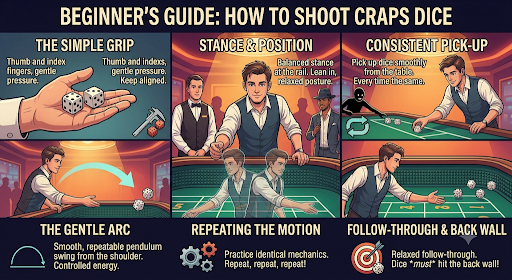
There is no single official grip required for shooting craps dice, and different players develop personal preferences over time. That said, three grips dominate at most tables, and understanding each one helps you find what feels natural.
- Two-finger grip: Line the dice up flat, side by side, so their faces match. Pinch them along the seam between your thumb and middle finger, making sure both fingers make contact with both dice simultaneously. This is the most widely used grip because it offers a good balance of control and simplicity.
- Three-finger grip: Cradle the dice between your thumb, index finger, and middle finger, letting them rest lightly against your fingertips rather than pinching them tightly. This grip tends to suit players with smaller hands, and the throw comes more from a wrist snap than a full arm swing.
- Palm wrap: Wrap your entire hand around both dice and release them with a backhand style motion. This is generally considered the least precise of the three grips, but many total beginners find it the most intuitive starting point since it mimics how people naturally throw small objects.
Whichever grip you settle on, the goal is the same. Hold the dice firmly enough that they won’t slip loose mid-swing, but stay relaxed enough that your hand and wrist don’t tense up. A tense grip almost always leads to an erratic, unpredictable throw.
Step 4: Stand in the Correct Position
Positioning matters more than most beginners realize when trying how to shoot craps dice:
- Stand at the section of the table designated for shooting.
- Make sure you’re positioned behind the line marking the come-out area.
- Hold your throwing hand a few inches above the table surface.
- Keep the dice close without letting them touch the felt prematurely.
This setup gives the dice the room and height they need to build proper momentum once released. Standing too far forward, leaning over the table, or resting your arm directly on the rail can all interfere with a clean throw and may draw a correction from the dealers.
Step 5: Set Up Your Throw
Before releasing the dice, take a moment to find a stable, comfortable stance.
The Pendulum Motion
- Draw your arm back slightly before releasing.
- Swing forward in one smooth, continuous arc.
- Aim toward the far end of the table as you release.
- Keep your feet planted so your upper body stays steady.
Setting the Dice Beforehand
Some players choose to “set” the dice, meaning they orient the faces in a particular pattern before throwing.
- Dice setting is completely legal and common at most tables.
- It should be done quickly, without slowing down the game.
- Taking too long can annoy other shooters waiting for their turn.
Rushing this setup phase is one of the most common reasons new shooters end up with weak or crooked throws, so it’s worth taking an extra second to line yourself up properly rather than throwing on autopilot.
Step 6: Release the Dice Correctly
This is the actual moment of the throw, and it comes with several strict rules enforced by the boxman, the supervisor watching over the table. Breaking any of these rules results in a “no roll” call, meaning the throw doesn’t count and must be redone.
- Use one hand only. Once you’ve picked up the dice, you must throw them using that same single hand from start to finish. Switching hands, cupping the dice between both palms, or passing them from one hand to the other before release will void the roll entirely.
- Loft the dice in a clearly visible arc. The dice need to leave your hand and travel visibly through the air rather than sliding flat along the felt. A grounded, skidding throw does not count as a legitimate roll.
- Add a light flick of the wrist as you release. This small motion imparts natural tumbling rotation to the dice as they travel down the table, which helps create a fair, unpredictable landing.
- Use moderate force, not maximum effort. You don’t need to fire the dice hard across the table. Just enough momentum to carry them cleanly to the opposite end is all that’s required.
The boxman needs a clear, unobstructed view of both dice while they’re airborne to confirm the throw is legitimate. A smooth, visible release matters just as much as where the dice eventually land, so don’t rush this part even if you feel a bit of pressure from the table watching you.
Step 7: Make Sure Both Dice Hit the Back Wall
Every legitimate throw must send both dice the full length of the table so they strike the back wall, which is lined with small pyramid shaped bumps. These bumps exist for a very specific reason: they randomize the bounce of the dice as they hit, preventing any shooter from reliably predicting or controlling the outcome.
What Happens on a No Roll
- If either die falls short of the wall, the boxman calls a no roll.
- You simply gather the dice and throw again.
- No bets already placed on the table are affected.
- This happens to shooters of every skill level from time to time.
Step 8: Wait for the Dice to Fully Settle
Once the dice bounce off the back wall, they’ll tumble briefly before coming to a complete stop somewhere on the table surface. A roll only becomes official once both dice are entirely stationary and resting flat, showing their top faces clearly.
Only after the dice have fully settled will the dealers read the resulting numbers aloud and begin settling all the bets around the table. Trying to call a result before the dice have completely stopped moving is not how the game works, and dealers will always wait for that final stillness before doing anything else.
Understanding the Come-Out Roll
Your very first throw as the new shooter is called the come-out roll, and it sets the direction for the entire round that follows. Understanding this roll is essential to grasping how the rest of the game unfolds.
| Roll | What happens |
| 7 or 11 | Pass Line wins instantly, and a brand new come-out roll begins right away |
| 2, 3, or 12 | Called “craps,” the Pass Line loses, but the shooter still keeps the dice |
| 4, 5, 6, 8, 9, or 10 | Becomes “the point,” marked with a puck placed on that number’s box |
It’s worth repeating that losing on the come-out roll does not end your turn as shooter. Many beginners assume that a losing roll means they’re done shooting, but that’s only true once a point has been established and a seven follows it. Rolling craps on the come-out simply resets the round with you still holding the dice.
The Different Kinds of Shooters in Craps
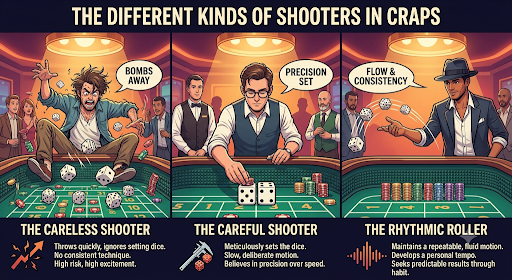
Spend enough time at a craps table and you’ll start noticing that not everyone approaches their turn the same way. Long-time players and dealers alike tend to sort shooters into a few loose categories based on attitude and technique.
The Careless Shooter
This shooter grabs the dice and tosses them without much thought, treating the roll as a formality rather than a moment that matters to the other players. Their rolls are just as random as anyone else’s, but the lack of care can take some of the energy out of the table.
The Careful Shooter
Careful shooters take their time. They set the dice deliberately, settle into a consistent stance, and clearly want to do well, both for themselves and for the other players riding on their roll. Most tables respond well to this energy, since it signals respect for the game and for everyone’s money on the layout.
The Rhythmic Roller
A small number of experienced players practice what’s often called rhythmic rolling, dice control, or precision shooting: a consistent grip, set, and release intended to influence the outcome slightly compared to a purely random toss. This remains a disputed and unproven claim. Casino dice, table bounce requirements, and independent testing are all specifically designed to keep every roll random, and no throwing technique can be relied on to overcome that. Treat this category as a description of a playing style, not a strategy that changes your odds.
Common Mistakes New Shooters Make
Even experienced players occasionally slip up, but these particular errors are worth watching for closely as a beginner.
- Throwing with two hands, or accidentally letting the dice brush against your other palm mid-motion, which automatically voids the roll and forces a re-throw.
- Tossing the dice too gently so they never actually reach the back wall, resulting in a wasted no roll call that slows down the game.
- Taking far too long to select dice or set them before throwing, which frustrates other players waiting their turn around the table.
- Forgetting to place a bet before attempting to pick up the dice, which will simply prevent you from being handed the dice at all.
- Getting visibly frustrated or rattled after sevening out, rather than calmly passing the dice along, since literally every shooter eventually loses their turn this way.
- Standing too far from the table or leaning awkwardly, which throws off balance and often leads to a weaker, less controlled throw.
Avoiding these small mistakes goes a long way toward making your shooting turns smoother, faster, and more enjoyable for everyone standing around the table with you.
Playing Craps Without a Physical Table
If you’d rather build confidence with your throw and betting decisions before stepping up to a live casino table, online craps offers two main formats worth knowing about.
- RNG craps uses software to generate every single result, meaning there’s no physical shooter involved at all. You simply click a button to roll, and the game follows the exact same Pass Line rules and betting structure as the live version, just at a much faster pace. This format is a genuinely practical way to internalize the come-out roll, point phase, and odds betting without any pressure from a crowded table watching your every move.
- Live dealer craps, on the other hand, streams a real table from a professional studio, complete with an actual human dealer physically throwing dice while you place bets remotely from your device. This format gives you the closest possible experience to shooting on a real casino floor, minus the actual physical throw, since the dealer handles that part on your behalf.
Both formats are excellent ways to get comfortable with the rhythm and language of craps before you ever set foot at a physical table.
Bringing Your Shooting Skills to the Table
You now understand every stage of how to shoot dice properly, from placing your first bet and selecting your grip, through the mechanics of a clean release, all the way to reading the come-out roll and backing your point with free odds. The rules around one-handed throws, visible arcs, and hitting the back wall exist to keep the game fair for everyone, and once you internalize them, shooting stops feeling intimidating and starts feeling genuinely fun. Take these steps with you the next time you’re handed the dice, and you’ll shoot with far more confidence than you would have otherwise.
Try your hand at craps on Twinqo today and see how your rolls play out.