Traditional online casinos have trained players to expect a slow, document heavy signup process. You create an account, upload a photo ID, sometimes a utility bill, wait for a review team to approve everything, and only then can you deposit or withdraw. For many players this feels like an unnecessary barrier, especially when the amounts involved are modest and the wait times stretch into days.
No KYC casinos flip this process. Instead of identity documents, they rely on crypto wallets, blockchain transactions, and automated risk monitoring to manage fraud and compliance. Twinqo fits into this category as a licensed, crypto focused casino that allows players to register with just an email address and fund their account using Bitcoin, Ethereum, Litecoin, or other supported cryptocurrencies.
This guide breaks down exactly what KYC means, why some casinos skip it, what triggers verification even at supposedly anonymous sites, and what players should check before trusting any no KYC platform with their money. Players new to the topic can also read What are No KYC Casinos for a wider explanation of how crypto-led registration, deposits, and account reviews work.
No KYC Casino Play
|
What Does KYC Actually Verify?
KYC stands for Know Your Customer, and it is the standard compliance process regulated financial institutions and gambling operators use to confirm who a customer actually is. At a licensed casino, KYC typically verifies three things: identity, age, and source of funds. Each of these checks serves a distinct compliance function, and understanding them individually makes it much easier to see why no KYC casinos represent such a fundamental departure from the traditional onboarding model.
Identity and Age Verification
Identity verification usually involves a government issued ID such as a passport or driver’s license, matched against the name on the account through a process called document authentication. This process checks for tampering, checks that the document has not expired, and often runs a facial recognition or selfie match to confirm the person submitting the document is the same person pictured on it. Age verification confirms the player meets the legal gambling age in their jurisdiction, which is 21 in most US states and 18 in many others, and is typically cross checked against the date of birth printed on the submitted ID rather than a self reported number entered during signup.
Source of Funds and Wealth Checks
Source of funds checks are less visible to players but are used by compliance teams to flag deposits that may be linked to money laundering or other illicit activity. Larger or high frequency deposits sometimes trigger a source of wealth review, where the operator asks for bank statements, payslips, or other financial documentation to confirm the money being wagered came from a legitimate source rather than an attempt to launder funds through gameplay. This layer of KYC tends to activate only at higher deposit volumes, which is why casual players rarely encounter it even at fully KYC compliant casinos.
What Makes Twinqo a No KYC Casino?
Twinqo fits the no KYC casino model because it removes the usual identity verification steps that slow down many traditional online casinos. Players can typically get started without uploading a passport, utility bill, or selfie before making their first deposit, which is the main reason this type of platform appeals to crypto users who want a faster and more private signup experience.
Crypto First Payment Structure
One of the biggest reasons Twinqo can be described as a no KYC casino is its crypto focused payment model. Instead of relying on bank cards or standard fiat payment rails, it uses digital currencies such as Bitcoin, Ethereum, Litecoin, or similar options. This matters because crypto transactions are handled through wallet addresses rather than bank account details, which reduces the need for traditional identity checks at the start.
Minimal Signup Friction
Another factor is the simplified registration process. At a no KYC casino, the signup flow is usually built around basic account creation rather than document review. That means players can often create an account quickly, enter the platform, and begin browsing games much sooner than they would at a casino that requires full verification before the first deposit. For users who value convenience, this is a major part of the appeal.
Faster Access to Play
Twinqo also matches the no KYC model because it prioritizes fast access to gameplay. Instead of forcing players to wait for manual approval, the platform lets them move from registration to deposit to play in a much shorter time. This faster onboarding is especially important for players who want to enjoy casino games without delays caused by verification queues or document rejections.
Privacy Oriented User Experience
A no KYC casino is not just about skipping paperwork. It is also about giving players more privacy and less friction in the overall experience. Twinqo aligns with that expectation by keeping the process lean and focusing on wallet based transactions rather than personal data collection. That makes it a stronger fit for users who want a more private way to play online.
Step by Step: Playing At No Identity Verification Casino
Here’s the actual flow a new player goes through on this no identity check casino:
Step 1
Register using an email address or connect a crypto wallet, no document upload prompt appears anywhere in the process.

Step 2
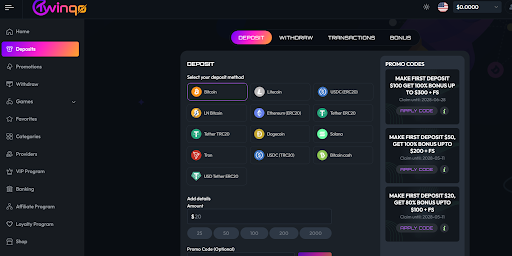
Deposit crypto using BTC, ETH, USDT, LTC, or other supported coins depending on what the platform accepts at the time.
Step 3
Claim a welcome bonus if one is available, since most no identity verification casino offers apply automatically after the first deposit.

Step 4
Play immediately across slots, live tables, or crash games without a verification wait blocking access.

Step 5
Withdraw normally from a no id verification withdrawal casino, while understanding that an ID request can still arise if the account triggers a risk or compliance review.
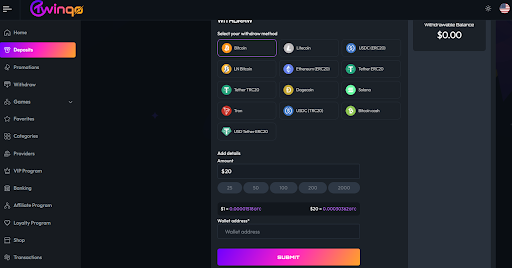
That five step flow is essentially the entire pitch for why players gravitate toward a no ID verification casino format. Fewer steps between deposit and play means fewer chances for friction to kill the experience.
The Regulatory Thresholds Behind KYC Triggers
Most explanations of no KYC casinos stay vague about exactly when verification becomes mandatory. In reality, US gambling compliance is built around specific dollar thresholds set by federal regulation, and understanding these numbers explains why even lenient platforms eventually ask for information. These thresholds were not designed arbitrarily, they reflect decades of financial crime research into where laundering and structuring risk statistically concentrates.
Currency Transaction Reports and the $10,000 Threshold
Under Title 31 of the Bank Secrecy Act, licensed casinos must file a Currency Transaction Report for any cash-in or cash-out transaction, or series of related transactions, totaling more than $10,000 in a single gaming day. This applies to cash and cash equivalents, and while crypto-first platforms operate outside traditional cash handling, the same underlying logic often shapes internal withdrawal thresholds at offshore operators. A CTR itself is not an accusation of wrongdoing, it is simply a mandatory record filed with financial regulators whenever transaction volume crosses this line, and licensed casinos file thousands of these routinely as part of normal operations.irs+1
Suspicious Activity Reports and the $5,000 Threshold
A Suspicious Activity Report must be filed for any transaction, cash or otherwise, that exceeds $5,000 and shows any indicia of fraud or structuring, meaning deliberately splitting a large transaction into smaller pieces to avoid the CTR threshold. This lower threshold is one reason mid-sized withdrawals sometimes trigger a review even when they fall well below the $10,000 CTR level. Unlike a CTR, a SAR filing does carry an implication of suspicious behavior, which is why compliance teams apply more judgment before triggering one, often looking at patterns like rapid deposit-withdrawal cycles or accounts that show no genuine gameplay between transactions.
W-2G Reporting Thresholds by Game Type
The IRS sets specific win thresholds that trigger a Form W-2G, which reports gambling winnings for tax purposes regardless of the casino’s KYC policy. Slot and bingo wins of $1,200 or more require a W-2G, keno wins of $1,500 or more for one to twenty games trigger the same form, and most other wagering categories use a $600 threshold when winnings exceed 300 times the amount wagered. These thresholds apply at the federal tax level and exist independently of whether a casino verifies identity at signup, meaning a player who wins big at a no KYC casino still generates a reportable tax event even if the platform itself never asks for a Social Security number.
How No KYC Casinos Bypass Traditional Checks?
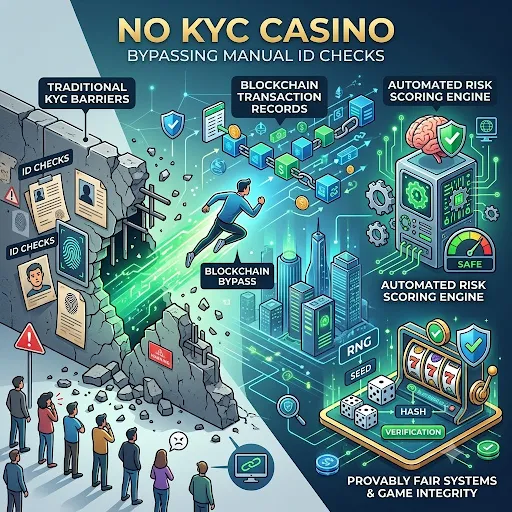
No KYC casinos do not simply ignore fraud and compliance. Instead, they replace document based verification with a different set of tools built around blockchain technology and automated monitoring.
Blockchain Transaction Records
When a player deposits using top cryptocurrencies at online casinos, the transaction is recorded permanently on a public ledger. This gives the operator a transparent record of the deposit amount, timing, and wallet address, even without knowing the player’s real world identity. Every transaction is timestamped and immutable, which creates an audit trail that regulators and internal compliance teams can review retroactively if needed, without requiring documents at the point of deposit. This is a meaningful distinction from traditional cash transactions, which leave no inherent digital trail unless a bank or casino manually records them.
Automated Risk Scoring Engines
Combined with automated risk scoring software that flags unusual account behavior, blockchain records create a layer of oversight that does not require a photo ID to function. These systems typically weigh factors like deposit-to-withdrawal velocity, device fingerprinting, session duration patterns, and geolocation consistency to assign each account a real-time risk score, with higher scores triggering manual review rather than an automatic block. A player who deposits, plays normally for a reasonable stretch of time, and withdraws a proportionate amount will generally register as low risk, while a player who deposits and immediately attempts a large withdrawal with minimal gameplay in between is far more likely to get flagged, regardless of how the platform markets its KYC policy.
Provably Fair Systems and Game Integrity
What makes an online casino safe even without KYC is the provably fair systems. Many crypto casinos use cryptographic hash algorithms that let players independently verify a game’s outcome was not manipulated after the fact, typically by revealing a server seed that was hashed and displayed before the bet was placed. This builds trust in game fairness without needing to know who the player is, since the verification is mathematical rather than identity based. In practice, this means a player can check the fairness of an individual spin or hand using publicly available seed data, something that is simply not possible at most traditional online casinos where the random number generator’s internal logic stays hidden from the player entirely.
Twinqo’s crypto deposit and withdrawal flow follows this same general model, using wallet based transactions as the primary account activity record rather than personal documents, which is part of why it can offer fast onboarding while still maintaining a functioning risk management layer behind the scenes.
What a No KYC Casino Actually Skips vs What It Still Checks?
It helps to separate what “no KYC” really means in practice from what players sometimes assume it means. The label creates an impression of zero oversight, when in reality the casino is simply reorganizing which checks happen upfront versus which ones happen quietly in the background.
Checks Skipped at Signup
Most no KYC casinos skip the following at registration:
- Photo ID upload, such as a passport or driver’s license
- Proof of address documents like a utility bill or bank statement
- Selfie verification matched against an ID photo
- Manual review delays before a first deposit or withdrawal
- Credit checks or bank account linkage verification
This is the part of the process players notice immediately, since it removes the friction that normally delays access to real money play by hours or days at a traditional operator.
Checks That Continue in the Background
What most platforms still monitor on an ongoing basis includes transaction size patterns measured against CTR and SAR style thresholds, wallet address consistency across deposits and withdrawals, IP and device fingerprinting to detect location mismatches or multi-accounting, and win-to-deposit ratios that might indicate bonus abuse or fraud. None of this is visible to the player during normal use, which is exactly why it creates confusion when an account is suddenly flagged despite the casino having advertised itself as verification free.
In other words, the visible paperwork disappears, but the underlying risk management does not fully go away. It just moves from a manual, upfront process to an automated, ongoing one that operates silently unless a threshold is crossed. Players who understand this distinction going in are far less likely to be caught off guard later, since the absence of a signup document request is not the same thing as the absence of any monitoring at all.
Recommended Crypto Wallets for No-KYC Casino Payments
The most suitable wallet depends on the cryptocurrency and network selected in the casino cashier. These options are commonly used because they support a broad range of assets and allow users to control their own wallet addresses.
| Wallet | Suitable for | Key strength |
| Trust Wallet | BTC, ETH, SOL, TRX, USDT, USDC, DOGE, and many other assets | Multi-chain support makes it practical when a casino accepts several coins or networks |
| MetaMask | Ethereum, ERC-20 tokens, Polygon, Base, Arbitrum, BNB Chain, and compatible networks | Useful for Ethereum-based casino deposits and browser wallet connections |
| Phantom | Solana, Bitcoin, Ethereum, Base, Polygon, and Sui | A strong choice where a casino supports SOL or Solana-based assets |
| Bitcoin wallet with Lightning support | BTC and Lightning payments | Suitable when the casino accepts Bitcoin through Lightning for smaller, faster transfers |
| Hardware wallet | Longer-term crypto storage | Keeps private keys offline, making it better for funds not intended for immediate use |
Before using any wallet, check that the casino supports the exact coin and network. For example, USDT on Tron is different from USDT on Ethereum, even though both use the same token name. A wallet should only be chosen after confirming the cashier’s payment instructions.
The Different Tiers of No Verification Casinos
In practice, a no id verification withdrawal casino usually allows routine crypto cashouts without documents, while keeping verification available for higher-risk accounts or larger withdrawal requests.
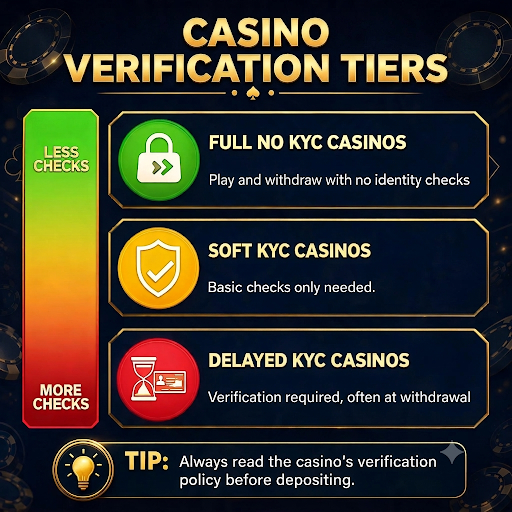
- Full no KYC casinos allow deposits and withdrawals with no identity checks at any stage, relying entirely on crypto transaction monitoring. These are the least common and typically operate under the lightest regulatory frameworks.
- Soft KYC casinos let players deposit and play without verification, but require documents once withdrawals cross a set threshold. This is the most common model in the current market, since it balances player convenience with the operator’s fraud protection needs.
- Delayed KYC casinos only request verification at the point of a large or first withdrawal, regardless of amount, essentially deferring the check rather than skipping it. Platforms like
Twinqo generally fall into the soft or delayed KYC category, offering fast signup and crypto funding while reserving the right to request information under specific circumstances tied to withdrawal size or account activity.
How We Review No-KYC Casinos
A no-KYC casino should be judged on more than fast registration or the absence of document uploads. Our review looks at the information an operator makes available before a player deposits, with particular attention to transparency, safety, and practical payment conditions.
Licence and Operator Details
We start by checking whether the casino identifies the company behind the platform and provides clear licence information. Players should be able to find the operator name, applicable terms, and a list of restricted countries. A licence does not make a casino legal in every location, but visible operator details offer an important level of accountability.
Payments and Withdrawals
We examine the casino’s supported cryptocurrencies, network requirements, transaction limits, fees, and withdrawal policy. A genuine no-KYC policy should explain that document checks may still be requested in certain circumstances, including high-value withdrawals, account-security concerns, or compliance reviews.
Fairness and Bonus Rules
We look for details about game providers, RNG testing, and provably fair systems where relevant. Bonus conditions should clearly state wagering requirements, eligible games, maximum bet limits, expiry dates, and possible cashout caps. Players should not need to search through unclear terms to understand what applies to a promotion.
Support and Player Protection
We also consider available customer support, account security, responsible-gambling tools, and complaint procedures. A transparent platform gives players clear answers about its rules instead of relying only on broad claims about privacy or instant payouts.
Transaction Processing Times
We also consider how clearly a casino explains deposit and withdrawal processing. Fast crypto transfers depend on two separate stages: the casino’s internal approval process and confirmation on the selected blockchain network. A platform should state whether requests are reviewed automatically or manually, outline any pending period, and disclose the factors that can slow a payout.
Why Does Crypto Make Anonymous Play Possible?
Cryptocurrency is the technical foundation that makes low verification gambling possible at scale. Traditional banking rails require a name, account number, and often a physical address tied to every transaction, which naturally pulls identity data into the process. Crypto wallets do not work this way, so the operator can accept deposits and send withdrawals without collecting the same personal information a bank transfer would require.
How Wallet Addresses Work
A crypto wallet address is just a long string of characters generated from a public-private key pair. It is not a legal identity by itself, which means the under 1 hour withdrawal casino sees a transaction destination rather than a bank account holder’s full profile. That difference matters because the platform can verify that funds arrived and left the right wallet without ever asking for a driver’s license or utility bill.
Pseudonymity vs True Anonymity
This system is pseudonymous rather than perfectly anonymous. Every transaction sits on a public blockchain, which means the transfer itself is visible and permanent, even if the user’s real name is not attached. If a wallet is ever linked to a KYC exchange or a custodial service, that trail can connect it back to a real person, which is why no KYC does not automatically mean untraceable.
Why Crypto Improves Speed
If you are wondering how casino withdrawals work in different payment methods. Crypto is the one which improves speed. Bank payouts can take several business days because they pass through payment processors, bank compliance checks, and settlement layers, while crypto withdrawals often complete in minutes or hours depending on the network. That is why a no id verification withdrawal casino often appeals to crypto users who want their winnings sent to a wallet rather than processed through a bank or card provider.
For a player using a platform like Twinqo, that faster settlement is one of the main attractions because it removes the waiting period that usually follows a traditional casino win.
Why Casinos Prefer It
From the casino’s side, crypto reduces payment friction, chargeback risk, and card processor dependence. It gives the operator a cleaner transaction trail and lets the business serve players across multiple regions without building separate banking relationships for each one. That combination of flexibility and traceability is what makes crypto the core infrastructure behind most no KYC casinos.
When Even a No KYC Casino Will Ask for Verification?
Despite the marketing language, no fully licensed casino operates with zero verification safeguards. Despite the marketing language, no fully licensed casino operates with zero verification safeguards. Real world triggers that lead to a verification request include unusually large single withdrawals, a pattern of small deposits followed by one large win and immediate withdrawal attempt, multiple accounts detected from the same device or IP address, and regulatory reporting thresholds that apply regardless of the casino’s internal KYC policy.
Large Withdrawal Triggers
One of the most common reasons a no KYC casino asks for documents is a withdrawal that crosses its internal limit. Operators often align these limits with the same risk logic used in broader casino compliance, so a player who is perfectly fine cashing out a few hundred dollars may still get flagged once the amount becomes material. The threshold is not always public, which is why players sometimes discover it only after requesting a large payout. Even at a no id verification withdrawal casino, unusually large payouts may lead to a document request before funds are released.
Unusual Betting Behavior
A pattern of small deposits followed by one large win and an immediate withdrawal attempt can also raise alarms. Compliance systems look for behaviors that resemble bonus abuse, arbitrage, or money laundering, especially when the account shows minimal gameplay before cashout. Even if the casino advertises itself as no verification, rapid deposit and withdrawal cycles are exactly the kind of activity that makes a review more likely.
Device and Location Mismatches
Multiple accounts detected from the same device or IP address are another obvious trigger. Casinos use device fingerprinting, browser metadata, and location checks to reduce multi accounting and fraud, so a sudden mismatch between login locations, repeated VPN use, or account access from several countries can prompt a request for verification. This is one of the reasons players who want to stay under the radar should keep their setup stable and avoid switching devices or networks unnecessarily.
Regulatory Threshold Pressure
Regulatory reporting thresholds also apply in the background, even if the platform is offshore. Once transaction behavior starts resembling the levels that would normally require CTR or SAR review in a US regulated environment, the casino has a strong incentive to ask for more information before approving the payout. In practice, this means no KYC is often more accurately described as reduced KYC until risk or withdrawal volume reaches a point where the operator needs to protect itself.
No-KYC Casinos: Key Advantages and Points to Consider
No-KYC casinos are designed to reduce friction at registration by using crypto-focused payments and lighter upfront identity checks. The table below highlights the practical differences players should understand before opening an account.
| Area | Potential advantage | What players should keep in mind |
| Account creation | Players can usually register faster without uploading documents during signup | Account details must still be accurate, and the operator may review activity where necessary |
| Privacy | Fewer personal documents may be required at the start | Wallet transactions remain visible on the blockchain and are not fully anonymous |
| Deposits | Crypto payments can be sent directly from a compatible wallet | Players must select the correct asset and network before confirming a transaction |
| Withdrawals | Crypto payments can avoid standard banking hours and card-processing steps | Processing time can vary due to bonus checks, security reviews, transaction limits, and network confirmations |
| Game access | Players can browse and start playing without a lengthy document-review queue | Game availability may differ by location, provider arrangements, and platform rules |
| Promotions | Eligible users may claim offers without completing ID verification at registration | Wagering requirements, game restrictions, expiry dates, and cashout conditions still apply |
| Account reviews | Automated monitoring can help identify unusual activity and protect accounts | A no-KYC policy does not guarantee that documents will never be requested |
How to Reduce Your Chances of Getting Flagged?
While it is not possible to guarantee zero verification requests on any platform, a few habits reduce the likelihood significantly.
Use One Wallet Consistently
Using a consistent crypto wallet address for both deposits and withdrawals avoids one of the most common automated flags, since a mismatch between deposit and withdrawal addresses is treated as a fraud signal by most risk engines. It also creates a cleaner transaction history, which helps the casino see normal play behavior instead of scattered, hard to verify movement across multiple wallets.
Keep Your Activity Pattern Steady
Keeping deposit and withdrawal amounts within a realistic, steady pattern rather than sudden large swings also helps, since risk scoring systems weigh velocity and volume changes heavily. A player who deposits small, plays for a while, and withdraws a modest amount usually looks far less suspicious than someone who makes repeated deposits and then attempts a very large cashout immediately after a single win.
Avoid VPN and Location Changes
Avoiding VPN use while playing matters as well, since location mismatches between login sessions are a frequent trigger for automated review systems. If you log in from one country, then suddenly appear in another, the account can be flagged even if the casino otherwise accepts players without documents. For that reason, stability is often more important than trying to optimize for every possible privacy setting.
Read Bonus Terms Before Claiming
Reading bonus terms carefully before claiming an offer also reduces the chance of a flag tied to bonus wagering irregularities. Offers like Twinqo’s 100% match bonus up to $200 plus 50 free spins can be valuable, but only if the player understands the wagering rules, eligible games, and cashout restrictions before accepting them. A lot of verification requests start with bonus misuse rather than raw deposit size, so this step is easy to overlook but highly practical.
No KYC vs Traditional Casinos: What Actually Changes for Players
| Factor | No KYC Casino | Traditional or Fiat KYC Casino |
| Signup time | Minutes, email only | Often 1-3 days for document review |
| Withdrawal speed | Usually fast, crypto based | Can take days for bank or card payouts |
| Regulatory oversight | Often offshore licensing | Typically state or nationally licensed |
| Dispute protection | Limited formal recourse | Regulator backed complaint process |
| Privacy | Higher, minimal personal data collected | Lower, full identity on file |
| Bonus terms | Similar wagering requirements apply | Similar wagering requirements apply |
The core trade off between crypto casinos and fiat casinos is speed and privacy versus formal regulatory protection. Neither model is inherently better for every player, it depends on what a given player values most.
Risks and Trade-Offs of Skipping Verification
Skipping identity verification gives players speed and privacy, but it also removes several protections that come standard at fully regulated casinos. The biggest trade-off is that a no KYC platform can feel easier to use until something goes wrong, at which point the lack of formal oversight becomes much more visible.
Limited Dispute Recourse
If a payout is delayed or denied at an offshore casino, the player often has far fewer complaint channels than they would at a state-licensed operator. Regulated casinos usually sit under a clear consumer protection framework, while offshore sites may only offer internal support and whatever dispute process is written into their terms. In practical terms, that means you may have to collect screenshots, transaction receipts, bonus terms, and chat logs yourself before you even have a basis to challenge the decision.
Weaker Self-Exclusion Enforcement
Self exclusion is another area where verification matters. At casinos that tie every account to a verified identity, it is harder for a person to simply open a new account after blocking themselves, but at no KYC sites that protection is much easier to bypass. That creates a real concern for players trying to control gambling behavior because the operator has fewer identity anchors to enforce repeated restrictions across multiple accounts.
Higher AML and Fraud Exposure
No KYC models also create more room for AML and fraud problems. Without a strong identity link, it becomes easier for bad actors to open fake accounts, move illicit funds through play, or attempt multi account bonus abuse. That risk does not just affect the operator, it can also affect regular players through slower withdrawals, extra manual checks, stricter bonus rules, or sudden policy changes when the casino tightens controls.
Less Protection Against Age and Identity Abuse
Another trade-off is weaker protection against underage access and identity misuse. A full verification process helps confirm age and identity upfront, while a no KYC model may only rely on payment behavior and later monitoring, which is a softer barrier. That does not automatically make every no KYC casino unsafe, but it does mean the burden shifts from the operator to the player when it comes to choosing a trustworthy platform and staying within the rules.
Payment and Banking Instability
Finally, some no KYC casinos can be less stable from a payments perspective because banks and payment processors are often wary of businesses with weak customer identification controls. That can lead to blocked merchant accounts, tighter withdrawal policies, or sudden changes in accepted payment methods. For players, the result is usually not a visible crisis on day one, but a higher chance that a platform becomes less flexible over time if it cannot maintain good banking relationships.
What to Check Before Trusting a No KYC Platform?
Before depositing at any no KYC casino, a few checks go a long way toward confirming legitimacy. Look for a real license number displayed on the site, ideally one that can be verified against the issuing authority’s public registry. Published RTP percentages and third party game audits are another strong signal, since they indicate the platform allows independent verification of its game fairness.
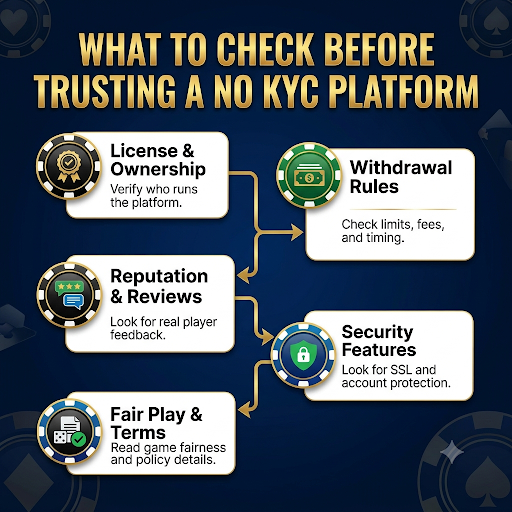
Clear withdrawal limits and processing time disclosures matter too, along with transparent bonus terms that spell out wagering requirements in plain language. Before depositing, check whether a no id verification withdrawal casino clearly explains its withdrawal limits, review triggers, processing times, and bonus-related cashout rules.
Platforms like Twinqo that publish licensing details and clear crypto deposit information tend to score better on this kind of trust checklist than sites that keep this information vague or hard to find.
Why Licensing Matters at No-KYC Casinos
Licensing gives players a way to check who operates a casino and what rules apply. It matters even when registration does not require ID documents.
- Identifies the Operator: A licence should connect the casino to a named company rather than an anonymous website.
- Sets Operating Rules: Licensed operators may need to follow conditions covering customer treatment, payments, marketing, and account management.
- Supports Fair Play: Players can look for information about game providers, RNG testing, or provably fair systems before wagering.
- Provides Complaint Routes: If a withdrawal or account issue cannot be resolved through support, licensing details may help players understand their available options.
- Encourages Safer Gambling: A responsible operator should provide information about age restrictions, spending controls, time-outs, and self-exclusion tools.
How Anonymous Casino Bonuses Work?
Yes, there are bonuses at no KYC casinos, but they are usually structured as standard crypto casino promos rather than fully anonymous, no-strings-attached rewards. The bonus may be available without ID verification at signup, yet it still comes with wagering rules, max bet limits, and withdrawal conditions that matter just as much as the headline offer.
Common Bonus Types
Anonymous or low verification casinos usually offer the same core promo types as traditional sites:
- Welcome bonuses, often a matched deposit offer.
- Free spins, usually tied to a specific slot.
- Cashback or reload bonuses for returning players.
- No deposit bonuses, though these are less common and often come with stricter limits.
What Makes Them “Anonymous”
They are called anonymous because the player does not have to upload identity documents to claim them. In many cases, you can register with just an email address and a crypto wallet, then activate the bonus after making a qualifying deposit. That keeps the signup process fast, but it does not remove the operator’s right to review the account later if the activity looks suspicious.
The Catch Behind the Bonus
The real trade off is that anonymous bonus access does not mean anonymous cashout freedom. Casinos still apply wagering requirements, game weighting rules, maximum bet limits, and sometimes withdrawal caps on bonus winnings. If a player violates any of these terms, the casino can void the bonus or delay the payout, even if no KYC was requested at registration.
Why Players Still Use Them
Players like these offers because they preserve speed and privacy while giving access to extra value. A crypto focused platform such as Twinqo can use this model effectively by pairing a low friction signup with a clear welcome package like 100% match bonus up to $200 plus 50 free spins on a $50 minimum deposit. The bonus is not “free money,” but it can extend gameplay and improve value if the terms are understood upfront.
What to Check Before Claiming
Before accepting any anonymous casino bonus, check the wagering requirement, eligible games, max cashout, and deadline to complete the rollover. Those details matter more than the headline percentage, because a large bonus with harsh terms can be worse than a smaller bonus with simple rules.
Warning Signs to Watch for at No-KYC Casinos
A no-KYC policy is not automatically a safety concern, but unclear practices should make players pause before sending crypto. The most reliable platforms explain how accounts, payments, and withdrawals work before money enters the casino balance.
- Hidden Withdrawal Conditions: Be cautious if limits, fees, pending periods, or document-request rules only appear after a withdrawal is submitted.
- Unclear Bonus Restrictions: Promotions should state their wagering requirement, eligible games, maximum bet, expiry date, and cashout limit. Missing details can create problems later.
- No Payment Evidence: A casino should confirm a completed crypto withdrawal with a transaction reference. Vague payout updates without proof deserve scrutiny.
- Poor Support Responses: Support should give direct answers about withdrawal status, wallet-network compatibility, and account reviews. Repeated generic replies are not helpful.
- Aggressive Claims: Avoid sites that promise guaranteed wins, risk-free bonuses, or permanently anonymous withdrawals. Gambling outcomes remain uncertain, and legitimate operators may need to review activity.
What May Shape the Next Phase of No-KYC Casinos?
The next stage of no-KYC gambling may be less about removing every identity check and more about making account access less intrusive. Instead of requiring the same documents from every new player, operators may divide accounts into different review levels based on activity, transaction size, and local rules.
Flexible Account Tiers
A player might begin with basic access using an email address and wallet. Additional information could be requested only when account activity reaches a level that requires closer review.
More Visible Terms
Players are likely to expect clearer explanations of when an account may be reviewed, what documents may be requested, and how a suspended withdrawal can be resolved.
Better Account Control
Future platforms may place more emphasis on player-led settings, such as deposit caps, cooling-off periods, loss limits, and account breaks. These controls can be useful even when the casino does not rely on full identity verification at registration.
Greater Focus on Reputation
As players become more cautious, a casino’s record for handling withdrawals, complaints, account closures, and support requests may become more important than its “no-KYC” label.
A More Defined Category
The term no-KYC may gradually become more specific. Instead of suggesting complete anonymity, it may describe casinos that allow low-friction onboarding while keeping clear rules for security reviews, age controls, and player protection.
Responsible Play Without an Operator Enforcing Limits
When a casino does not tie every account to a verified identity, some of the traditional responsible gambling safeguards become harder for the operator to enforce consistently, such as identity based self exclusion across multiple accounts. This puts more responsibility on the player to self monitor.
Setting personal deposit limits before starting a session, tracking time spent playing, and using any self exclusion or cool down tools a platform does offer are good habits regardless of KYC policy. Players who notice signs of problem gambling should reach out to resources like the National Council on Problem Gambling helpline, which operates independently of any specific casino platform.