





Slot games may appear similar, but their payout behavior can differ widely over time. One key factor behind these differences is RTP, a term many players see but rarely understand in context. When asking what is RTP in slots, the answer goes beyond a simple percentage, it helps explain why some games offer better long-term value than others. This guide breaks down how slots work, why return rates vary between online games, and how players can identify better paying slots through comparison and understanding. The goal is simple: clearer expectations, smarter choices, and less reliance on guesswork.
Why Do Some Slot Games Feel More Generous Than Others?
Many players sense it quickly, some online slot games seem to give back more, while others feel tighter, even when bets are identical. This “generosity” isn’t about luck alone. It’s shaped by how a game delivers its returns over time and how those returns are experienced during play.
Several Factors Influence This Perception:
-
Win distribution:
Slots that pay frequent small wins tend to feel smoother and more forgiving. Even modest payouts can slow balance decline and create a sense of momentum.
-
Dry spells vs clusters:
Games that rely on infrequent, larger payouts often include long losing stretches. These gaps can make a game feel harsh, despite having similar long-term return rates.
-
Base game vs bonus reliance:
-
-
- Some slots spread value across regular spins.
- Others concentrate most returns into bonus rounds.
When bonuses trigger rarely, the game can feel less generous in day-to-day play.
-
-
Session length effects:
Short sessions amplify perception. A few early wins can make a slot feel generous, while early losses can brand another as “bad,” even if both behave similarly over time.
-
Psychological feedback:
Small, regular wins provide reinforcement. They don’t change outcomes, but they change how the experience feels.
RTP Isn’t About Winning, So What Does It Really Explain?
RTP is often misunderstood because it’s commonly linked to the idea of winning or losing. In reality, RTP does not predict outcomes or signal when a slot is about to be paid. Instead, it explains how value flows through a game over long periods of play.
What RTP Actually Helps Explain:
- Long-term return patterns:
RTP shows the average portion of wagered money that returns to players across thousands or millions of spins. It describes a trend, not a promise tied to any single session. - Balance movement over time:
RTP helps explain why some online games drain balance more slowly than others. A higher return rate generally means less value is removed from play over extended sessions, even though short-term results can vary widely. - Why short sessions feel misleading:
A handful of spins can produce extreme results, big wins or rapid losses. RTP doesn’t smooth these moments out; it only becomes visible when gameplay stretches over time. - Consistency across players:
RTP applies to the game itself, not individual players. Everyone plays under the same mathematical structure, even though each person’s experience may look different. - Why “hot” and “cold” streaks don’t matter:
RTP does not track past outcomes. Each spin is independent, which explains why a game can feel unfair in one session and balanced in another.
Are “Better Paying Slots” Always High RTP Slots?
It’s common to believe that slots with higher return percentages are automatically the best paying. While return rates do matter, they don’t fully explain why some games feel more rewarding than others during actual play. “Better paying” is often shaped by how an online game delivers its payouts, not just by the number attached to it.
Reasons High Return Rates Don’t Always Equal Better-paying Games:
- Long-term averages vs real sessions
Return percentages are calculated over extremely long periods. A single session, or even several, can look very different from that average, making short-term results unreliable. - How are payouts distributed?
Two online games can have similar return rates but very different payout patterns:- One may offer frequent small wins that keep play steady
- Another may rely on rare, larger payouts
Regular wins often make a game feel more generous, even if total returns are similar.
- Volatility influences perception
Games with higher volatility can go through long stretches without wins. During these periods, the slot may feel tight or unrewarding despite strong underlying return values. - Bonus-focused game design
Slots that place much of their value in bonus rounds can feel inconsistent. If those bonuses trigger infrequently, players may not experience the intended return during normal play. - Session length shapes judgment
Early wins can make a slot seem great, while early losses can do the opposite. These impressions are often formed long before the game’s long-term behavior becomes visible.
In practice, a better-paying slot is often one that matches a player’s expectations and comfort with balance swings. Return rates provide useful context, but the overall experience, win frequency, payout timing, and gameplay rhythm, plays a much bigger role in how generous a slot feels.
What Role Does Volatility Play in How RTP Is Experienced?
RTP describes how much a slot is designed to return over long-term play, but volatility determines how that return is delivered. This is why two online games with the same RTP can feel completely different in real sessions. Volatility shapes the rhythm of wins, the size of payouts, and the emotional highs and lows players experience.
In simple terms:
- RTP = how much is returned over time
- Volatility = how that return is distributed
How Volatility Changes the Feel of RTP?
- Win frequency:
Low-volatility slots tend to award wins more often, even if those wins are small. High-volatility slots may go many spins without a payout. - Payout size:
Low volatility spreads returns across many modest wins. High volatility concentrates returns into fewer, larger payouts. - Session experience:
Volatility affects whether a session feels steady or swingy. RTP alone can’t explain this difference.
Why Low Volatility Can Feel More “Generous”?
- Frequent small wins slow balance decline
- Players receive regular feedback and reinforcement
- Sessions often last longer on the same budget
Even though individual wins are modest, the consistency creates a sense of value and control.
Why Can High Volatility Feel Unfair (Even When It Isn’t)?
- Long losing streaks are common
- Most of the return is locked into rare outcomes
- Players may exit sessions before reaching high-paying events
This can make a game feel tight or unrewarding, despite strong long-term return math.
Volatility and Player Expectations
Volatility doesn’t change RTP, but it changes how quickly and clearly RTP is felt.
- Short sessions favor low volatility for visible returns
- Long sessions are where high volatility can finally reveal its value
Understanding volatility helps explain why RTP percentages alone don’t tell the full story. The experience of return depends less on the number itself and more on when and how that value appears during play.
Why Does the Same Slot Pay Differently on Different Platforms?
Many players are surprised to find that a familiar slot seems to behave differently depending on where it’s played. The visuals, rules, and features may look identical, yet the gameplay experience can vary noticeably. This difference isn’t imagined, it often comes down to how return settings are applied across platforms.
Key Reasons the Same Slot Can Pay Differently:
- Multiple return configurations:
Some slot titles are released with more than one return setting. The core game remains unchanged, but the return rate is adjusted before the game goes live on a platform. - Platform-level selection:
Platforms typically choose which version of a slot to offer. This decision may be influenced by market regulations, audience preferences, or internal operating models. - Identical gameplay, different math:
Because the game’s visuals and features don’t change, players assume the experience should be the same everywhere. In reality, the underlying return structure can differ while everything else appears identical.
Why Players Rarely Notice the Difference?
- Return information is often buried in help menus
- Players focus on themes and features, not technical settings
- Short sessions can mask long-term differences
These factors make it easy to assume all versions behave the same.
How Do These Differences Affect Gameplay?
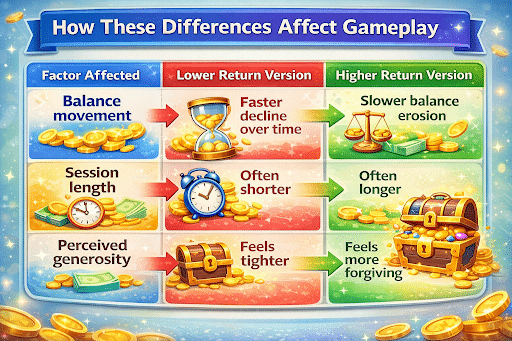
Understanding how to play slot games helps explain why return differences affect how long your balance lasts and how the game feels over time. Over long play, these differences become more noticeable, even though individual spins remain random.
Why Regulation and Region Matter?
In some regions, return settings are regulated or must meet minimum standards. In others, platforms have more flexibility. This explains why the same slot can feel more player-friendly in one region and less so in another, even when everything else is identical.
What Players Can Take Away?
The key point is that a slot’s behavior isn’t defined by its name or appearance alone. Platform-level return settings play a major role in shaping long-term results. Understanding this helps players avoid assumptions and better explain why the same slot title can feel noticeably different across platforms, even when the gameplay looks exactly the same.
How Can Players Identify Better Paying Games Without Chasing Numbers?
When players look for better paying online slot games, the first instinct is often to search for the highest percentages or compare figures across titles. While return rates provide useful background information, focusing on numbers alone can lead to misleading conclusions. A more reliable approach is to understand how a game behaves in practice and how its design influences the playing experience over time.
One of the most important signs of a better paying game is balance behavior. Online games that feel fair over longer sessions often show gradual balance movement rather than sudden, steep drops. This doesn’t mean constant wins, but it does suggest that the game distributes payouts in a way that allows play to continue without extreme swings dominating every session.
Key Gameplay Traits That Often Signal a More Balanced Slot Include:
- Clear and predictable payout structure
Slots that clearly explain how wins are formed, how bonuses trigger, and how features work tend to feel more consistent. Confusing mechanics can hide value behind rare or hard-to-understand events. - Regular interaction during base play
Games that provide small but frequent interactions, such as modest wins, recurring slot symbols combinations, or minor feature activations, often feel more rewarding than online games that rely almost entirely on rare, high-impact bonus rounds.
Another important factor is how value is spread across the game. Some slots allocate most of their return to base gameplay, while others concentrate it heavily on bonus features. Games that spread value more evenly tend to feel better during typical play sessions because players don’t have to wait long periods for meaningful outcomes.
Design Clues That Often Point to a More Player-Friendly Experience Include:
- Bonus features that trigger at a reasonable pace
- Multiple win paths rather than a single high-paying event
- Transparent rules without excessive conditions
Familiarity also plays a larger role than many players realize. When players understand a game’s rhythm, how often it tends to pay, how features activate, and how the balance moves, they make calmer decisions. This familiarity reduces impulsive betting and helps players recognize when a game’s behavior aligns with their expectations.
Another overlooked element is session consistency. A game doesn’t need to produce large wins to feel worthwhile. Slots that offer steady play, predictable volatility, and manageable swings often feel better paying over time because they avoid extreme outcomes that end sessions quickly.
Instead of Chasing Numbers, Players Benefit From Observing:
- How often wins appear relative to bet size
- Whether losing streaks feel manageable or excessive
- How quickly bonuses or features reappear
It’s also important to separate short-term luck from overall game design. A single strong or weak session doesn’t define a slot. Players who evaluate online games across multiple sessions often develop a clearer sense of which titles provide a smoother, more balanced experience.
Ultimately, identifying better paying online games without relying on numbers comes down to pattern recognition rather than calculation. Games that communicate clearly, distribute value steadily, and align with a player’s tolerance for swings tend to feel more rewarding in real play. By focusing on how a slot behaves, rather than what its statistics promise, players can make more informed choices and enjoy a more consistent playing experience over time.
Final Thoughts
Slot RTP is best viewed as a design reference rather than a form of control, reflecting how a game is structured to return value over long periods of play rather than how it will behave in any single session. It doesn’t predict outcomes or signal when wins are due, but understanding it helps shape the right mindset for winning at slot games by focusing on informed choices instead of false guarantees. RTP mainly explains why certain slots feel different from others, as real gameplay is influenced far more by win frequency, volatility, bonus mechanics, and balance movement than by a single percentage. When players expect RTP to balance losses or “kick in” after dry streaks, frustration often follows. A practical understanding of RTP encourages realistic expectations and helps players choose online games based on comfort and play style rather than chasing numbers.