
AHL hockey betting means choosing an outcome, accepting the bookmaker’s price and staking money under that market’s settlement rules. Check the available lineup and starting goalie if a National Hockey League (NHL) recall or late team announcement changes the matchup.
AHL Betting Tips: Match Predictions and Pre-Match Analysis
AHL match predictions assess a fixture using team form, available players, expected starting goalies and the market being considered. Reassess a prediction if confirmed team news or the available betting price changes before puck drop.
A useful preview identifies the selected outcome and explains the evidence behind it. A winner forecast, projected score and goals prediction answer different questions, so each needs a clearly defined market and settlement period. An opinion about the eventual winner does not automatically support a regulation victory or a particular goal margin.
Compare the forecast with the available AHL odds before deciding whether to bet. A team expected to win is not automatically an attractive selection at every price. Predictions remain forecasts rather than guaranteed results, and a projected score is not a confirmed outcome.
This guide explains how to place an AHL bet, read decimal and American odds, compare the 6 main markets and understand settlement. It covers match research, Calder Cup futures, live betting and practical spending limits.
 Grand Rapids Griffins4
 Colorado Eagles2
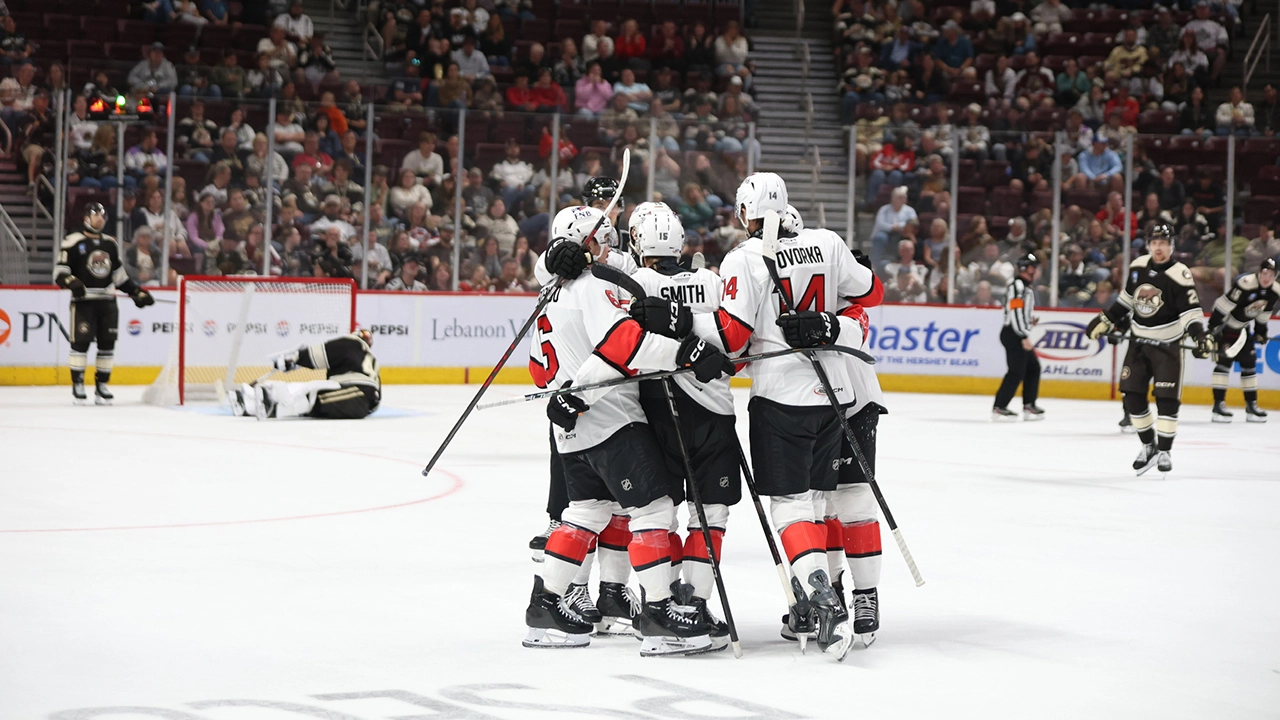
Grand Rapids Griffins edged Colorado Eagles 4-3 in overtime, with John Leonard scoring twice, including the dramatic game-winner of their November 20, 2026 clash.Read More
The American Hockey League (AHL) is the NHL’s main development competition, with clubs in the United States and Canada. For bettors, that relationship makes current personnel as relevant as recent results. A team’s record describes what happened with previous lineups, not every player available for its next game.
AHL Betting: Key Takeaways
|
What Is the American Hockey League?
The American Hockey League (AHL) is a professional ice hockey competition in the United States and Canada and the main development league for National Hockey League (NHL) organizations. Check the full team name if a betting page lists clubs from both competitions.
The AHL gives players a development route to the NHL, but its clubs compete in their own regular season and playoffs. Its main features are:
- League structure: The 2026–27 season includes 32 clubs, each affiliated with an NHL organization.
- Regular season: Each club plays 72 games before the playoffs.
- Playoff qualification: A total of 23 teams qualify through division-based standings.
- Championship: AHL teams compete for the Calder Cup, while NHL teams compete for the Stanley Cup.
The Toronto Marlies and Providence Bruins are AHL clubs. The Toronto Maple Leafs and Boston Bruins are NHL clubs. Related names and shared locations do not make their schedules, results or betting markets interchangeable.
For AHL hockey betting, player movement between affiliated clubs deserves particular attention. An NHL recall removes a player from the available AHL roster, while an assignment adds a player to it. Check the latest transactions before assessing a matchup, especially when they involve a leading scorer, regular defenceman or starting goalie.
How Do You Place an AHL Bet in 7 Steps?
To place an AHL bet, follow these 7 steps, from choosing an eligible operator to checking your confirmed wager. Stop before submitting the bet if the price or conditions differ from your intended selection.
Step 1: Check Operator Eligibility
Check that the operator is authorized to accept bets in your location and that you meet its age and account requirements. Review the registration conditions if you are opening an account for the first time.
Step 2: Prepare Your Account
Prepare your account by completing registration, required identity checks and payment setup. Review the deposit and withdrawal conditions if you plan to transfer money into the account.
Set an entertainment budget before depositing. Keep betting funds separate from money needed for bills, savings or other commitments.
Step 3: Find the AHL Fixture
Find the AHL fixture by selecting Ice Hockey, then American Hockey League or AHL in the sportsbook menu. Check the full team names if the listing uses abbreviations.
Confirm both teams, the match date and the displayed timezone before opening the betting markets.
Step 4: Review the Matchup
Review the matchup by comparing the available roster, expected starting goalie, recent performance and rest schedule. Update your assessment if a late injury or NHL recall changes the lineup.
Separate confirmed team news from projected lineups. A previous result does not describe every player available for the next game.
Step 5: Select Your Betting Market
Select the betting market that matches your prediction, such as the winner, regulation result, puck line or goals total. Check the settlement period if your selection depends on overtime or shootouts counting.
Compare AHL betting odds for the same outcome and conditions. A regulation-win price and an overtime-inclusive winner price concern different bets.
Step 6: Enter Your Stake
Enter your stake using money already allocated to your entertainment budget. Reduce the amount or skip the bet if it exceeds your planned limit.
Review the potential total return and distinguish it from profit. The total return on a winning bet includes the original stake.
Step 7: Check and Confirm Your Bet
Check the team, market, period, line, odds and stake before confirming your bet. Review the selection again if the bookmaker displays a price-change notification.
Submit the wager only after accepting its conditions. Open your account’s betting history or open-bets section to confirm acceptance, then retain the bet reference.
How Do You Read AHL Betting Odds?
To read AHL betting odds, check what you are betting on, identify the price format and calculate the potential payout. Review the settlement rules if the market does not clearly state whether overtime and shootouts count.
AHL betting odds appear here in 2 formats: decimal and American. American odds use either a plus or minus sign, as explained below.
| Odds Format | Example | How to Read It | Result of a $10 Winning Bet |
| Decimal | 2.50 | Multiply your stake by 2.50 to calculate the total return. | $25 returned: $10 stake plus $15 profit. |
| American, positive | +150 | A $100 stake earns $150 profit. Smaller stakes scale proportionally. | $25 returned: $10 stake plus $15 profit. |
| American, negative | −200 | A $200 stake earns $100 profit. Smaller stakes scale proportionally. | $15 returned: $10 stake plus $5 profit. |
How Do You Read an AHL Betting Selection?
To read an AHL betting selection, check the outcome, settlement conditions, odds and stake before calculating the potential return. Review the bet slip again if any detail differs from your intended wager.
Consider this hypothetical example:
Home team to win, including overtime | Decimal odds: 2.50 | Stake: $10
Step 1: Identify the Team or Outcome
Identify the team or outcome you are backing. Check the full team name if the listing uses an abbreviation.
“Home team to win” means your selection depends on the home team winning under the market’s rules. You are not predicting an exact score or requiring a particular winning margin.
Step 2: Check the Settlement Conditions
Check which parts of the game count towards settlement. Read the market rules if overtime or shootout treatment is unclear.
“Including overtime” means the home team does not need to win within regulation. A regulation draw followed by a home-team overtime victory satisfies that condition. Check shootout treatment separately rather than assuming it is included.
Step 3: Read the Offered Odds
Read AHL betting odds to understand the return available for each unit staked. Convert the price if you are comparing different odds formats.
Decimal odds of 2.50 mean every $1 staked returns $2.50 after a win, including the original stake. The equivalent American price is +150.
Step 4: Confirm Your Stake
Confirm the amount you are risking on the selection. Reduce the stake or skip the bet if it exceeds your planned spending limit.
In this example, you commit $10. A losing selection normally results in losing that stake unless an applicable settlement rule provides otherwise.
Step 5: Calculate the Return and Profit
Calculate the total winning return by multiplying your stake by the decimal odds. Subtract the original stake if you want to find the profit rather than the total payout.
- Total return: $10 × 2.50 = $25.
- Profit: $25 − $10 = $15.
A successful wager returns $25 in total: your original $10 stake plus $15 profit.
Which 6 AHL Betting Markets Do You Need to Understand?
The 6 main AHL betting markets are the moneyline, regulation result, puck line, total goals, team totals and period markets. Check the individual fixture page if your bookmaker offers only some of these options.
Each market requires a different outcome, so choose the one that matches your prediction.
| Market | What You Predict | Hypothetical Selection |
| Moneyline | The winning team under the stated settlement rules | Home team to win, including overtime |
| Regulation result | Home win, draw or away win after three periods | Draw after regulation |
| Puck line | Whether a team covers a goal handicap | Away team +1.5 |
| Total goals | Both teams’ combined scoring | Over 5.5 goals |
| Team total | One team’s scoring | Home team Over 2.5 goals |
| Period market | An outcome within a specified period | First-period draw |
The examples below explain how these selections work. They are not current AHL betting recommendations.
1. Moneyline: Bet on the Winning Team
The moneyline requires your selected team to win under the market’s stated settlement rules, without a specific winning margin. Choose an overtime-inclusive offer if your prediction concerns the eventual winner rather than the regulation result.
A 3–2 victory and a 5–1 victory both satisfy the winner requirement under matching rules. The size of the victory does not change the payout at the accepted odds.
The available AHL odds still matter. A strong favourite at short odds offers less profit for the same stake than a longer-priced selection. Predicting the most probable winner and finding an attractive price are separate decisions.
2. Regulation Result: Bet on Home, Draw or Away
The regulation-result market concerns the score after three periods, excluding subsequent overtime or shootout play. Select the draw if your forecast is a tied score at the end of regulation.
The three outcomes usually appear as:
- Home win, labelled 1.
- Draw, labelled X.
- Away win, labelled 2.
Consider a hypothetical match tied 2–2 after regulation, followed by a home-team overtime goal. The eventual score is 3–2, but the regulation result remains a draw. A home regulation-win selection loses, while an overtime-inclusive home-winner selection succeeds.
3. Puck Line: Bet on the Goal Margin
The puck line applies a goal handicap to your selected team’s score for settlement. Avoid a −1.5 selection if your prediction supports a victory without a margin of at least 2 goals.
The two common handicap positions work differently:
| Selection | Result Required | Winning Example | Losing Example |
| Team −1.5 | Win by at least 2 goals | A 4–2 victory | A 3–2 victory |
| Team +1.5 | Win or lose by only 1 goal | A 2–3 defeat | A 2–4 defeat |
These examples assume the result falls within the market’s accepted settlement period.
Review how previous winning margins occurred. A 5–2 result containing 2 late empty-net goals does not describe the same performance as a game controlled comfortably throughout. The final margin alone is an incomplete basis for the next handicap prediction.
4. Total Goals: Bet on Combined Scoring
Total-goals betting asks whether both teams’ combined score finishes above or below a listed line. Review both attacks, the expected goalies and defensive personnel if your selection depends on a particular scoring pattern.
At a hypothetical 5.5-goal line:
- Over 5.5 requires at least 6 goals. A 4–2 result wins.
- Under 5.5 requires 5 goals or fewer. A 3–2 result wins.
The winning team does not matter. A 5–1 result and a 3–3 score both contain 6 goals, although settlement still depends on the market’s time period.
Whole-number lines require an extra rule check. For a 6.0-goal total, confirm how the bookmaker settles a result containing exactly 6 goals.
5. Team Totals: Bet on One Team’s Goals
A team-total market concerns the goals scored by one specified team, regardless of the opponent’s scoring. Compare this option with the combined total if your analysis supports one attack without a clear forecast for the other.
A hypothetical home-team Over 2.5 selection requires at least 3 home goals:
- A 3–0 victory wins the bet.
- A 3–4 defeat wins the bet.
- A 2–1 victory loses the bet.
These results demonstrate why a team-total selection is different from a winner prediction. Your chosen team does not need to win, but it needs to meet the scoring requirement.
Assess its available forwards, power-play personnel and recent shot production alongside the opposing goalie and penalty kill.
6. Period Markets: Bet on a Specific Part of the Game
Period markets concern a defined segment, such as the first-period result or second-period goals total. Check the period number and market conditions if several similar selections appear on the bet slip.
Depending on availability, period options include:
- Period result: home win, draw or away win during the selected period.
- Period total: combined goals scored during that period.
- Period team total: goals scored by one team during that period.
- Period double chance: two covered outcomes, such as home win or draw.
A first-period draw succeeds when the opening period finishes level, regardless of the eventual match winner. A team selected to win the full game does not need to lead after the first period.
Use statistics from the same segment as your selection. A third-period scoring trend does not establish a first-period result, and a period double-chance selection is not a full-game winner bet.
How Are AHL Betting Results Decided?
AHL betting results are decided by applying the recorded result to the market, settlement period and line accepted when you placed your wager. Check the market rules before confirmation if overtime, shootouts or a schedule change affect your selection.
Regulation result
Only the score after the third period counts. A match tied 2–2 after regulation settles as a draw in this market, even if the home team wins 3–2 in overtime. The home regulation-win selection loses because the victory occurs outside the selected period.
Match winner
The selected team needs to win under the offer’s stated conditions. An overtime-inclusive selection wins when your team wins in overtime, even after a regulation draw. Check shootout treatment separately rather than assuming every winner market follows identical rules.
Handicaps and totals
Settlement uses the line accepted when you placed the bet, within its specified time period. A team backed at −1.5 needs to win by at least 2 goals: a 4–2 victory covers, while 3–2 does not. For an Over 5.5 goals selection, the combined score needs to reach at least 6 goals.
Pushes on whole-number lines
An exact match with a whole-number line produces a push where the market rules specify that treatment. A hypothetical Over 6.0 selection with exactly 6 goals returns the stake under those rules. The returned amount is not profit.
Postponed, abandoned or void bets
The operator’s rules determine whether an affected wager remains active or becomes void. Review the completion and rescheduling conditions rather than assuming every postponed match is cancelled for betting purposes. A void standard single bet returns the stake without profit.
Shootout scoring
The bookmaker’s stated method determines the score used to settle winner, handicap and goals markets. Do not add individual successful shootout attempts to the goals total yourself. Check the specific scoring provision when the final settlement depends on the shootout.
For a standard single bet, a win returns your original stake plus profit at the accepted odds. Record pushes and voids separately from winning selections when tracking your betting results.
What Information Improves an AHL Betting Assessment?
An AHL hockey betting assessment combines the available lineup, starting goalie, recent performance, special teams and schedule. Update your assessment if late team news changes a player central to the original prediction.
Review these 5 areas before choosing a winner, handicap or goals market.
1. Confirm the Available Lineup
The available lineup identifies the players expected to compete, including changes caused by injuries, NHL recalls and assignments. Recheck the forward lines and defensive pairings if a regular contributor becomes unavailable.
Identify the absent player’s role rather than relying only on season totals. A leading scorer’s absence affects attacking options, while a missing power-play regular changes the personnel available during penalties. Keep confirmed availability separate from a projected lineup.
2. Assess the Starting Goalie
The starting-goalie assessment combines recent performance, workload and defensive support. Revise the prediction if the confirmed starter differs from the goalie originally assessed.
Use these 2 statistics together:
- Save percentage: saves compared with shots faced.
- Goals-against average: goals conceded in relation to playing time.
Neither figure describes the difficulty of every chance. A shutout after disciplined defending and a shutout requiring repeated difficult saves produce the same score but represent different performances.
3. Compare Recent Scoring and Shots
Recent scoring and shot records describe attacking production across a defined period. Use matching 5-game or 10-game samples if you are comparing two teams directly.
Assess the opposition alongside the figures. Three wins against weaker opponents do not provide the same evidence as three wins against stronger teams. Review goals, shots and opponent quality together rather than judging an attack from its latest score alone.
4. Review Power Plays and Penalty Killing
Special-teams analysis compares power-play production, penalty killing and the opportunities each team receives or concedes. Review the opponent’s disciplinary record if your selection depends on power-play scoring.
Check these 4 measures:
- Power-play opportunities received.
- Power-play conversion rate.
- Penalties taken.
- Penalty-kill performance.
A strong conversion rate is only part of the assessment. A team receives fewer power-play opportunities against an opponent that rarely takes penalties, so compare opportunity and conversion together.
5. Check Rest, Travel and Venue
The schedule identifies rest days, consecutive-night games, travel and home-away conditions. Check the previous fixture’s location if the next game follows immediately afterwards.
Compare the relevant home and road records rather than relying only on overall form. Review the available skaters and expected goalie before treating a rest advantage as a reason to bet. Older head-to-head results deserve less weight after roster, coaching or goaltending changes.
How Do You Use AHL Fixtures, Standings and Betting Trends?
To use AHL fixtures, standings and betting trends, identify what each record measures and the period it covers. Change the date or season filter if the displayed information belongs to an earlier schedule.
These 3 sources of information answer different research questions.
| Information | What It Describes | What to Verify |
| Fixtures and results | The opponent, venue, schedule and recorded score | Date, timezone, home-away order and match status |
| Standings | Team records and points within the selected table | Games played, division and table definitions |
| Statistical trends | How often a specified outcome occurred in past games | Sample size, venue, settlement period and betting line |
Confirm Fixtures and Completed Results
Fixtures identify scheduled games, while completed results provide the scores used for form analysis. Check the match status if upcoming, live and finished games appear together.
Verify the full team names, home-away order and displayed timezone. Keep a preview’s projected score separate from the recorded result, and distinguish regulation finishes from overtime or shootout outcomes.
Compare Standings on Equal Terms
Standings comparisons require games played as well as points totals. Review the relevant division table if you are assessing playoff position.
Check the table legend before reading abbreviations:
- P: games played.
- W: wins.
- L: losses.
- L10: record over the last 10 games.
- Pts: points.
An overall record and a home-only record describe different samples. Compare teams using the same table view, then assess the venue relevant to the upcoming fixture.
Match the Trend to the Betting Market
A statistical trend describes a historical outcome, not a guaranteed result in the next game. Reassess its relevance if the lineup, opponent or selected market differs from the original sample.
Check these 4 details:
- Sample: all games, home games or away games.
- Period: regulation, full match or one specified period.
- Line: the exact handicap or goals threshold.
- Personnel: whether the relevant players remain available.
A third-period unbeaten sequence does not establish a full-game winner. Likewise, results at +1.5 do not support a selection at a different handicap without further analysis.
How Do Live AHL Betting and Calder Cup Futures Differ?
Live AHL betting concerns an ongoing game, while Calder Cup futures concern which team wins the league championship. Use the appropriate research period if deciding between a live selection and a championship wager.
| Feature | Live AHL Betting | Calder Cup Futures |
| Selected outcome | An outcome within an ongoing game | The AHL championship winner |
| Main assessment | Current score, remaining time, manpower and price | Roster depth, sustained performance and qualification position |
| Research period | The remaining game or selected segment | The remaining season and playoffs |
| Settlement | After the selected market is decided | After the championship outcome is decided, subject to the rules |
Live AHL Betting: Assess the Remaining Game
Live AHL betting requires an assessment of the current game situation at the offered price. Recheck the selection before confirmation if the score, clock or betting line changes.
Review these 4 details:
- Score and time: assess the lead or deficit alongside the time remaining.
- Manpower: identify power plays and penalty-killing situations.
- Goaltending: check for a goalie change or late goalie removal.
- Price and line: confirm the exact outcome and conditions being offered.
A trailing favourite is not automatically good value at longer odds. Judge the remaining game rather than relying only on the pre-match prediction.
Check timestamps when using a third-party score tracker. Its display and the bookmaker’s screen are not necessarily synchronized, so review the final offered price and accepted-bet record.
Calder Cup Futures: Assess the Championship Outlook
Calder Cup futures require a longer-term assessment of a team’s prospects across the remaining season and playoffs. Review the wider record if a short winning streak is the main reason for considering a selection.
Focus on these 4 areas:
- Roster depth: assess the players available beyond the leading scorers and starting goalie.
- Sustained performance: review a longer sample rather than a brief run of results.
- Playoff qualification: check the team’s position in the relevant division.
- Market conditions: review the offered price, settlement rules and any early-exit option.
A strong championship opinion does not make a team attractive at every price. Do not assume the stake is available for withdrawal before settlement.
How Do You Manage AHL Betting Spending?
To manage AHL betting spending, set a fixed entertainment budget, limit individual stakes and decide when to stop before reviewing the fixtures. Stop betting if another wager requires money reserved for bills, debt payments or savings.
Use these 5 controls to keep spending within your planned limits.
1. Set a Spending Limit
Set a spending limit that defines the amount available for betting without affecting essential expenses or savings. Avoid depositing more if you reach that limit.
Treat the budget as money at risk, not money expected to produce income. More fixtures on the schedule do not justify a larger budget.
2. Limit Each Stake
Limit each stake before adding a selection to the bet slip. Reduce the amount or skip the wager if it exceeds your planned limit.
Keep the stake within that limit regardless of confidence in the prediction. A strong opinion does not remove the possibility of losing.
3. Record Every Bet
Record each bet’s stake, odds, result and return to track the full financial outcome. Review the complete record if individual winning selections make the overall performance difficult to judge.
Calculate net profit or loss by subtracting total stakes from total returns. Record returned stakes separately from profit, and include losing bets rather than counting only successful predictions.
4. Set a Session End Time
Set a session end time before browsing pre-match or live markets. Close the betting session if you reach that time, even when more games remain available.
A later puck drop is not a reason to extend the session. Keep time limits separate from results so that neither a win nor a defeat becomes a reason to continue.
5. Avoid Chasing Losses
Avoid chasing losses by increasing stakes or placing extra wagers to recover money already lost. Stop the session if recovering an earlier loss becomes the reason for the next bet.
A previous defeat does not improve the next selection’s chances. No staking system removes the risk of losing the amount committed.
Use deposit limits, time restrictions or self-exclusion after losing control of spending or betting time. Seek gambling-support assistance available in your location when betting causes financial or personal harm.
What Makes AHL Betting Different From NHL Betting?
AHL betting places particular emphasis on NHL affiliations, developing players and roster movement between the two levels. Review the latest transactions if a recall or assignment changes the lineup used in your original assessment.
The comparison below explains how these differences affect match research.
| Research Area | AHL Betting | NHL Betting | What to Check |
| Competition role | Concerns clubs in the NHL’s primary development league. | Concerns teams competing in the separate NHL competition. | Confirm the league and full team names before selecting a market. |
| Player movement | NHL recalls and assignments change the players available to AHL affiliates. | NHL clubs receive players from or assign players to their affiliates. | Review each transaction and the player’s role in the affected lineup. |
| Player development | Clubs combine developing prospects with experienced professionals. | Organizations use their AHL affiliates to develop players for NHL competition. | Assess the available roster rather than relying on the parent club’s reputation. |
| Goaltending | A recall or assignment changes the goalies available to the AHL coach. | The corresponding transaction changes the NHL club’s goalie options. | Confirm the expected starter and review recent workload. |
| Team form | Requires the AHL club’s own results and statistics. | Requires the NHL club’s own results and statistics. | Keep affiliated teams’ records separate when assessing a matchup. |
The Bakersfield Condors are affiliated with the Edmonton Oilers, but an Oilers winning streak does not establish a Condors betting selection. Assess Bakersfield’s available players, recent performances and next opponent independently.
Both competitions require roster and goalie research. For an AHL fixture, check how movement between the two levels affects the players available rather than assuming that the team fields the same lineup every game.
AHL Betting Starts With Clear Markets and Informed Decisions
AHL betting starts with understanding the selected market, reading AHL odds correctly and assessing the players available for the fixture. Revisit your assessment if confirmed goalie news, roster changes or a different price alters the basis of your prediction.
Match the wager to the evidence: a winner forecast does not automatically support a handicap, and strong attacking form does not establish a combined goals total. Check the settlement conditions, calculate the potential return and keep the stake within your planned budget. Choosing not to bet remains a valid decision when the information or price does not support a selection.
FAQs
1. Is the AHL Played Only in the United States?
2. Which AHL Betting Market Is Easiest for Beginners to Understand?
3. Do AHL Winner Bets Include Overtime and Shootouts?
4. Are AHL Correct-Score Predictions Guaranteed?
5. When Does an AHL Betting Prediction Need Updating?
Responsible Gambling
Treat betting as entertainment, set spending and time limits, and never use money needed for essentials. Stop and seek support if gambling affects your finances, relationships or wellbeing. Confidential help and local support resources are available through the National Problem Gambling Helpline.